The short version
A water damage insurance claim in Alabama stands its strongest chance when a pipe, fixture or appliance failed suddenly, or when a storm opened the roof and rain followed. Creek and river flooding needs a flood policy, and sewer backup needs an endorsement. Under r. 482-1-125, the insurer acknowledges a claim in 15 days and gives you the status of acceptance or denial in 30 days after proofs of loss, or the period in your policy.
What water damage does an Alabama homeowners policy cover?
Usually yes, when the water escaped suddenly from plumbing, a heating or cooling unit, or an appliance inside the house. A water damage insurance claim in Alabama gets harder when the water rose from outside, came up through a drain, or seeped for months. Pin down the source before you report the loss.
The Insurance Information Institute (Triple-I) keeps a list of the perils a standard home form names. One covers water or steam released by accident from a household appliance, the pipes, a fire sprinkler, or the heating and cooling equipment. Another covers those same systems freezing.
The NAIC consumer page counts roof leaks and leaks from the house's own pipes as typically covered. Water from the ground, rain runoff and melting snow land on the other side. Upkeep, mold and pests are off the table too, Triple-I says, because maintaining the home is the owner's job.
How long does an Alabama insurer have to answer a water damage claim?
Alabama's claim standards, Ala. Admin. Code r. 482-1-125, give an insurer 15 days to acknowledge notice of a first party claim unless it pays in that time. Once it receives properly executed proofs of loss, it must tell you the status of acceptance or denial in 30 days, or in the period your policy sets.
| Point in the claim | What r. 482-1-125 asks of the insurer | Your move |
|---|---|---|
| You give notice of the loss | Acknowledge it in 15 days, unless it pays in that time (.06(1)) | Note the date and claim number |
| You need forms or instructions | Provide claim forms, instructions or reasonable help in 15 days (.06(4)) | Ask what the company needs |
| Proofs of loss reach the insurer | Tell you the status of acceptance or denial in 30 days, or the policy's own period (.07(1)) | Keep dated copies |
| The insurer wants more time | Reasons in 30 days after proofs of loss, then an update 45 days from that notice and every 45 days after (.07(2)) | File each update |
| The claim is turned down | Name the policy provision, condition or exclusion it relies on (.07(1)) | Ask for the denial in writing |
The 30-day status clock starts with proofs of loss, not your first phone call, and a policy may set its own period. Read rule 482-1-125-.06 and rule 482-1-125-.07 in the Alabama Administrative Code.
The Alabama Department of Insurance takes complaints about claim handling. Meanwhile, water mitigation keeps a wet house from getting worse.
Which Birmingham water losses does a standard policy usually pay for?
The cause settles most of it, and your declarations page and endorsements settle the rest. The table matches losses Birmingham homeowners run into with how a standard form tends to treat each one. Read every row as something to confirm with your agent, because the wording of your own policy can flip it.
| What happened | Typical outcome | The reasoning | Source |
|---|---|---|---|
| A dishwasher supply line let go under the counter | Often paid | Accidental release from an appliance is on the peril list | Triple-I |
| A pipe under the house split during a cold snap | Often paid | Frozen plumbing appears among the perils | Triple-I |
| Storm winds peeled shingles and rain soaked the attic | Often paid | Roof leaks usually count; a neglected roof does not | NAIC, Triple-I |
| Sewage rose out of a basement floor drain during a thunderstorm | Paid only with an endorsement | Home and flood policies both leave sewer backup out | Triple-I |
| Village Creek or Shades Creek water reached the house | Flood policy needed | Standard home and renters forms exclude flood | Triple-I, FEMA |
| Runoff from the slope above seeped through a basement wall | Usually not paid | Runoff and ground water fall outside it | NAIC |
| A shower pan dripped into the subfloor for a year | Often refused | Wear and missed upkeep are excluded | Triple-I |
Renters and condo owners may deal with two policies; see the renters and condo guide. For repairs, see burst pipe water damage and storm roof leaks.
Does home insurance cover flooding from Village Creek or the Cahaba River?
No. Flood sits outside both homeowners and renters forms, per Triple-I, and FEMA says most home insurance leaves flood losses out. Water from a creek, a river or overland flow needs a separate flood policy, usually written through the National Flood Insurance Program, with its own limits and a waiting period.
According to FloodSmart, NFIP coverage on a single-family home reaches $250,000 for the building and $100,000 for contents. The FEMA flood insurance manual describes a 30-day wait, with limited exceptions, before a fresh NFIP policy takes hold. Buying one when a storm is forecast does nothing for that storm.
Birmingham's creeks climb quickly in heavy rain. The National Weather Service gauge on Village Creek at Avenue W in Ensley reaches minor flood stage at 10 feet, and its highest listed crest is 14.8 feet on December 3, 1983. On Shades Creek near Homewood, minor flood stage is 14 feet, and the creek crested at 19.88 feet on September 16, 2004.
Creek water that rises into a house is Category 3, grossly contaminated, in the IICRC S500 standard. The Birmingham flooding page and the flood cleanup page cover what comes after the water drops.
Does homeowners insurance pay for a sewer backup in Birmingham?
Only when you have bought that protection separately. A typical homeowners form leaves sewer backups out, Triple-I explains, and a flood policy leaves them out too; the protection is sold as an endorsement or separate product, usually at a nominal cost. Ask your agent what limit it carries and compare it with what sits in your basement.
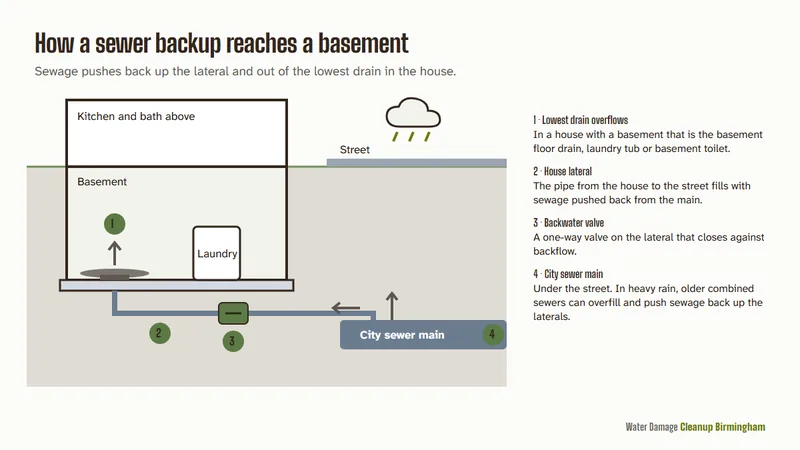
Sewage falls in Category 3 under the S500 standard, so soaked carpet, pad and drywall are usually removed instead of dried in place. That changes the size of the claim. The sewer backup cleanup page walks through the work, and the basement flooding guide covers water that pushes in through walls and window wells.
Will insurance cover rain that got in after a tornado or severe storm?
Usually, when wind or hail opened the roof, a window or the siding and the rain followed through that opening. The NAIC puts roof leaks among losses that are typically covered. Expect the adjuster to study the age and condition of the roof, because Triple-I says damage from poor maintenance is not paid.
Severe weather is a regular part of life here. Wikipedia's Birmingham article places the city in Dixie Alley, describes spring cold fronts that bring strong to severe thunderstorms, and names November and early December as a secondary severe weather season. It also records an EF4 tornado in the area in April 2011.
After a storm, photograph the outside damage before a tarp goes on, then the wet ceilings and attic insulation inside. Keep the receipts for tarps and fans. The Birmingham tornado history page explains how roof and window damage turns into water damage, and ceiling water damage covers a ceiling that sags.
Are burst pipes from a hard freeze covered in Alabama?
In most cases, yes, when the pipe froze and split suddenly in a house that was kept reasonably warm. Pipes and heating or cooling equipment that freeze are on Triple-I's named peril list for standard forms. A house left unheated for weeks invites hard questions, since losses from neglect are excluded.
Freezes are not rare in Birmingham. Wikipedia's Birmingham article counts an average of 47 days a year with a low at or below freezing, and it lists a record low of minus 10 F on February 13, 1899.
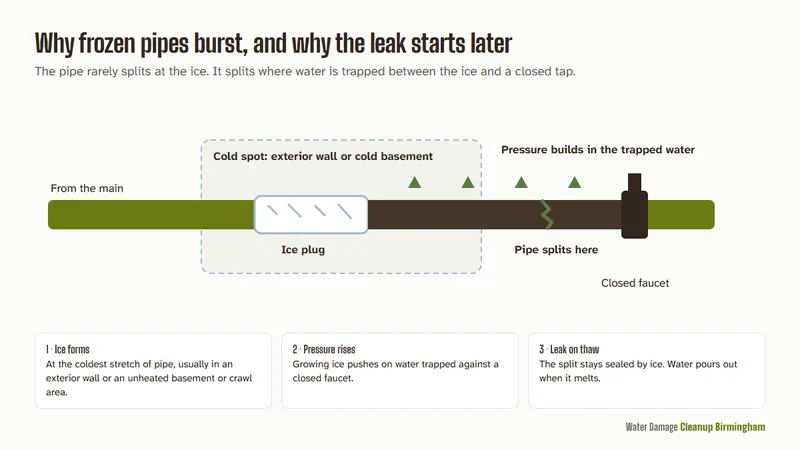
The American Red Cross names supply pipes in crawl spaces, basements, attics, garages and kitchen cabinets as the ones most at risk. Before a cold-weather trip, set the thermostat to 55 F or higher and leave it there day and night, the Red Cross says. The guide to preventing water damage lists other winter checks.
How do you file a water damage insurance claim in Alabama?
Stop the water, record the damage, report the loss and start drying. Triple-I tells homeowners to contact the agent or company promptly, take reasonable steps so the damage does not spread, and leave major permanent repairs until the adjuster has seen it. The list below puts that in order.
- Close the fixture valve or the main shutoff, and keep away from wet outlets, cords and a sagging ceiling.
- Shoot photos and video of each room, the source and the high water mark before you move anything.
- Report the loss and note when you called, the claim number and who the adjuster is. The insurer's 15 days to acknowledge start there.
- Ask in writing what counts as proof of loss, since the 30-day status clock starts when the insurer receives it.
- Start drying. Getting wet rooms and belongings dry in the first 24 to 48 hours keeps mold from starting, per the EPA.
- Set ruined items aside until the adjuster has visited, and list them as you go.
- Keep every receipt, and get written bids from licensed contractors with materials and prices on separate lines.
Read any form a restoration team hands you before you sign it, and ask how billing works. Water removal describes a typical first visit, and choosing a restoration company lists questions worth asking.
When is a small leak not worth an insurance claim?
When the repair estimate lands close to your deductible. A claim that barely clears it returns little money and still sits on your record, while a loss far above it is usually worth reporting. Get a written repair price first, then ask your agent how your company treats small claims.
Triple-I statistics show water damage and freezing claims averaging $15,400 over the 2019 through 2023 period. Roughly 1 in 60 insured houses has one in a given year. In 2023 that category held 22.6 percent of all homeowners losses.
The restoration cost guide gives national price ranges to hold a written estimate against.
What are your options after an Alabama claim denial?
Get the reason on paper first, with the policy wording behind it. Under r. 482-1-125-.07, a denial based on a specific provision, condition or exclusion has to reference it. Then move up the chain: Triple-I suggests the agent first, then the claim department manager, and many policies include an appraisal clause.
Under an appraisal clause you choose an appraiser, the insurer chooses one, those two name an umpire, and agreement by two of the three sets the figure. Line up proof against the clause cited: the plumber's written cause, photos with dates, meter readings and bids broken out by item.
The claim denied guide covers appeal letters, evidence and complaints to the Alabama Department of Insurance in more depth.
When does a public adjuster make sense?
A public adjuster works for you and is paid out of the settlement, and Triple-I warns the fee can reach 15 percent of it. Before hiring one, search the BBB and ask the state insurance department about that adjuster, as Triple-I suggests.
That share makes more sense on a big claim in dispute than on a modest one. Nothing here is legal advice; it is general information for homeowners.
Sources: Ala. Admin. Code r. 482-1-125-.06 (acknowledgment, replies, claim forms); Ala. Admin. Code r. 482-1-125-.07 (status of acceptance or denial, 45-day letters); Alabama Department of Insurance; Triple-I on covered perils; Triple-I on settling claims after a disaster; Triple-I claim statistics; NAIC consumer guide; FEMA on flood coverage; FloodSmart coverage limits; FEMA manual, waiting period; NWS, Village Creek at Avenue W, Ensley; NWS, Shades Creek near Homewood; IICRC S500 (Category 3 water); American Red Cross, frozen pipes; EPA, drying window; Wikipedia, Birmingham, Alabama (climate, severe weather, freeze days, record low).