Quick answer
Water damage restoration cost in Birmingham has no local benchmark, so start from Fixr: most jobs nationally fall between $1,200 and $5,000, averaging $3,000. Bills rise with sewage or creek water, several wet rooms, plaster or hardwood, and long drying times. Get itemized bids in writing, and read what your Alabama policy says about this cause before anyone starts.
What is a realistic water damage restoration cost in Birmingham, AL?
Nobody publishes a price survey for Alabama alone, so water damage restoration cost in Birmingham has to be read against national data. Fixr's January 2025 numbers show most jobs falling between $1,200 and $5,000, averaging $3,000. Bob Vila (May 2023, using Angi and HomeAdvisor data) reports $1,305 to $5,707, averaging $3,455.
Use those figures to test a bid, not to predict one. Each restoration team you reach through this site runs its own business and writes its own prices, and this site has no part in setting or approving them. Read the surveys directly: Fixr's cost page and Bob Vila's cost article.
A house stepped into a hillside, an older city home over a crawl space and a newer slab house in a subdivision can each fall inside those ranges or far beyond them. The expensive outliers usually share one of three things: dirty water, many wet rooms, or a leak that ran for days before anyone saw it.
Why do some Birmingham water damage bills run so much higher?
Five variables explain most of the spread between a modest bill and a painful one: water quality sets the safety work, wet square footage sets the labor, and the materials decide how hard each surface is to save. Equipment days and the handling of your belongings then stack on top of all that.
- Water quality. Sewage or creek water adds suits, disinfectant and dump fees.
- Wet area. Tear-out and extraction are frequently billed per square foot.
- Materials. Saving plaster or solid hardwood costs far more than saving gypsum board or vinyl plank.
- Equipment days. Air movers and dehumidifiers are usually charged per unit, per day.
- Belongings. Packing, cleaning and storage show up as their own lines; see contents pack-out.
Hidden water costs extra too. Moisture under a finished basement floor, above a ceiling between stories or behind built-in cabinets takes longer to reach and dry than water on a bare slab. A vacant rental where a supply line ran unnoticed usually lands near the top of any estimate.
Does dirty water from a sewer or creek change the price?
Yes, and by a wide margin per square foot. For black water, Fixr's extraction rate is $7 to $7.50 a foot; the clean-water rate is a much lower $3.75 to $4.25. That spread pays for suits and respirators, antimicrobial treatment, and hauling off materials that cannot be cleaned safely enough to stay in the house.
Contamination sets the category, not depth. The IICRC S500 standard files both sewage and flood water rising out of rivers or streams under Category 3, so a thin film from a floor drain gets the same handling as several inches of creek water across a den.
| Category under IICRC S500 | Example in a Birmingham-area house | Extraction cost per square foot (Fixr) |
|---|---|---|
| Category 1, clean | A supply line that cracked during a hard freeze | $3.75 to $4.25 |
| Category 2, grey | A dishwasher or washer that overflowed, no sewage involved | $4.10 to $6.50 |
| Category 3, grossly contaminated | A floor drain backup during a thunderstorm, or creek water indoors | $7 to $7.50 |
Fixr national rates from the January 2025 update. Actual Birmingham bids will differ.
Spread across an entire lower level, that per-foot gap becomes real money. The water removal page explains what extraction involves on site.
What is a damage class, and how does it move the total?
Class measures spread and absorption: how much of the space got wet and how deeply the materials soaked it up. It is separate from how dirty the water was. Fixr assigns each class a flat national range, from a damp corner at the low end up to water wicked high into walls, ceilings and insulation.
| Class | What the restoration team measures | Fixr flat range, whole job |
|---|---|---|
| Class 1 | Water in only part of a room, with low absorption | $150 to $400 |
| Class 2 | An entire room, wet carpet, moisture partway up the walls | $500 to $1,000 |
| Class 3 | Water pulled far up the walls or into ceilings and insulation | $1,000 to $3,000 |
Fixr whole-job ranges (2025), not per-foot rates.
Each class up means more equipment, more tear-out and more days of readings. Shutting a leak off early is the single biggest saving most owners can make, and the structural drying page explains what extra equipment days accomplish inside framing.
Are plaster and hardwood floors more expensive to dry out?
They are the two priciest surfaces on Fixr's list. Plaster reaches $18.75 a square foot at the top of its range, and hardwood starts at $10, while drywall never climbs past $3, with carpet and mold work in the middle. An older house with plaster walls and wood floors can spend most of its estimate on those two materials.
| Surface | From (Fixr, per sq ft) | Up to (Fixr, per sq ft) | Where it tends to show up |
|---|---|---|---|
| Drywall | $1.50 | $3 | Most walls and ceilings in newer houses |
| Mold work | $4.75 | $5.50 | Spaces that stayed damp too long |
| Carpet | $4.75 | $10.50 | Bedrooms and finished basements |
| Hardwood | $10 | $15 | Older homes and remodeled main floors |
| Plaster | $6.25 | $18.75 | Homes built before gypsum board took over |
Rates from Fixr, January 2025 update. The right-hand column describes a general pattern only.
Several close-in suburbs date to the 1920s. Wikipedia's Homewood article says its Hollywood subdivision began in 1926, and the Mountain Brook article dates that city's first development to 1929. For how each surface is judged, see wet drywall, wet carpet and water-damaged floors.
How much should basement water cleanup cost in Birmingham?
The simplest basement case, roughly an inch of clean water, costs $500 to $1,500 nationally in Bob Vila's figures. Many real basements are more involved. Sewage from a floor drain, a sump pump that died mid-storm, or a finished room with carpet and drywall all move the job into a more expensive bracket quickly.
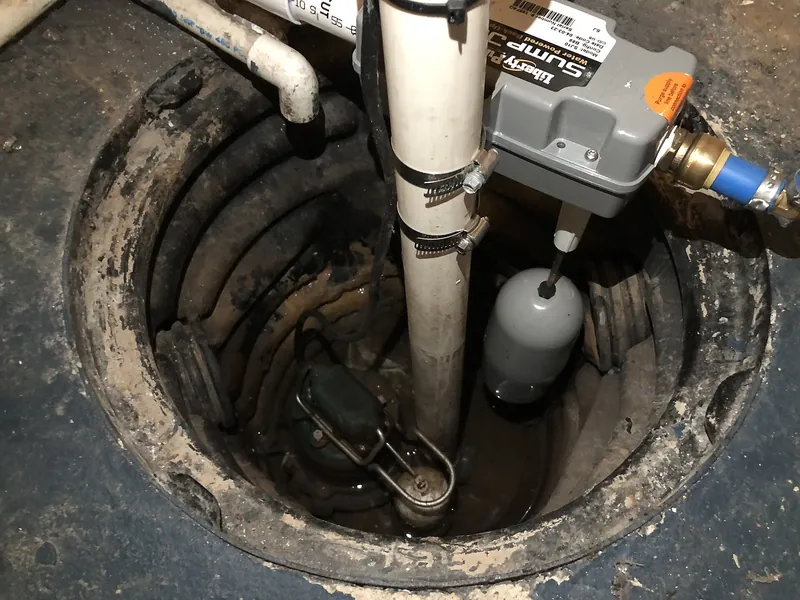

Terrain plays a part. Wikipedia describes Birmingham in Jones Valley between long parallel ridges, drained by small creeks such as Village Creek and Valley Creek. If your house is built into a slope, the uphill basement wall holds back soil that soaks up every storm, so ask a restoration team to check that side first.
Match your situation to a page: basement flooding, sewer backup cleanup or sump pump failure. Each one lists what to check while you wait for help.
Do tornado and storm repairs come with more than one bill?
Usually, because storms bring several trades into one house. When wind lifts shingles or breaks windows, a roofer or glazier seals the opening while a restoration team dries the attic, ceilings and walls that took on rain. A frozen pipe works the same way, with a plumber first, so plan on separate estimates from each trade.
Severe weather is part of life here. Wikipedia places Birmingham in Dixie Alley and records F5 tornadoes in the northern suburbs in 1977 and the western suburbs in 1998, then an EF4 in April 2011. It also calls November and early December a secondary severe weather season.
Rain driven through a damaged roof is the cost to watch, since soaked insulation and ceiling board add up. First steps are on the storm roof leak page, and the Birmingham tornado history page covers how past storms shaped local risk.
What if mold has already started growing?
Then plan for a separate line item. Bob Vila's national mold removal figures run from $1,100 up to $3,400, averaging $2,200, and Fixr charges it at $4.75 to $5.50 a square foot. Getting wet materials dry before growth starts remains the surest way to keep mold off an estimate altogether.
A small patch is often something you can handle. When growth covers less than about 10 square feet, around a 3 by 3 foot area, the EPA's mold and moisture guide says most people can clean it themselves. Growth that followed sewage or other dirty water is another matter, and the EPA's cleanup page recommends an experienced professional.
Coverage is uncertain as well. Per the NAIC, many homeowners policies exclude mold. For when to bring in a mold specialist, read the mold after water damage guide.
Which lines belong on a restoration estimate?
Each charge should point to something you can verify on your own property. That means the area treated, the machines and their days on site, every material taken out, and the moisture numbers behind each decision. In its claim advice, Triple-I recommends written bids listing materials and prices item by item.
- The square footage and rate for extraction and for tear-out.
- Each machine with its days on site, so equipment charges add up.
- A separate line per removed material: pad, carpet, drywall, plaster, insulation, trim.
- A daily moisture log, with photos taken from the same spots.
- Mitigation and rebuild in separate sections, so you can compare each phase across bids.
Before you hire anyone, read choosing a restoration company. Trade terms on a bid, such as class, category or flood cut, are defined in the water damage glossary.
How much of the cost will Alabama homeowners insurance pay?
That turns on the cause and on your policy wording. Triple-I notes that standard forms name sudden discharge of water from household plumbing, heating, cooling, sprinklers or appliances as a covered peril, and freezing of those systems too. Flooding is excluded, and sewer backup takes a separate endorsement.
These are big claims. In Triple-I's homeowners statistics, water damage and freezing claims averaged $15,400 over 2019 through 2023, about 1 in 60 insured homes has such a claim every year. Of all homeowners insurance losses in 2023, 22.6 percent came from water damage and freezing.
Alabama sets claim-handling deadlines in the Alabama Department of Insurance claim standards, Ala. Admin. Code r. 482-1-125. An insurer acknowledges a claim in 15 days unless it pays first. It reports acceptance or denial 30 days after proofs of loss, or in the policy's period, and sends 45-day updates if it needs longer; the insurance claims guide has the details.
Who pays when a creek floods the house?
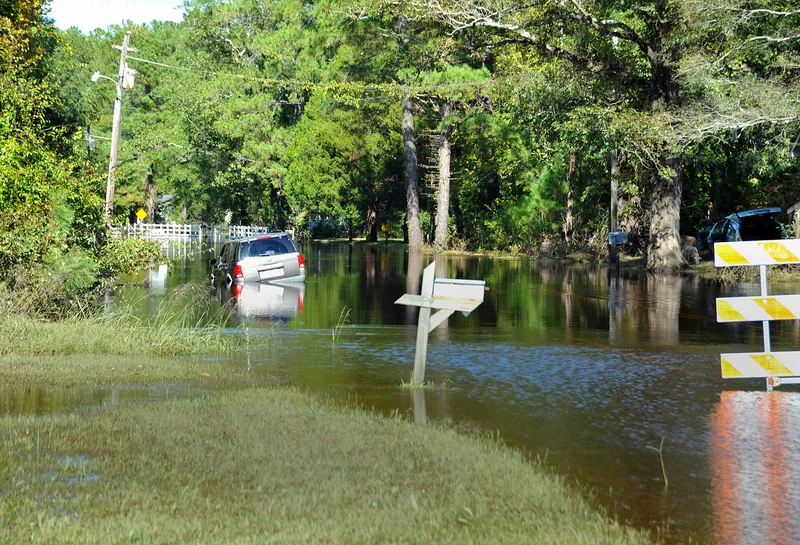
A flood policy pays, if you carry one, because homeowners forms leave out rising outside water. On its flood insurance FAQ, FEMA notes that most homeowners insurance does not pay for flooding. Without flood coverage, cleanup is generally your bill, apart from any disaster aid that may follow a declared event.
Creeks here rise quickly. The National Weather Service gauge on Valley Creek at Center Street marks minor flooding at 11 feet and crested at 12.89 feet on September 15, 2024. On Village Creek at Avenue W in Ensley, minor flooding starts at 10 feet, and the highest listed crest is 14.8 feet on December 3, 1983.

Buy coverage early: FEMA's April 2024 manual says a newly bought NFIP policy starts only after a 30-day waiting period, with limited exceptions. Read about local risk on the Birmingham flooding page; the flood cleanup page covers the work itself.
What can you do in the first hour to keep the bill smaller?
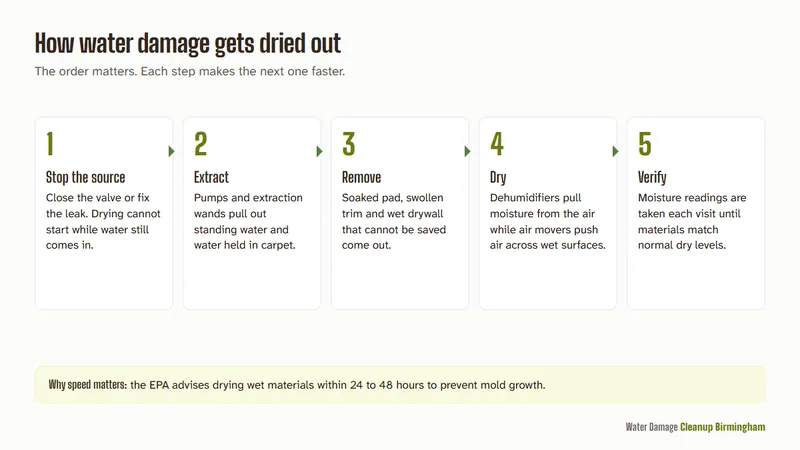
Move quickly, because time is what turns a small job into a large one. Close the valve, get belongings off the floor and start a dehumidifier, since the EPA's target is to have soaked materials dry in 24 to 48 hours. Each extra day lets moisture travel into more material, can raise the class and invites mold.
- Shut the closest valve, or the main if you are not sure which one feeds the leak.
- Kill power to wet rooms from a dry place.
- Lift boxes and furniture off wet floors; soaked contents add labor.
- Keep photos and every receipt, since Triple-I says to submit receipts for reimbursement.
- Check a hygrometer and bring the room under 60 percent humidity, the EPA ceiling.
What usually happens on the first visit is described on the emergency water damage restoration page. To reach a restoration team, call or send the request form, and ask how the work will be priced before it begins.
Sources: Fixr cost data (national ranges, extraction, class and material rates; updated January 31, 2025); Bob Vila cost data (overall range, basement, mold; updated May 30, 2023); IICRC S500 water categories; Wikipedia, Homewood (Hollywood subdivision, 1926); Wikipedia, Mountain Brook (developed 1929); Wikipedia, Birmingham, Alabama (Jones Valley, creeks, Dixie Alley, 1977, 1998 and 2011 tornadoes, fall storm season); EPA mold and moisture guide (10 square feet, drying window, humidity); EPA, mold after contaminated water; NAIC homeowners page (mold exclusions); Triple-I claim settlement advice (bids, receipts); Triple-I covered disasters (perils, flood, sewer backup); Triple-I homeowners statistics (severity, frequency, loss share); Ala. Admin. Code r. 482-1-125-.06 and -.07; FEMA flood insurance FAQ; NWS gauge VALA1, Valley Creek; NWS gauge ENSA1, Village Creek; FEMA NFIP manual, April 2024 (waiting period).