Before you sign
Buying a house with water damage in Birmingham is reasonable once you know the cause, have paperwork for the repair and can accept the insurance price. Get the loss history report, written seller answers, a moisture check and a sewer camera inspection, look up the lot on the FEMA map and nearby creek gauges, and quote flood and backup cover while you can still back out.
Is buying a house with water damage in Birmingham a bad idea?
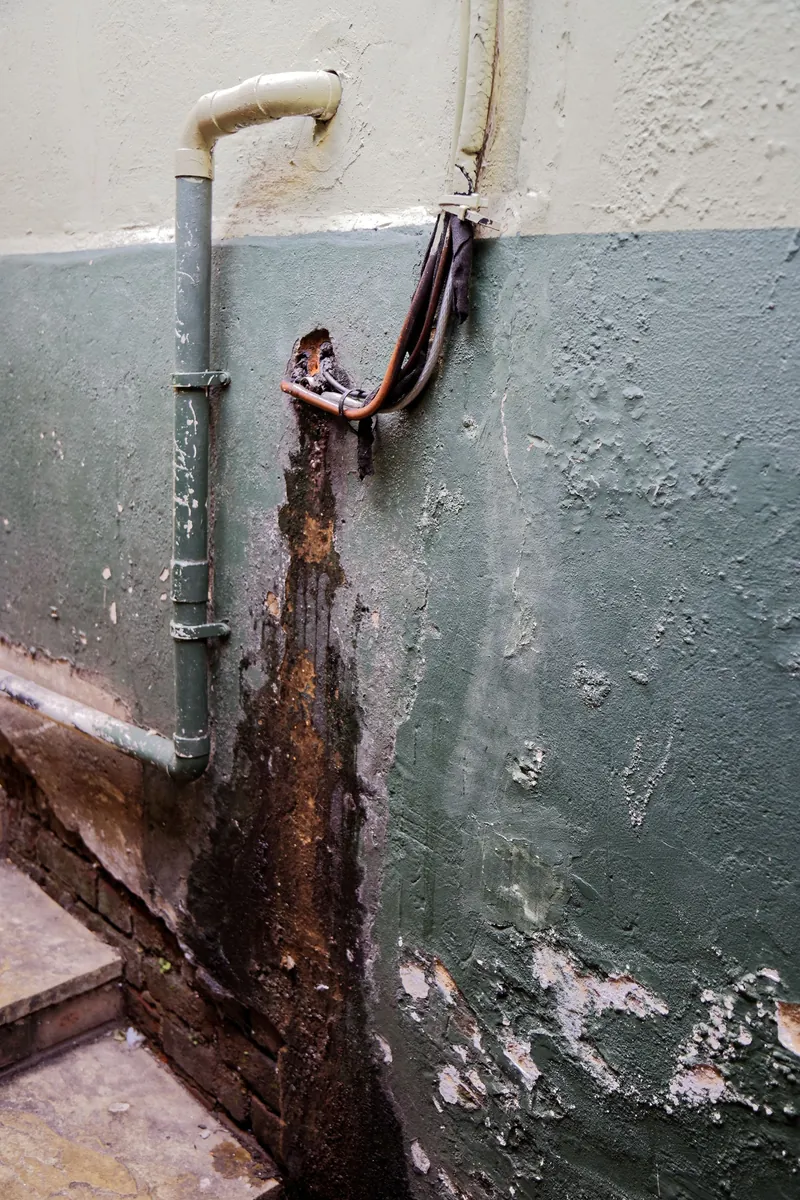
Not by default. Buying a house with water damage in Birmingham works out when the leak had a single known cause, a repair you can see on paper and dry readings since. It becomes a gamble when stains keep returning after storms, nobody can say where the water came from, or the lot sits low beside a creek.
Think of each clue as either an event or a pattern. A burst washer hose that someone replaced is an event. A water line on the same basement block after every spring downpour is a pattern, and patterns come with the deed.
Rain gives patterns plenty of chances to show. Wikipedia's Birmingham article describes abundant rainfall spread fairly evenly through the year, with summer rain arriving mostly as afternoon and evening thunderstorms. Price any repeat problem before you sign; the Birmingham water damage cost guide explains how repair bills build up.
How do I find out if a Birmingham house had water claims?
Ask the seller for a C.L.U.E. loss history report. The Insurance Information Institute explains that most home insurers feed claim records into this database, and that a report lists each claim on the house by type, date, amount and status, going back five years.
By law, one copy a year is free. When the report turns up damage, Triple-I suggests a professional look at the house before you are bound to buy it.
A single water claim is not a red flag on its own. The same institute puts the yearly rate of water and freezing claims at roughly one insured home in 60, and the average such claim at $15,400 across 2019 to 2023.
The report misses anything a seller paid for in cash. New paint on the lower wall of a basement, fresh vinyl plank over a slab or a newly finished bonus room downstairs all deserve a written answer about what happened there.
This guide does not interpret Alabama disclosure rules. Put contract and disclosure questions to your agent or a real estate attorney before the inspection period ends.
Which parts of the Birmingham area sit near flood-prone creeks?
Much of the city lies in Jones Valley, which Wikipedia says is drained by Village Creek and Valley Creek on their way to the Black Warrior River. Over the Mountain, Shades Creek runs through Homewood, Mountain Brook, Hoover and Irondale, and the Cahaba begins near Trussville. A lot near any of them deserves a closer look.
The Shades Creek article traces the creek 55.8 miles from Sadler Gap on Red Mountain to the Cahaba, passing through Birmingham, Irondale, Mountain Brook, Homewood, Hoover and Bessemer. Its 2021 watershed plan, the article says, named poor flood management and rising runoff from urban growth among the main problems.
How to check one address
| Source | What it tells a buyer | What it leaves out |
|---|---|---|
| FEMA flood map | Whether the lot falls in a mapped high-risk zone | Sewer backups and seepage on lots outside the zone |
| Nearby NWS creek gauge | How high the creek has crested in past storms | Street ponding and small unmeasured ditches |
| Loss history report | Insured claims on the house over five years | Repairs the owner paid for directly |
| Inspection and sewer camera | Stains, soft wood and a cracked or rooted line | Wet framing already closed behind new drywall |
| Seller disclosure answers | Backups, leaks and repairs the owner recalls | Anything before that owner moved in |
Two gauges show how quickly the creeks rise. The NWS lists minor flooding at 10 feet on Village Creek at Avenue W in Ensley, with a top crest of 14.8 feet on December 3, 1983. Shades Creek near Homewood reaches minor flood at 14 feet and crested at 19.88 feet on September 16, 2004.
FEMA's Special Flood Hazard Area is the land a 1-percent-annual-chance flood would cover, marked on the map as Zone A, Zone AE and similar codes. Type the street address into FEMA's Flood Map Service Center, then read the Birmingham flooding page for each creek's gauge history.
What should I check in a hillside basement or crawl space?
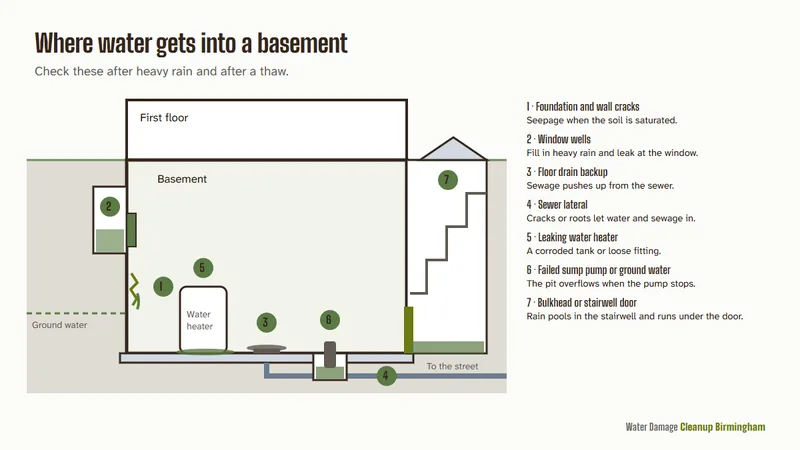
Start below the main floor with a flashlight and pay attention to smell. A musty odor, chalky white deposits on block, a rusty ring under the water heater, swollen paneling and silt around the floor drain all point to water. Houses cut into a slope can take water at the uphill wall, so look hardest there.
Many older city houses were built for working families. The Ensley article mentions hundreds of small workers' cottages built there after 1898, so expect old foundations, piers and plumbing from several eras in the city's older neighborhoods.
- Sump pit. A shiny pump sitting in a stained, silted pit often means the old one quit. See sump pump failure.
- Crawl space. Damp soil, sagging insulation and dark, soft joists are warning signs. Water-damaged floors explains what that does to the rooms above.
- Water heater. Rust trails down the tank or a stained drip pan suggest a slow leak. Read water heater leaks.
- Lower walls. Drywall that crumbles at the bottom edge or trim that has pulled away points to standing water. The wet drywall page covers why it wicks.
More clues are listed in signs of water damage, and basement flooding in Birmingham explains how water reaches a lower level.
Will a home inspection find hidden water damage?
Sometimes, but not reliably. A general inspector reports what is visible and reachable on the day of the visit. Framing that got wet before fresh drywall went up, carpet pad that was dried and relaid, or an old roof leak that has stopped can all pass unnoticed, so read every line about moisture or staining.
Phrases like moisture noted, staining observed or recommend further evaluation are your cue to bring in someone with a moisture meter before the inspection window closes. Ask for readings along baseboards, inside sink cabinets and under upstairs bathrooms. The home inspection and water damage page lists what to ask the inspector.
Muggy weather slows drying. Wikipedia calls Birmingham summers hot with high humidity, and the EPA sets 60 percent as the indoor humidity limit, with 30 to 50 percent as the goal. A lower level that stays above that line through summer will keep feeding mold.
If mold is already there, the leak has to be fixed first. The EPA treats a patch under about 10 square feet as a job most owners can handle, and its cleanup guide warns against painting or caulking over growth. See mold after water damage for more.
Is a sewer camera inspection worth it on an older Birmingham house?
On an older house it is usually worth the fee. A plumber feeds a camera down the lateral, the owner's pipe from the house to the public sewer, and the video shows roots, cracks, sags and separated joints. General inspections rarely go past the floor drain, which is where a failing line usually announces itself first.
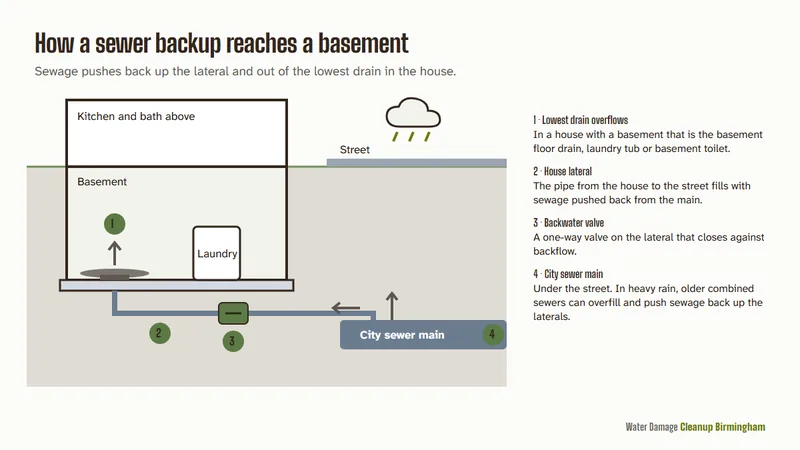
Find out if anyone installed a backwater valve, a one-way flap on the lateral. If the video shows a broken section, get a plumber's written repair price and bring it into the negotiation.
Ask the seller directly about backups during heavy rain. The Insurance Information Institute says a standard homeowners form will not pay for a backup and a flood policy will not either; that protection is bought on its own or as an endorsement. The sewer backup cleanup page explains what a backup leaves behind.
Could a vacant Birmingham house have frozen pipe damage?
It could, even this far south. Wikipedia counts an average of 47 days a year in Birmingham with a low at or below freezing, and 1.4 days when the high stays below it. An estate sale, foreclosure or empty rental that sat unheated through a cold snap may hide a split pipe that ran for days.
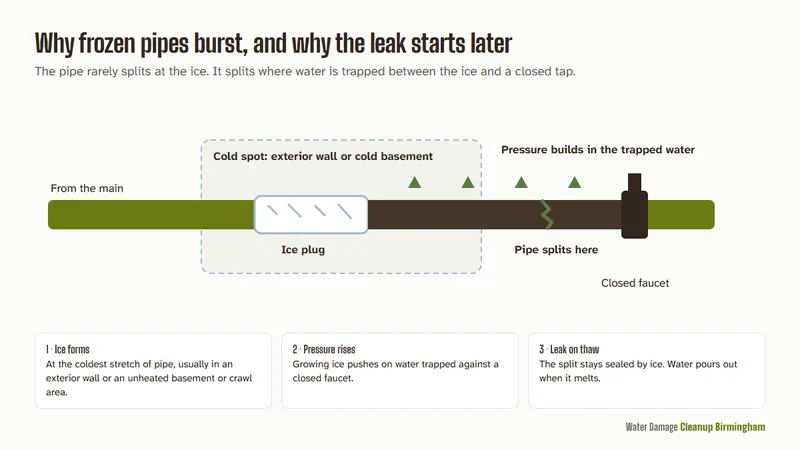
The American Red Cross names crawl spaces, attics, garages, unheated basements and kitchen cabinets as the places supply pipes freeze most. For a house left empty in cold weather, it says to keep the heat at 55 F or higher.
Ask whether the house was winterized: was the main shut, were the lines drained, and did a freeze ever force a plumbing repair? Shiny new pipe joined to old copper in the crawl space, or fresh drywall tape on a ceiling under a bath, calls for a straight answer. Read burst pipe water damage for what follows a split.
What insurance should I price before closing on an Alabama home?
Ask agents for three prices before the inspection period runs out: the homeowners premium, a flood policy and a sewer backup endorsement. Homeowners forms pay for many sudden plumbing leaks but leave flood out and usually need an add-on for backups, so you only see the true yearly cost of the house with all three in hand.
- Homeowners. Plumbing and roof leaks are the water losses these forms usually pay, per the NAIC; seepage from ground water and rain runoff usually is left out.
- Flood. Standard homeowners policies exclude it, so you need an NFIP or private flood policy. Expect a 30-day gap between buying an NFIP policy and its start date; FEMA's flood insurance manual allows only limited exceptions, such as cover tied to a loan closing.
- Sewer backup. Ask for the endorsement price in writing; Triple-I describes the cost as usually nominal.
- Mold. Read the mold wording closely; the NAIC points out that many homeowners forms exclude it.
NFIP cover for a single-family home reaches $250,000 for the building and $100,000 for contents, according to FloodSmart. After you own the house, Alabama's claim standards in Ala. Admin. Code r. 482-1-125 give an insurer 15 days from notice of a first party claim to acknowledge it, unless payment goes out first. Our Birmingham insurance claims guide lays out the later deadlines.
What happens if my new house leaks after closing?
Treat it like any other leak: cut off the supply, keep away from outlets and cords in wet areas, and film the damage before cleanup. The EPA's target is to get soaked materials dry in 24 to 48 hours, before mold takes hold, so the calls to your insurer and to a restoration team belong in that first stretch.
- Shut the main valve or the stop on the leaking fixture.
- Turn off breakers for wet rooms, but only from a dry floor.
- Record every room on video. Ruined belongings should stay on hand for the adjuster to inspect, Triple-I advises.
- Call the insurer to learn which policy applies and what it expects you to do first.
- Handle sewage and creek water with gloves and boots. Under the IICRC S500 both count as Category 3, the dirtiest class; children and pets stay out.
- Keep every receipt, from a box fan to a hotel night.
Suspect the seller knew and said nothing? Save the inspection report, photos and emails, and ask a real estate attorney; this site is no judge of that. Emergency water damage restoration describes what a first visit usually involves, and water removal covers extraction.
Sources: Insurance Information Institute, What is a loss history report; Insurance Information Institute, homeowners claim statistics; Insurance Information Institute on flood and sewer backup cover; Insurance Information Institute on settling claims; EPA on drying times and indoor humidity; EPA on small mold jobs and painting over mold; NAIC on what homeowners forms pay; FEMA NFIP flood insurance manual (April 2024); FloodSmart coverage limits; FEMA flood zone glossary; FEMA Flood Map Service Center; NWS gauge ENSA1, Village Creek at Avenue W in Ensley; NWS gauge SCHA1, Shades Creek near Homewood; Alabama Department of Insurance claim standards, Ala. Admin. Code r. 482-1-125; American Red Cross on frozen pipes; IICRC S500 standard; Wikipedia, Birmingham, Alabama; Wikipedia, Shades Creek; Wikipedia, Cahaba River; Wikipedia, Ensley.