Emergency Water Damage
For the night a supply line splits or a storm opens the roof: the shutoffs and calls that count before help arrives.
When it is urgentBirmingham, Jefferson and Shelby counties and central Alabama
Water damage in Birmingham usually starts with a split supply line, a creek that jumps its banks or a storm that lifts shingles before the rain. Your first two jobs are the same every time: stop whatever is feeding the leak, and keep people back from soaked outlets, cords and the electrical panel. When the job needs pumps, drying machines and tear-out, this site can pass your call to a restoration team who works your corner of the metro.
By the Water Damage Cleanup Birmingham editorial team · Last reviewed
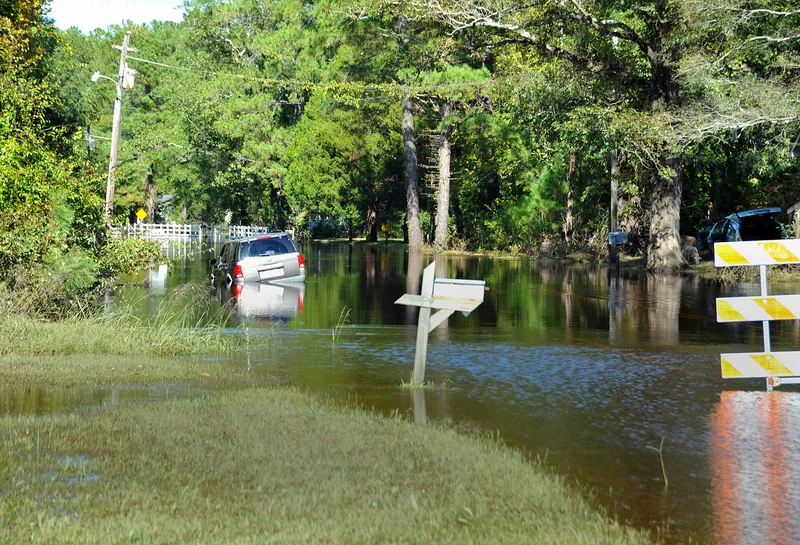
Work through five steps in this order: shut off the water, keep away from anything electrical, photograph the damage, move valuables to a dry room and open an insurance claim. Each one limits how far the water spreads or protects the claim. If water is rising fast or reaching outlets, get everyone out before doing any of them.
A ceiling that sags or water near the panel means you leave the room and call from outside or upstairs. Moving water is stronger than it looks: Ready.gov says a person can be knocked over by six inches of it.
Step 1
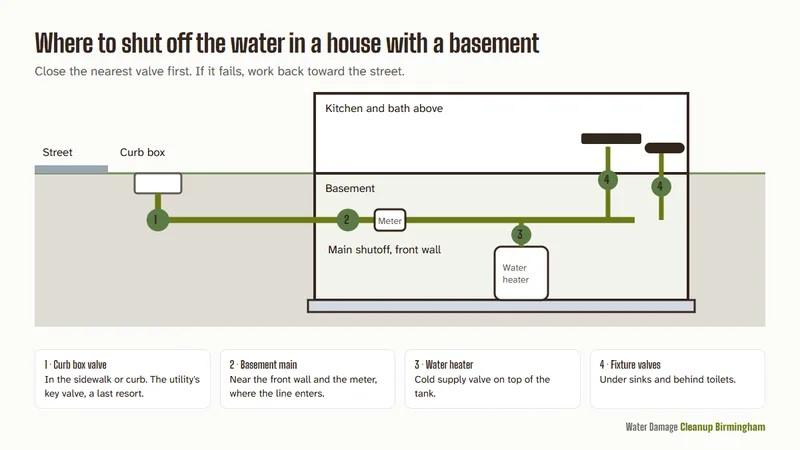
Start at the stop under the sink, toilet or washer. If the leak is in a wall or you cannot find its source, shut the main where the service line enters the house, often near the water heater, in a crawl space or in a basement utility corner. A seized main is a job for the water utility at the curb.
Step 2
Do not wade toward the breaker panel through standing water. If the panel sits in a wet basement or garage, leave it alone and ask the power company to cut service from outside. Unplug nothing with wet hands.
Step 3
Before you move or toss anything, take wide shots of each wet room and close shots of the waterline, the floor, the ceiling and the part that failed. The Triple-I asks owners to keep damaged items until the adjuster has seen them.
Step 4
Carry papers, photos, rugs and electronics to a dry room. Set the legs of sofas and dressers on foil squares or wood blocks so they stop drinking from the wet carpet.
Step 5
Phone the insurance company, then jot down the claim number and who took the call. Temporary fixes such as a tarp or a towel dam are fine; hold off on permanent repairs until an adjuster inspects. Say so plainly if sewage came up through a drain.
Let the source pick the service. A burst pipe points to emergency response and water removal. Creek water or street runoff indoors is flood cleanup. A slow drip that soaked a wall for weeks is mostly drying and repair. The pages below lay out the tools, the order of the work and the paperwork worth having before demolition.
For the night a supply line splits or a storm opens the roof: the shutoffs and calls that count before help arrives.
When it is urgent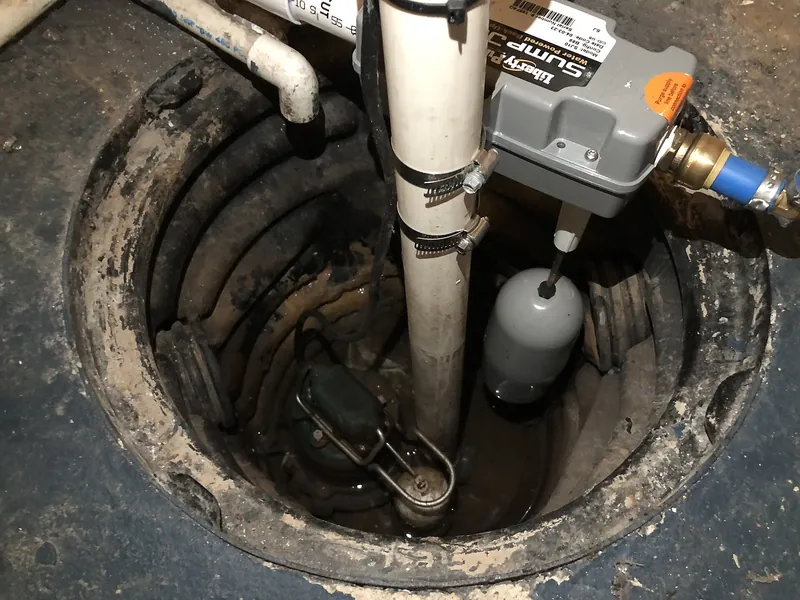
Submersible pumps and extraction wands clear pooled water from slabs, lower levels and crawl spaces.
Pumping it out
Creek overflow and street runoff bring silt and sewage, so soaked porous materials usually come out and hard surfaces get disinfected.
Creek and runoff water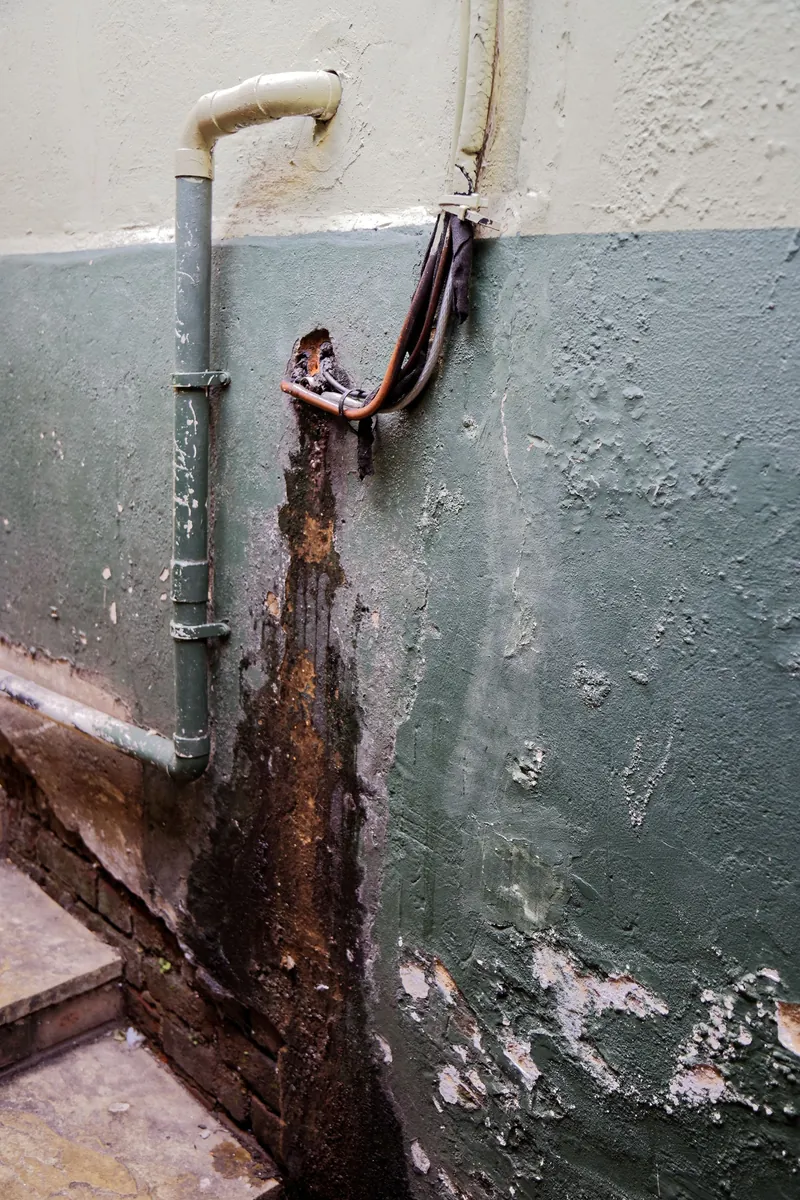
The early work that keeps a loss from growing: source stopped, ruined materials out, readings taken, drying set up before mold starts.
Stopping the spread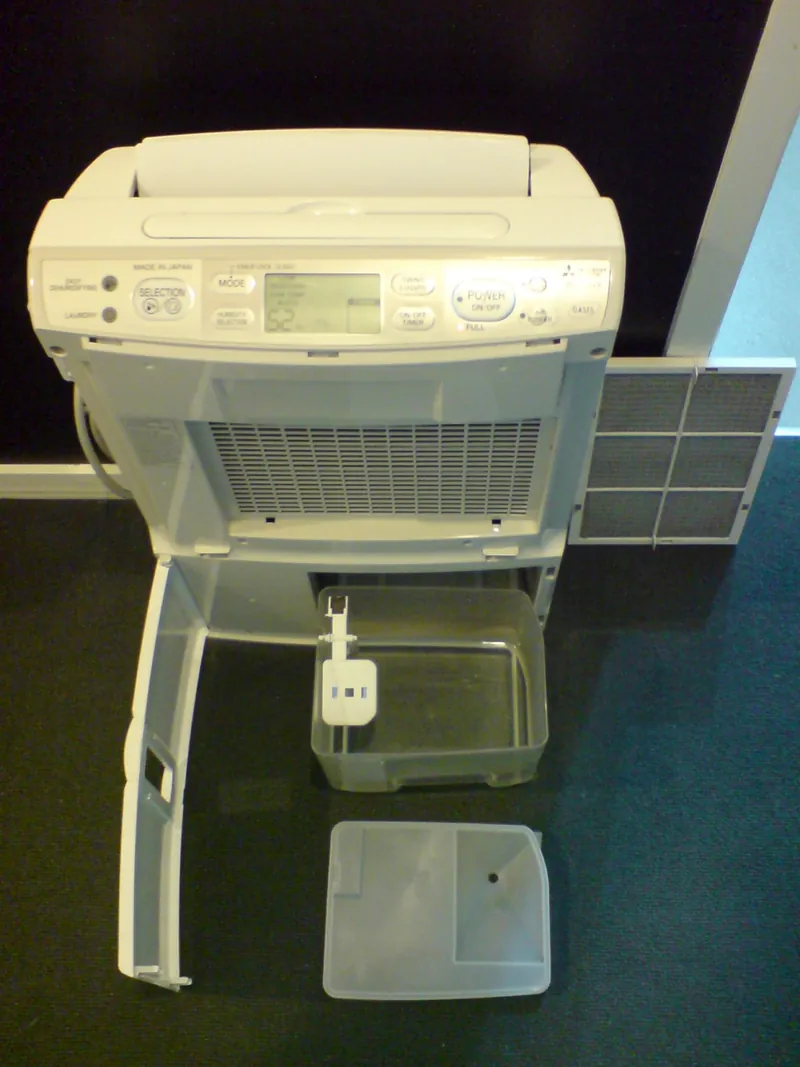
Framing, subfloor, plaster and slabs dry at their own pace, and muggy Alabama summers slow every one of them. Logged readings show the finish.
Drying the structure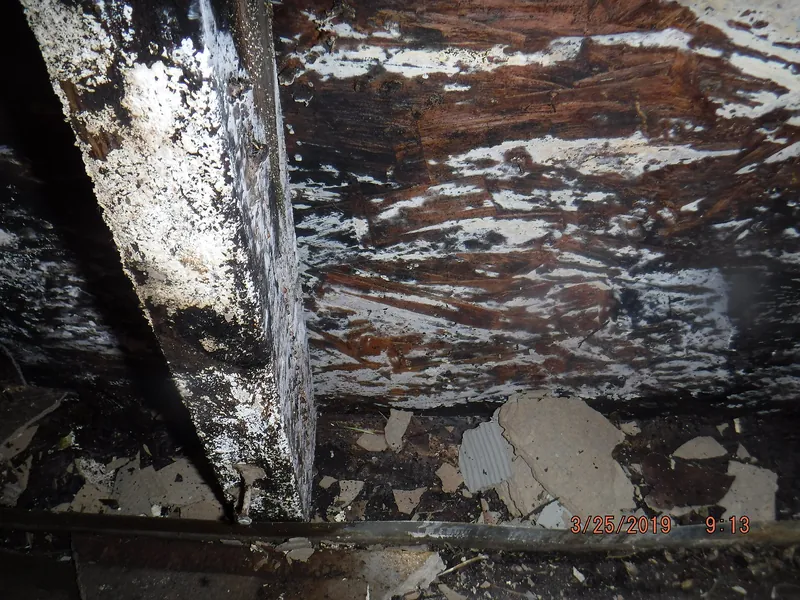
New drywall, flooring, trim and paint, started once the framing tests dry, never before.
Putting rooms back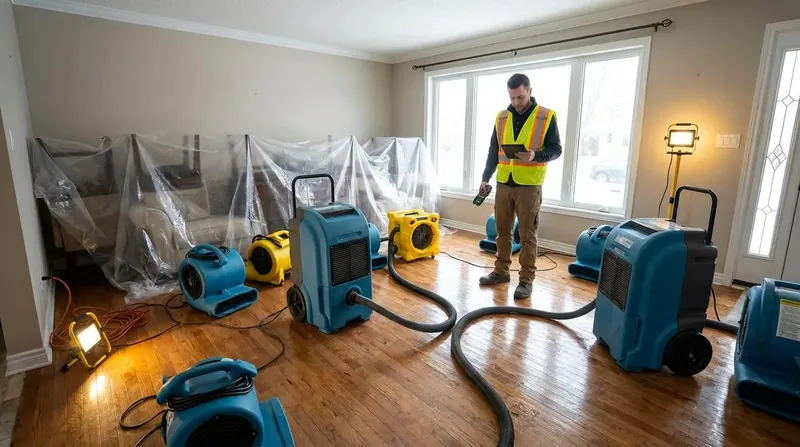
Furniture, files and keepsakes listed, photographed and moved out so drying can run, then stored until rooms are ready.
Moving belongings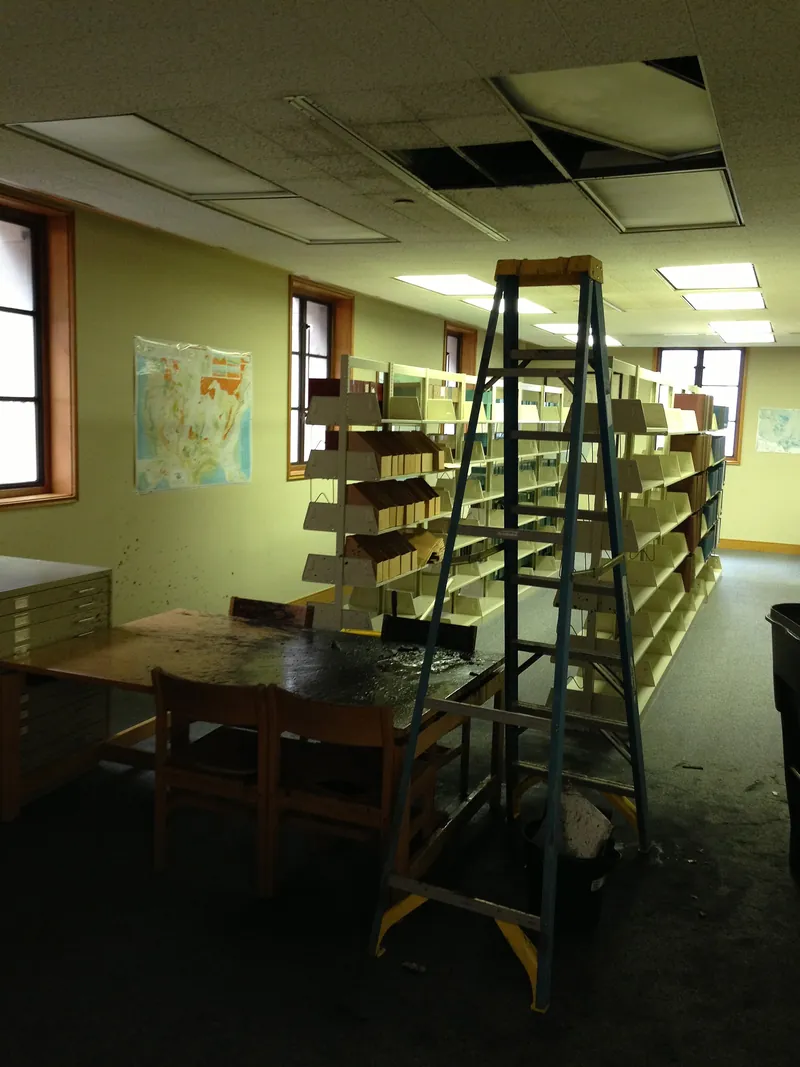
Offices, stores, schools, rentals and churches, where drying has to fit around tenants, customers and services.
For businessesCost, Alabama claims, mold, hidden moisture, renting, buying a house with a water past, and how to question a company.
The city sits in a valley between ridges, so heavy rain drains into a few small creeks that rise in hours. Thunderstorms and tornadoes rip roofs open before the downpour, and a hard freeze now and then splits pipes. Wikipedia describes a humid subtropical climate with abundant rainfall spread through the year.
Birmingham occupies Jones Valley, drained by Village Creek and Valley Creek on their way to the Black Warrior River, per Wikipedia. The National Weather Service gauge on Village Creek at Avenue W in Ensley reaches minor flooding at 10 feet, moderate at 13 and major at 16; its highest listed crest is 14.8 feet on December 3, 1983, and it hit 14.22 feet on June 20, 2021.
The Valley Creek gauge at Center Street starts minor flooding at 11 feet and crested at 12.89 feet on September 15, 2024. The Birmingham flooding guide follows these creeks street by street, and the flood cleanup page covers what creek water leaves behind.
South of Red Mountain, Shades Creek runs 55.8 miles from Sadler Gap through Irondale, Mountain Brook, Homewood, Hoover and Bessemer to the Cahaba River, per Wikipedia. Its gauge near Homewood floods at 14 feet and crested at 19.88 feet on September 16, 2004, then 18.79 feet on May 4, 2021. Upstream, the Cahaba at Trussville reached 19 feet on May 7, 2003.
If your house sits on a slope with a lower level dug into the hill, runoff from above can push against that wall in every hard rain. The basement flooding page explains how water gets through and what a restoration team checks.
Wikipedia places Birmingham in Dixie Alley and notes F5 tornadoes in the northern suburbs in 1977 and the western suburbs in 1998. The April 27, 2011 Tuscaloosa and Birmingham tornado reached high-end EF4 strength, and the January 25, 2021 Fultondale tornado damaged 265 homes. Rain through a torn roof is the water problem that follows; see the tornado history page and the storm and roof leak page.
Winters are mild, but the city averages 47 days a year with a low at or below freezing, per Wikipedia. Pipes in crawl spaces, attics, garages and kitchen cabinets are the ones the American Red Cross flags for freezing, and it suggests leaving the heat at 55 °F or higher when you travel. Thawing and repair are on the burst and frozen pipes page.
Twelve guides split Jefferson County, each written around its own creeks, slopes and housing. Birmingham is the county seat, founded in 1871, and counted 200,733 people in the 2020 census, per Wikipedia. Jefferson County had 674,721 that year, making it the most populous county in Alabama, per its Wikipedia article.
Inside the city: Downtown and Southside, Avondale and East Lake, the West End and Ensley, and North Birmingham and Center Point. Over the mountain: Homewood and Mountain Brook, Vestavia Hills and Hoover, which reaches into Shelby County.
Around the edges: Bessemer and McCalla, Trussville and Pinson, Gardendale and Fultondale, Irondale and Leeds, and Fairfield and Pleasant Grove. Water service for the county comes from the Birmingham Water Works Board and sewer service from Jefferson County Environmental Services, per Wikipedia; Bessemer runs its own water and sewer system.
Yes. A call from Pelham, Tuscaloosa, Cullman or Gadsden is routed the same way as one from downtown Birmingham. The water is what changes: a newer Shelby County subdivision, a house near the Black Warrior River and a lake cabin on Smith Lake each take on water differently, so each area has its own guide.
Shelby County counted 223,024 people in 2020 and is drained mostly by the Cahaba and Coosa rivers. Start with the Pelham and Helena page or the Alabaster and Calera page. To the west, Tuscaloosa County had 227,036 people; the Black Warrior gauge at Oliver Lock and Dam rose above major flood stage in March 1951, February 1961 and April 1979. See the Tuscaloosa page.
North, Cullman County counted 87,866 people and shares Lewis Smith Lake with Walker and Winston counties; read the Cullman page. Northeast, Etowah County is the smallest county in Alabama by area, and the Coosa River gauge at Gadsden crested above major flood stage in 1886, 1916, 1936 and 1961. The Gadsden page has more.
You usually see the symptom first and learn the cause later. Pick the line that matches what is in front of you, whether that is a ring on the ceiling, a damp carpet edge or a sump pump that has gone quiet. Each one opens a page on the likely causes and the next steps for a central Alabama home.
Ask for moisture readings, a written scope, the standard the crew follows and how the bill is calculated, and get clear answers before any wall is opened. This site does not rank or vouch for anyone, so ask each company the same five things. A longer checklist sits in the Birmingham guide to picking a restoration company.
Your call or form goes to a local water damage restoration team that serves your ZIP code, and everything after that happens between the two of you. The four steps below show the route, and none of them costs you money.
Use the call button on any page. The call is free for you.
Say what failed, when you noticed it and which rooms are wet. Clean supply water and sewage call for different handling.
If a local water damage restoration team is taking jobs in your ZIP code, your call or request is passed to that business.
You and the restoration team agree on scope, schedule and cost. Turning it down is free.
Requests come from Jefferson and Shelby counties and from Walker, Fayette, St. Clair, Blount, Tuscaloosa, Bibb, Talladega, Clay, Cullman, Chilton, Etowah, Calhoun and Winston counties. That stretches from Haleyville and Cullman south to Clanton, and from Northport east to Anniston. Each card opens a guide to one part of that area.
Jefferson County is split into twelve neighborhood and suburb guides, and the Birmingham ZIP code table shows which one fits your code. A guide does not promise service; the restoration team settles that with you.
No card for your town?
Small towns share a guide with a larger neighbor. Type your code into the ZIP code finder, or scan the county list of service areas.
Find your code in the first column; the last column names the Jefferson County guide for that area, from Southside out to Bessemer, Trussville and Gardendale. Codes in Shelby County and the outer counties live on their own town pages. The restoration team confirms your street address when it calls you back.
Some codes cross neighborhood or city lines, so treat the match as a close fit.
We also take requests from Birmingham codes used only for PO boxes or a single large employer, with few or no households: 35201, 35202, 35220, 35231, 35232, 35237, 35238, 35246, 35253, 35255, 35259, 35260, 35261, 35266, 35270, 35282, 35283, 35285, 35287, 35288, 35290, 35291, 35292, 35293, 35295, 35296, 35297, 35298. If your mail carries one of them, give the restoration team the street address of the building that got wet. Codes outside Jefferson County are listed by county in the ZIP finder.
Typically the restoration team confirms the source is stopped, maps the moisture, sorts the water into a contamination category, pulls out standing water and sets up drying. This site publishes no customer stories, so treat the list as common industry practice, not a promise, and ask whoever arrives to walk you through their own plan.
Mitigation is the holding action that keeps a loss from growing; restoration is the rebuild that replaces what was ruined. Mitigation covers the shutoff, extraction, removal of ruined materials and structural drying. Restoration is the drywall, flooring and paint that follow, and doing it before framing and subfloor test dry seals moisture inside the new work.
Some companies handle both halves; others hand the rebuild to a separate contractor, so ask early. Each stage has its own page: mitigation in Birmingham and repair and rebuild. Keep every estimate and receipt together; the Triple-I suggests submitting receipts for reimbursement.
The total depends on how much area got wet, the type of water, the materials and how long drying takes. Sewage across a lower level costs far more than a clean leak on kitchen tile. Across the country, Fixr reports a typical range of $1,200 to $5,000 and an average near $3,000. No prices are set or quoted here.
For roughly an inch of clean water on a basement floor, Bob Vila gives $500 to $1,500. Ask every company for its pricing method in writing, and see the Birmingham restoration cost guide for ranges by water type and material.
Often for sudden water from inside the house, such as a burst pipe or a failed washer hose, though your policy wording decides. According to the NAIC, policies usually pay for a plumbing leak or a roof leak but leave out rain runoff and ground water. Creek and river flooding needs a separate flood policy.
Flood is excluded from standard homeowners and renters forms, and backup through drains is an add-on you buy separately, per the Triple-I. FEMA applies a 30-day waiting period, with limited exceptions, to new NFIP policies, which is why a policy bought while a creek is rising tends to start too late.
Alabama's claim standards, Ala. Admin. Code r. 482-1-125, give an insurer fifteen days to acknowledge a claim unless it pays first. Within thirty days after proofs of loss, or the period your policy sets, it must tell you whether the claim is accepted or denied, and a denial must cite the policy provision. If it needs more time, it writes with reasons, then again every forty-five days. The Alabama Department of Insurance takes complaints.
Water and freezing claims are common: roughly one insured home in 60 has one in a given year, and they averaged $15,400 over 2019 to 2023, per the Insurance Information Institute. The insurance claims guide walks through an Alabama claim.
Moist air slows evaporation, so a wall cavity, subfloor or slab stays wet inside after the surface feels dry. Wikipedia describes Birmingham summers as hot with high humidity. EPA guidance is to get wet materials dry inside a 24 to 48 hour window and hold indoor humidity under 60 percent, with 30 to 50 as the target (EPA).
Touch is a poor test; a meter reading compared with an unaffected room is a good one. See the water removal page for extraction, the structural drying page for drying targets, and the mold after water damage guide if spots or a musty smell appear. Soaked carpet or upholstery that will not dry fast should go, says the CDC.
At the seams. Water hides in stud cavities, under flooring, behind paneling and above ceiling drywall, and the first signs tend to appear where two materials meet: bubbling paint, swollen baseboards, cupped boards, a stale smell, or a water bill that climbs with no new use behind it.
A moisture meter and thermal camera let a restoration team map the wet area and open only what has to be opened. For a room-by-room checklist, open the hidden water damage signs guide; the water damage smell page helps when an odor lingers.
Sources: Birmingham, Alabama on Wikipedia: founding, 2020 census, Jones Valley creeks, climate, freezing days, tornado history, utilities; Wikipedia, Jefferson County, Alabama (2020 census); Wikipedia, Shelby County, Alabama; Wikipedia, Tuscaloosa County, Alabama; Wikipedia, Cullman County, Alabama; Wikipedia, Etowah County, Alabama; Wikipedia, Lewis Smith Lake; Wikipedia, Shades Creek; Wikipedia, 2011 Tuscaloosa and Birmingham tornado; Wikipedia, 2021 Fultondale tornado; NWS flood categories and crests, Village Creek at Avenue W in Ensley (ENSA1); NWS, Valley Creek at Center Street (VALA1); NWS, Shades Creek near Homewood (SCHA1); NWS, Cahaba River at Trussville (TRSA1); NWS, Black Warrior River at Oliver Lock and Dam (TODA1); NWS, Coosa River at Gadsden (GAPA1); Ala. Admin. Code r. 482-1-125-.06, acknowledgment; Ala. Admin. Code r. 482-1-125-.07, acceptance or denial; Alabama Department of Insurance; NAIC on what a homeowners policy pays; Triple-I on flood exclusions and backup endorsements; Triple-I on photos, receipts and adjuster visits; Triple-I homeowners claim statistics; FEMA NFIP manual (waiting period); Ready.gov on moving flood water; Red Cross on frozen pipes; EPA drying window and humidity range; CDC, mold symptoms and wet carpet; IICRC S500 category definitions; Fixr cost figures; Bob Vila estimate for an inch of basement water.
Yes. Requests come from Jefferson and Shelby counties and thirteen more counties in central Alabama, from Haleyville and Cullman down to Clanton. Check your code in the ZIP code finder; the restoration team confirms the street address with you on the call.
Often, for a clean water leak, though the machines are loud. Sewage, creek water or visible mold changes that answer. The CDC lists breathing symptoms mold can cause, so people with asthma or weak immune systems may need to stay away.
Fans and a dehumidifier help on a clean water leak once the source is off and the power is safe. Skip fans where sewage or creek water sat, since moving air spreads what it left behind. Photograph everything first.
The ZIP code of the wet property, what you think failed, when the water started, which rooms are wet and whether the main is off. Your insurer, policy number and a few phone photos make the first conversation with the restoration team shorter.
No. Your request goes to a local water damage restoration team covering your area, which books its own visits and names its own price. Whether you hire it is your choice.
Call now. A local water damage restoration team serving your part of central Alabama receives your details and works out timing with you. Meanwhile, leave the main closed, stay off the wet floor and note whether the water came from a fixture, a drain or outdoors.
Service area
We take water damage requests from Birmingham and the towns around it. The restoration team that takes calls for your ZIP code confirms whether they can reach your address.