In brief
For ceiling water damage, Birmingham homeowners should switch off the breaker for the room, put a bucket under any bulge and drain it through a small hole at the lowest point. Then trace the source: storm-damaged roofing, a pipe split by a freeze, a fixture upstairs or an AC drain. Drywall that went soft and plaster that pulled loose usually get torn out and replaced.
What should I do first when water drips through the ceiling?
Ceiling water damage in Birmingham usually announces itself as a drip, a brown ring or a soft bulge. Your first moves are the same in every case: make the room safe, catch the water, and stop whatever is feeding it. Repairs, claims and drying all come after the flow has ended.
- Turn off the breaker for that room if a light, fan or smoke detector sits near the wet area. Stay away from the panel if the floor around it is wet.
- Clear the floor under the leak. Electronics, rugs, paper and cloth furniture soak up water and stain quickly.
- Catch the drip in a bucket or storage bin, and lay a towel in the bottom to stop splashing.
- Find the supply. If a bathroom or laundry sits above, close the fixture stop valve. If you cannot tell where the water comes from, close the house main.
- Record everything with photos and a short video of the ceiling, the floor and any damaged items.
- Call your insurer once the water is under control, and keep receipts for tarps, buckets and fans.
A roof opening will keep leaking with every storm until it is covered. Once the cause is fixed, the water damage repair page explains how a damaged ceiling gets rebuilt.
Is a bulging ceiling going to collapse?
It might, and you should treat it as if it will. A bubble or sag means water is sitting on top of the drywall or plaster and adding weight by the minute. Draining it on your terms, through a small hole with a bucket under it, is safer than waiting for the panel to split open.
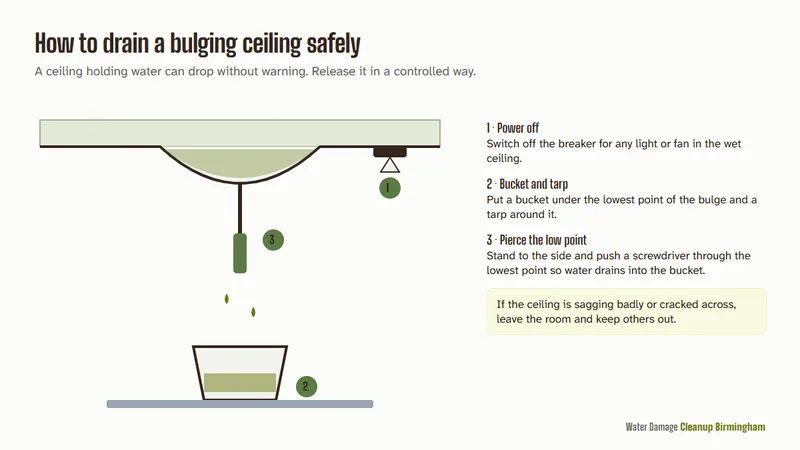
Use a screwdriver or awl at the lowest point of the bulge and stand to one side as you push. A sag can hold several buckets of water, so have a spare container and towels nearby.
- Leave the room if the sag is wide, if cracks are spreading outward, or if it is heavy plaster on wood lath.
- Keep ceiling lights and fans switched off until an electrician or the restoration team has checked them.
- Even after draining, wet gypsum is weak and can still drop. Do not stand under it.
Ceiling water often runs down into the walls. The wet drywall page shows how to check the walls below for soft spots and swelling.
Where is the water above my ceiling coming from?
Match the stain to what sits above it and to when it gets worse. Spots under a bathroom that darken after showers point to plumbing, while top-floor spots that appear in storms point to the roof. A stain that shows up after a freeze breaks, near an outside wall or garage, often means a split pipe.
| Stain location | When it gets wet | Probable cause | Who fixes the cause |
|---|---|---|---|
| Below an upstairs bath or laundry | When fixtures or the washer run | Wax ring, drain joint, shower pan or a supply hose | Plumber |
| Top floor, near chimneys or vents | During thunderstorms and wind-driven rain | Lifted shingles, worn flashing or a cracked vent boot | Roofer |
| Near an attic air handler or furnace closet | On hot, sticky days with the AC on | Blocked condensate line or overflowing pan | HVAC technician |
| Garage ceiling or exterior wall line | As temperatures climb after a freeze | Supply pipe that iced up and split | Plumber |
| Lower unit in a condo or apartment | Any time, without warning | A fixture or appliance in the unit overhead | Property manager or association |
Water can run along a joist for a long way before it falls, so the true source may sit a few feet off. See the bathroom and kitchen leak page for fixture problems and the renters and condos guide for leaks from a neighbor's unit.
Why do Birmingham ceilings leak after spring and fall storms?
Storms here bring wind and heavy rain together, and that combination finds weak roof spots. The Wikipedia article on Birmingham says cold fronts in spring and fall often bring strong to severe thunderstorms, with November and early December a second severe weather season.
The same article places the city in the area called Dixie Alley because tornadoes are so frequent in Central Alabama. It also notes that most summer rain comes from afternoon and evening thunderstorms, and that tropical storms sometimes reach the area in late summer and fall.
- After a storm, walk the yard and photograph any shingles, flashing or vent caps on the ground.
- Check the attic with a flashlight for wet insulation, damp decking or daylight around pipes.
- Get the roof covered before anyone hangs new drywall below it.
Shingles torn loose by wind let the next downpour straight into the attic. The storm and roof leak page covers tarping and claim records, and the tornado history page explains why roofs here take so much punishment.
Can a hard freeze in Birmingham burst pipes above a ceiling?
Yes. Birmingham winters are mild on average, but the city still sees enough freezing nights to crack supply lines that run through attics, garages and outside walls. The leak often stays hidden while the pipe is frozen, then pours through the ceiling once the ice melts and pressure returns.
The Birmingham article reports an average of 47 days a year with a low at or below freezing, and 1.4 days when the high stays below freezing. It also records 10.3 inches of snow on March 13, 1993, during the Storm of the Century.
Pipes in cold, unheated parts of a house freeze first, according to the American Red Cross, which points to attics, crawl spaces and garages. Before leaving home during a cold spell, set the thermostat to 55 F or higher, the Red Cross says.
- A ceiling that starts dripping on the first mild afternoon after a cold snap usually means a split pipe.
- A hair dryer or heating pad is a safe way to warm an iced-up pipe; a torch or other open flame is not.
The burst pipe page covers locating the break and drying the walls around it.
How are plaster ceilings in older Ensley or Homewood houses handled?
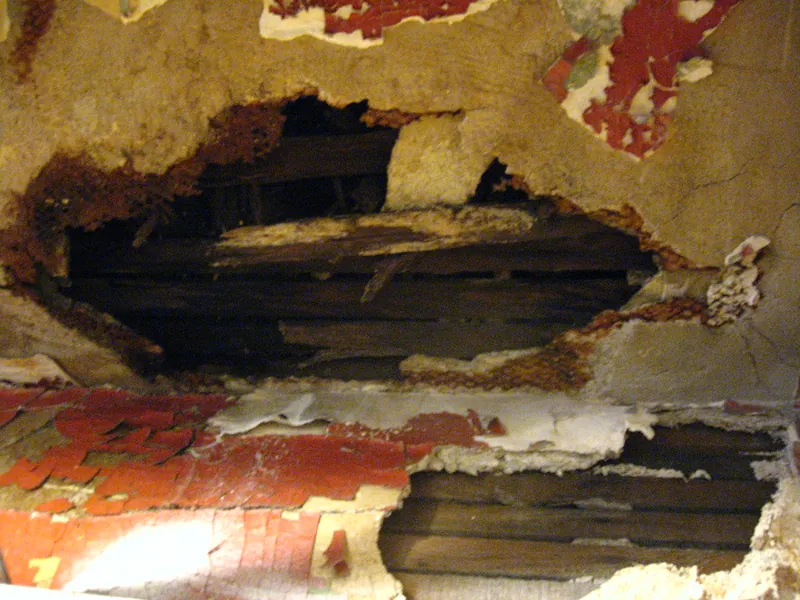
Carefully, because plaster on lath is heavy and old finishes can hide lead or asbestos. Wet plaster can let go in large slabs once the keys behind it soften. Ask for testing before anyone cuts or sands, and expect a restoration team to contain dust in older homes.
Birmingham has plenty of houses old enough to raise these questions. The Ensley article describes hundreds of small workers' cottages built there after the land company reorganized in 1898. The Homewood article says the Hollywood subdivision began in 1926 with many homes in the Spanish Colonial Revival style.
Lead-based paint is more likely in houses finished before 1978, according to the EPA, and peeling or chipping paint in those homes can expose people to lead dust. Its asbestos page says you generally cannot tell whether a material holds asbestos by looking, names water damage as a sign of wear, and warns against sawing, sanding, scraping or drilling it.
The West End and Ensley page and the Homewood and Mountain Brook page cover those areas in more detail.
Can a water-stained ceiling be patched, or does it need replacing?
The answer turns on three things: how much water, how long it sat, and how clean it was. A brief leak of clean water into drywall that stays firm can often be dried, sealed with stain-blocking primer and painted. Drywall that sagged, crumbles or stayed wet for days is normally cut out and replaced.
Restoration teams measure moisture with meters and often a thermal camera. The wet area above a ceiling tends to spread well past the visible ring, and those readings decide where the cuts go.
- Often saved: solid drywall or plaster that dries back to normal readings without mold.
- Often removed: drooping panels and insulation that matted down after soaking.
- Decided on site: plaster on lath, which may be dried, reattached with plaster washers or replaced.
The IICRC S500 standard sorts leaks by water type. Water from a broken supply line is Category 1, or clean. Grey water, Category 2, includes what spills from a washer, a dishwasher or a toilet bowl that holds no waste.
Grey water usually means more of the ceiling comes out. The structural drying page explains how the space above gets dried.
Is that ceiling spot a water stain or mold?
Water stains are usually flat, with a tan or yellow center and a darker tide line at the edge. Mold looks speckled or fuzzy, often black, green or gray, and keeps spreading after the leak stops. A musty smell near the spot is a reason to look closer even when nothing is visible yet.
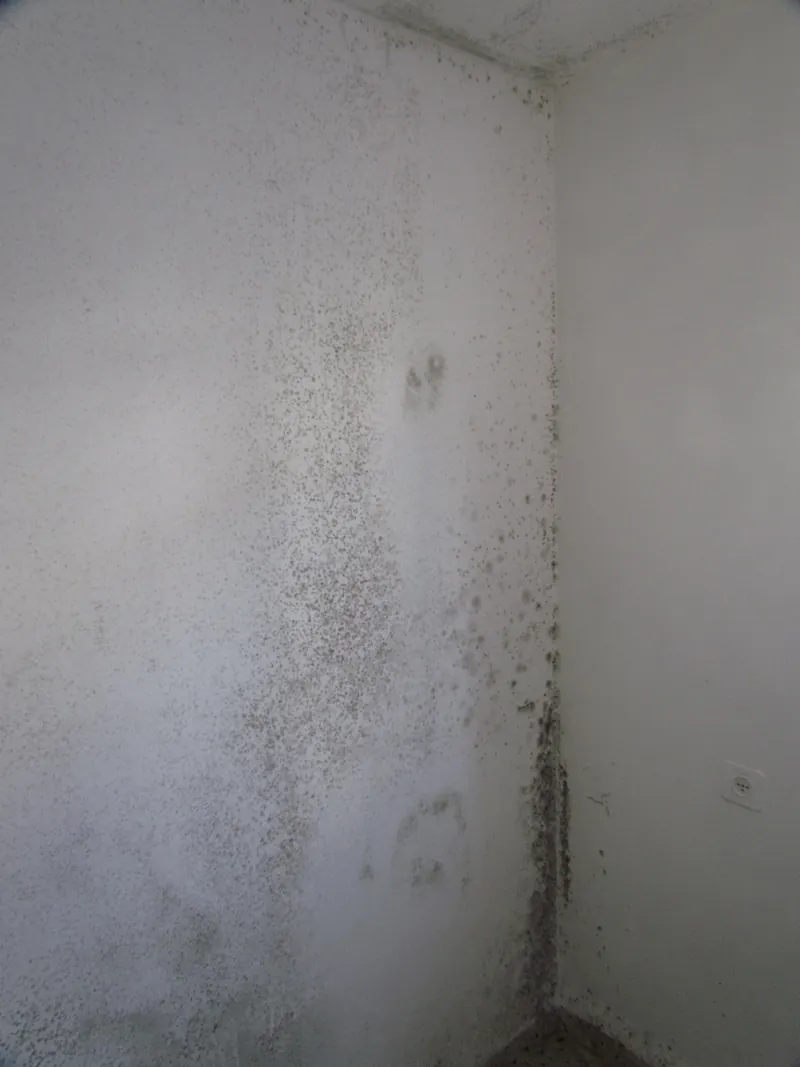

Mold rarely takes hold when soaked materials are dried in the first 24 to 48 hours, per the EPA. A moldy patch that measures under roughly 10 square feet is usually within a homeowner's reach, the agency adds. The agency's cleanup page says not to paint or caulk over mold.
Mold can trigger coughing, wheezing, a sore throat, a stuffy nose or itchy, burning eyes, according to the CDC, and people who have asthma or are allergic to mold may have strong reactions. The mold after water damage guide covers larger growth and when to bring in a mold specialist.
Does homeowners insurance cover a ceiling leak in Alabama?
Usually, when the water came from something sudden. Per the NAIC, a standard policy typically pays for water that escapes household plumbing or comes in through a roof leak. Triple-I points out that neglected upkeep is excluded, so a months-long drip or a worn-out roof can draw questions.
Alabama's claim standards, Ala. Admin. Code r. 482-1-125, give an insurer 15 days after it hears of your claim to confirm receipt, unless it has paid by then. Under rule 482-1-125-.07, you should hear whether the claim is accepted or denied within 30 days after the insurer receives proofs of loss, or the period your policy sets.
If the insurer needs more time, it must tell you why and then send status letters 45 days later and every 45 days after that. The Alabama Department of Insurance takes complaints.
- Protect the house from further harm, Triple-I says, yet hold large permanent repairs until the adjuster has inspected.
- Keep the removed ceiling pieces, or good photos of them, for the adjuster.
For context, water and freeze claims averaged $15,400 per claim over 2019 to 2023 in Triple-I data. The insurance claims guide walks through the full process.
What does ceiling water damage repair cost in Birmingham?
Every ceiling is priced on its own, but national figures give a starting range. Bob Vila puts ceiling repair at $350 to $1,250. Fixr rates plaster restoration from $6.25 up to $18.75 a square foot, while drywall work runs $1.50 to $3.
These figures are national, not Birmingham quotes. Local restoration teams set their own prices after they see the damage.
- How much of the ceiling got wet, and whether the insulation above it soaked through.
- Drywall or plaster, plus any texture, trim or ornament that has to match.
- Whether the water was clean or grey.
- The separate bill from the roofer, plumber or HVAC technician who fixes the cause.
Ask for a written estimate that lists drying, demolition and rebuild as separate lines. The restoration cost guide covers other factors that raise or lower a bill.
How long does a soaked ceiling take to dry in Birmingham humidity?
Expect it to take longer in July than in October. Humid air holds moisture in drywall, framing and insulation, so drying equipment has to work harder. A small clean-water leak opened up quickly may dry in a few days. The finish line is a normal moisture reading, not a ceiling that looks dry.
The Birmingham article describes a humid subtropical climate with hot, humid summers and highs at or above 90 F on 65 days a year. The EPA sets its indoor target at 30 to 50 percent relative humidity, and says to stay below 60 percent.
- Make sure the roof, pipe or fixture has been repaired, and keep wet fixtures switched off.
- Cut away the ruined drywall so moving air can get into the joist bays.
- Take out insulation that cannot dry where it sits.
- Run air movers and dehumidifiers, with readings logged at each visit.
- Prime and paint only after the readings confirm everything is dry.
Not every restoration team does drying, tear-out and rebuilding, so confirm the scope with each one. The contact page is where you can reach a local water damage restoration team near your ZIP code.
Sources: Wikipedia, Birmingham, Alabama (climate, storm seasons, freezing days, 1993 snowfall, summer heat); Wikipedia, Ensley (workers' cottages after 1898); Wikipedia, Homewood (Hollywood subdivision, 1926); American Red Cross on frozen pipes; EPA lead page (homes before 1978); EPA asbestos page (identifying and not disturbing materials); IICRC S500 (clean and grey water); EPA mold and moisture brief (drying time, humidity target, patch size); EPA mold cleanup (no paint over mold); CDC mold symptoms; NAIC consumer guide to homeowners coverage; Triple-I on maintenance exclusions; Triple-I on repairs before the adjuster visits; Triple-I average claim, 2019 to 2023; Ala. Admin. Code r. 482-1-125-.06; Ala. Admin. Code r. 482-1-125-.07; Alabama Department of Insurance; Bob Vila cost article ($350 to $1,250 ceilings); Fixr per-square-foot pricing.