The short version
For wet carpet in Birmingham, start by pulling up standing water, then peel back a corner to feel the pad, and keep the door shut with a dehumidifier going. A clean leak usually costs you the pad, not the carpet. Sewage or creek water costs you both. The EPA says wet materials usually turn moldy after two days, and humid Alabama summers make that window tighter.
Can wet carpet in a Birmingham home be saved?
Often it can, if the water was clean and someone pulled it out early. Wet carpet in Birmingham homes tends to come through a split supply line or an ice maker leak when extraction starts promptly. Carpet soaked by a floor drain backup, a creek over its banks or muddy yard runoff is almost always cut up and hauled off.
What you walk on is only the top layer. Beneath it are the pad, the tack strip along the walls, and either a wood subfloor or a concrete slab. Each layer holds water its own way, so a restoration team meters every one of them before deciding what stays.
Nothing dries while water still pools in the fibers. The water removal page explains how extraction pulls the bulk of it out of carpet and pad so the drying equipment has a job it can finish.
What should you do in the first hour after carpet floods?
Stop the flow, keep everyone clear of cords and outlets near the wet area, and record what you see before cleanup begins. Water spreads sideways through pad well beyond the dark patch on top, and it slips under baseboards into the next room. Photos taken now show the adjuster where it started and how far it went.
- Close the nearest valve, or the house main if you cannot tell which valve feeds the leak. Washer, dishwasher and fridge lines are covered on the appliance leak page.
- Trip the breaker for the room while standing somewhere dry, then unplug lamps and chargers on the floor.
- Take photos and a short video of the room, the source and anything sitting in the water.
- Set furniture legs on foil or plastic so wood stain and metal rust do not transfer into the pile.
- Carry out rugs, books and boxes before they wick up more water.
- Close the door and run a dehumidifier in that room only.
When the leak came from a tank in a closet or garage, the water heater leak page shows how to shut its cold supply before anything else.
Does wet carpet pad always need replacing?
Usually, yes. Pad is a foam layer that acts like a sponge pressed against the subfloor, where almost no air reaches it. It dries far more slowly than the carpet above it and is relatively cheap, so after a clean leak many restoration teams discard the pad, dry the carpet and lay it back down on new cushion.
Written bids usually list carpet and pad on separate lines. Saving the carpet, replacing the pad and re-stretching can come in under a full replacement. Ask each restoration team which route it plans and which meter readings back that choice.
Carpet glued straight to concrete is harder. The adhesive and the slab hold water under the backing, and after a long soak that carpet usually comes up. If hardwood, laminate or tile in the same room also got wet, read the water-damaged floors page.
Which kinds of water mean the carpet has to go?
Contaminated water usually decides it. The IICRC S500 standard puts sewage and flood water rising from rivers and streams in Category 3, its most contaminated group. Carpet and pad soaked by that water are normally thrown out, since cleaning cannot reliably reach what has worked into the backing and foam.
| Water category (IICRC S500) | Typical source in a Birmingham-area house | The carpet | The pad |
|---|---|---|---|
| Category 1, clean | A cracked supply line after a freeze, a refrigerator water tube, a leaking water heater inlet | Frequently dried and kept when extraction starts early | Most often replaced |
| Category 2, grey | Washing machine drain water, a dishwasher overflow, a toilet overflow without waste | Sometimes kept, depending on how long it stayed wet | Thrown out |
| Category 3, grossly contaminated | A basement floor drain backup, creek water after a storm, runoff from the yard | Cut out and discarded | Cut out and discarded |
Clean water also turns. A puddle left sitting through a few warm Alabama days begins to smell and grow bacteria, and a restoration team may then treat the carpet as if it were a dirtier category.
What happens to basement carpet after a sewer backup?
Expect it to go. In a heavy storm, an overloaded sewer main can force sewage back up the house's drain line and out the lowest opening in the home, often a basement floor drain. Everything that water reaches on the floor, from the carpet face down to the tack strip, is treated as contaminated and removed in one pass.
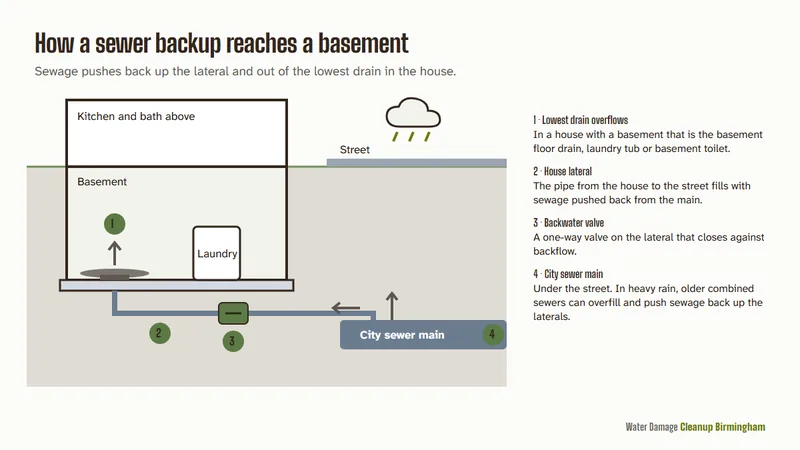
Put the shop vacuum away for this kind of water. For buildings hit by contaminated water, the EPA's cleanup guidance says to call in a professional who has handled that damage before. More on the cause is on the sewer backup cleanup page, and pits that overflow when the pump stops are on the sump pump failure page.
A backwater valve on the house line is the device shown in the diagram that stops sewage from reversing. Ask a plumber whether your home has one and whether it suits your drain layout.
How long does wet carpet take to dry in Birmingham's humidity?
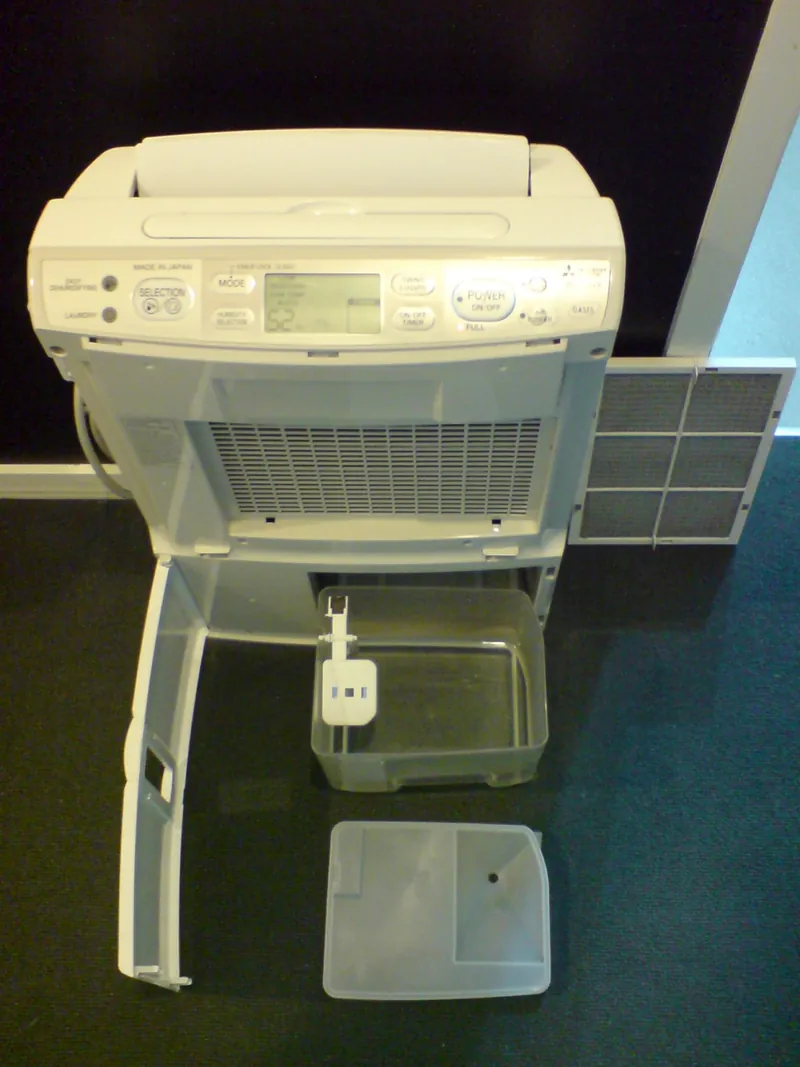
Longer than most people expect. Muggy air slows evaporation, which is why carpet in a closed Birmingham room can stay wet underneath for days and fans alone often fall short in summer. A dehumidifier pulls water out of the room air, which lets the pad and subfloor keep releasing moisture instead of stalling.
Wikipedia's Birmingham article describes hot summers with high humidity, and says most summer rain arrives in afternoon and evening thunderstorms. Spring and fall cold fronts often bring strong storms as well, which is when gutters overflow and water finds its way down to lower-level floors.
Timing matters most: on its flood cleanup and indoor air page, the EPA points out that mold usually follows when belongings stay wet past the two-day mark. Its moisture guide sets an indoor humidity limit under 60 percent, ideally 30 to 50, and the mold after water damage guide helps if spots are already showing.
Can wet carpet be dried without pulling it up?
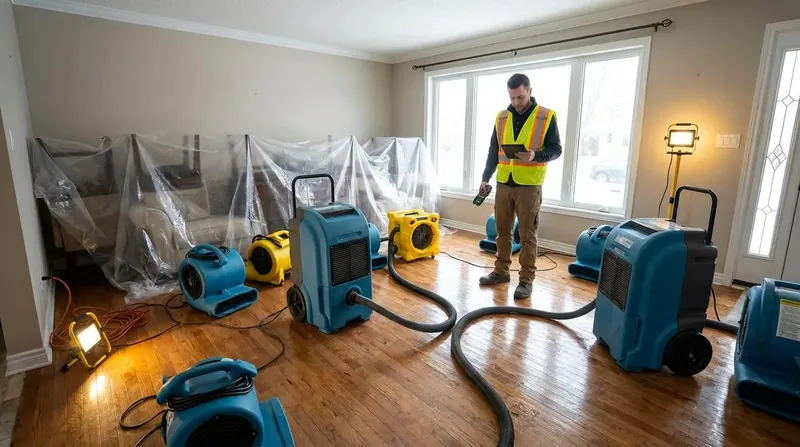
After a clean leak caught early, yes, in many cases. A restoration team makes repeated extraction passes, lifts the carpet at one corner and pushes air underneath so it flows between backing and cushion, while dehumidifiers pull moisture out of the room air. Readings logged each day show whether the method is working or the pad must go.
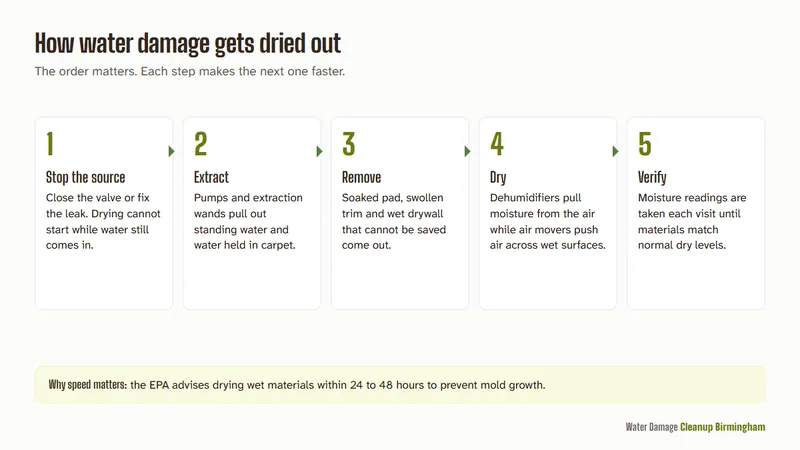
The approach stalls when the pad or slab stays wet beneath a face that feels dry. Numbers that refuse to drop for several days usually mean the pad has to come out. Before work starts, ask how many machines will run, for how long, and how you will see the readings.
Carpet can ripple as it dries, and a re-stretch at the end normally flattens it. Equipment is described on the structural drying page, and the first stage of the job on the water mitigation page.
Is carpet worth saving after Village Creek or Shades Creek floods a house?
Rarely. Water that comes in from outside, whether from a creek over its banks or storm runoff down a stairwell or window well, is Category 3, so carpet it reaches is usually discarded. That water can carry mud, fuel, lawn chemicals and sewage, and a soaked pad holds all of it against the floor underneath.
Local creeks rise well past flood stage. The National Weather Service gauge on Village Creek at Avenue W in Ensley marks minor flooding at 10 feet and lists a highest crest of 14.8 feet on December 3, 1983. The Shades Creek gauge near Homewood marks minor flooding at 14 feet and crested at 18.79 feet on May 4, 2021.
The CDC's flood advice is to take out soaked carpet and upholstered pieces that cannot be dried quickly. For local risk, read the Birmingham flooding page; for the work itself, the flood cleanup page lists the steps.
What if a frozen pipe floods carpet on an upper floor?
Water from a supply pipe is clean at first, so carpet hit by a burst line has a decent chance if the response is quick. Volume is the real risk. A cracked pipe in an empty house can run for hours, saturating an upstairs room and then leaking through the ceiling, so inspect both levels before deciding what stays.
Freezing weather is common enough here to plan for. Wikipedia counts an average of 47 days a year in Birmingham with a low at or below freezing. The American Red Cross singles out supply pipes in unheated spaces, naming garages, attics, crawl spaces, basements and even kitchen cabinets.
Valve locations and what to do while the line waits for a plumber are on the burst pipe page. If the ceiling below is stained, the ceiling water damage page explains what to check.
What does it cost to dry or replace wet carpet?
No Birmingham survey tracks carpet prices, so national figures are the fairest yardstick. Fixr's national list lists carpet restoration between $4.75 and $10.50 per square foot. Extraction there costs $3.75 to $4.25 a foot for clean water and $7 to $7.50 a foot for black water.
The same list gives flat ranges by damage class: $150 to $400 for a small Class 1 area, rising to $1,000 to $3,000 for Class 3, where water has climbed into walls. New pad, tack strip, baseboard and replacement carpet usually come as extra lines.
Each restoration team sets its own rates, and this site does not see or control them. Line up two or more itemized bids and check that they describe the same work. For other parts of an estimate, see the restoration cost guide.
Will Alabama homeowners insurance replace wet carpet?
Often, when water escaped suddenly from something inside the house. Triple-I lists the sudden release of water from household plumbing, heating and cooling systems or appliances among the perils that standard policies name, along with those systems freezing. Flood and poor maintenance are treated very differently.
Water from outside is another story. According to the NAIC, ground water and rain runoff are typically not covered by a homeowners policy.
Under the Alabama Department of Insurance claim standards, Ala. Admin. Code r. 482-1-125, an insurer that needs more time after proofs of loss must explain why, then send updates every 45 days while the investigation stays open.
Hold on to proof. Triple-I tells policyholders to photograph or video the damage and not to throw out damaged items before the adjuster visits, so cut and label a sample of carpet and pad before the rest goes out. The insurance claims guide covers filing.
Sources: IICRC S500, water categories; EPA, contaminated water and professional cleanup; Wikipedia, Birmingham, Alabama (summer humidity, thunderstorms, freezing nights); EPA, indoor air during flood cleanup (two-day mold warning); EPA, mold and moisture guide (humidity targets); NWS, Village Creek at Avenue W gauge; NWS, Shades Creek near Homewood gauge; CDC, soaked carpet after a flood; American Red Cross, pipes at risk of freezing; Fixr, carpet, extraction and damage class prices (January 2025 update); Triple-I, covered perils; NAIC, homeowners coverage basics; Ala. Admin. Code r. 482-1-125-.07, status of claims; Triple-I, keeping damaged items for the adjuster.