For Irondale, Leeds and Alton
For water damage restoration in Irondale, AL, or Leeds, close the main valve, take pictures and get drying under way; mold can start once materials stay wet past the EPA window of 24 to 48 hours. Cahaba River water is flood and needs a flood policy. ZIPs: 35015 Alton (PO box), 35094 Leeds and 35210 Irondale.
Which Irondale and Leeds addresses do you take requests from?
Anyone looking for water damage restoration in Irondale, AL, and its neighbor Leeds come from three ZIP codes: 35015 Alton, 35094 Leeds and 35210 Irondale. Alton's 35015 serves PO boxes only. A box number cannot point anyone to a house, so share the house number and street where the leak or flooding is.
The two cities sit side by side on the eastern edge of Jefferson County. Irondale counted 13,497 residents in the 2020 census, per the Irondale article on Wikipedia, and Leeds counted 12,324. Leeds also stretches into St. Clair and Shelby counties, although most of the city lies in Jefferson, the Leeds article says.
Up the valley to the north, the Trussville and Pinson page covers the towns near the river's source, and the North Birmingham and Center Point page picks up the neighborhoods west of Irondale. Over the ridge to the south, see the Vestavia Hills page.
Does the Cahaba River flood near Irondale and Leeds?
It can, even though the river is still young this far upstream. Wikipedia's Cahaba River article says the upper Cahaba passes through Trussville, Leeds and Irondale before reaching Mountain Brook and Hoover. Leeds itself grew up along the banks of the Little Cahaba River, so low ground near either stream is where trouble starts.
Four National Weather Service gauges watch this stretch of the watershed. Only two of them carry official flood stages, so the table shows what each one actually publishes.
| NWS gauge | Where it sits | What the weather service lists |
|---|---|---|
| Cahaba River near Whites Chapel (CWCA1) | St. Clair County, north of Leeds | Minor 8.5 ft, moderate 17 ft, major 20 ft |
| Little Cahaba River below Leeds (LCRA1) | Jefferson County, at Leeds | Readings only; no flood stages or crest history |
| Cahaba River at Trussville (TRSA1) | Upstream, in Trussville | No stages; crests of 19 ft on May 7, 2003 and 13.63 ft on May 18, 2013 |
| Cahaba River near Mountain Brook (MTBA1) | Downstream, southwest of Irondale | Action 9 ft, minor 20 ft, moderate 23.5 ft, major 24 ft |
What do those river readings mean for nearby homes?
The Whites Chapel gauge says the most about real homes. Its impact notes say water reaches a house near the river at 17 feet, and at 20 feet the river begins to top the bridge on Whites Chapel Road.
At Trussville, the May 2003 crest stands far above the next one on the list, a sign of how far one heavy storm can push the upper river. Never wade or drive into a flooded dip in the road. Ready.gov puts the danger plainly: half a foot of fast water can sweep you down, and a foot of it can float a car. The Birmingham flooding page covers gauges across the rest of the metro.
How can you tell if a Leeds or Irondale lot is in a flood zone?
Look the address up on the FEMA flood map. FEMA calls the land that a 1-percent-annual-chance flood would cover the Special Flood Hazard Area, marked as Zone A, AE or a similar code. Shaded Zone X falls between that line and the 0.2 percent chance flood, outside the high-risk area.
A house outside the shaded areas can still take water. Heavy rain can run across a sloped yard, pond against the foundation and seep through a crawl space vent or a block wall. The NAIC says homeowners policies do not pay for damage from rain runoff or ground water.
Leeds has a reminder of its own. The Leeds article notes a 2019 report that the Superfund site at Interstate Lead Co. in the city was at risk from flood hazards tied to climate change.
Timing matters if you add NFIP cover. A new policy usually does not take effect for 30 days, with limited exceptions, under FEMA's NFIP manual, so buying one as a storm approaches is too late. The flood cleanup page explains what happens after outside water gets in.
How old are the houses in Irondale and Leeds?
The towns themselves are old, which means the housing ranges widely. Irondale incorporated on October 19, 1887, taking its name from the Irondale Furnace, and Leeds incorporated on April 27 of the same year, Wikipedia says. Settlement in Leeds goes back to 1818, long before the subdivisions that now ring both cities.
Leeds grew as a cement and railroad town. It housed the workers and families of Lehigh, a Portland cement plant, and it lies along two large railroads and a stagecoach route, per the Leeds article. In 2020 Irondale had 6,319 housing units and Leeds had 5,348.
A house that has been added onto over the years often hides a mix of old and new plumbing in the same wall or floor. A few checks help find a slow leak before it spreads:
- Look for brown rings or bubbling paint on ceilings below bathrooms.
- Press on the floor beside the toilet, tub and dishwasher for soft spots.
- Check the crawl space or lower level after a hard rain for pooled water or damp insulation.
- Watch for a musty smell that returns in closets on outside walls.
The signs of water damage guide covers more warning signs, and the water damaged floors page explains cupped boards and soft subfloors.
How do you keep pipes from freezing in an Irondale or Leeds home?
Keep the heat on and protect the lines most exposed to cold air. The American Red Cross lists supply pipes in crawl spaces, basements, attics, garages and kitchen cabinets as the ones most at risk. If you leave home in cold weather, it advises a thermostat setting no lower than 55 F.
On the coldest nights, the same guidance suggests leaving the thermostat steady around the clock and opening the cold tap a crack wherever the pipe behind it runs through cold space. A frozen line can be warmed slowly with an electric heating pad, a blow dryer or hot, wet towels. Open flame of any kind is off the list.
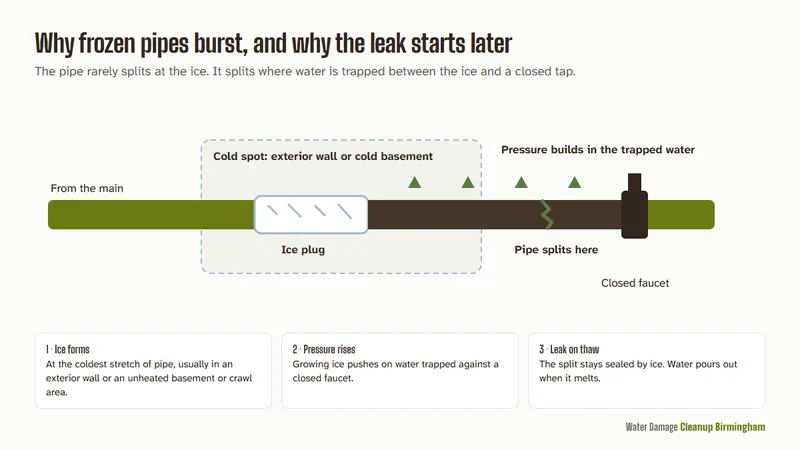
A split pipe can run unseen inside a wall for hours once it thaws. Find your main shutoff before winter, and see the burst pipe page for what to do when one lets go.
Will insurance pay for Cahaba River water in an Irondale home?
Not under a standard homeowners policy. When the Cahaba spills into a house, insurers treat it as flood, which Triple-I lists as an exclusion in ordinary home and renter coverage; it takes a separate flood policy. A burst pipe or a storm leak through the roof is different: the NAIC calls those typically covered.
Sewage pushing up through a floor drain is a third case. Per Triple-I, ordinary home coverage leaves it out and so does flood coverage, and people add it as an endorsement. Ask your agent whether yours has one before you need it.
For a covered loss, Alabama Department of Insurance claim standards, Ala. Admin. Code r. 482-1-125, give the insurer 15 days to acknowledge your claim. Within 30 days after it receives proofs of loss, or the period the policy names, it must tell you whether it accepts or denies the claim. If it needs more time, it writes with reasons, then again every 45 days. The Alabama Department of Insurance takes complaints. Our guide to Birmingham water damage claims lists the papers and photos an adjuster asks for.
What are the first steps after a leak or flood in an Irondale or Leeds house?
Shut the water off, keep away from wet outlets, take pictures and get air moving. Mold sets the deadline. Wet materials should be dry in 24 to 48 hours, per the EPA, while household humidity belongs below 60 percent and, better still, somewhere from 30 to 50.
- Close the main water valve, or the stop valve behind the fixture that failed.
- If the Cahaba or the Little Cahaba is over a road, wait for it to fall before driving out.
- Leave the electrical panel alone unless the floor in front of it is dry.
- Take pictures of each room, the waterline on the walls and ruined items while they are still in place.
- Let your insurer know about the loss and hold on to every receipt for tarps, fans or a pump.
- Get written estimates that list materials and prices line by line.
The IICRC S500 places river water and sewage in Category 3, so soaked carpet pad and the lower part of wet drywall are usually removed. Restoration teams differ in where they work and what they handle, so confirm directly. The water mitigation page explains the early drying work, and the emergency water damage page covers urgent leaks.
Sources: Irondale, Alabama, Leeds, Alabama and Cahaba River (Wikipedia); NWS gauges CWCA1, LCRA1, TRSA1 and MTBA1; Ready.gov on floods; FEMA flood zones; FEMA NFIP Flood Insurance Manual; Red Cross on frozen pipes; Triple-I on covered disasters; NAIC homeowners insurance; Alabama Department of Insurance claim standards, Ala. Admin. Code r. 482-1-125-.06 and 482-1-125-.07; EPA mold and moisture guide; IICRC S500 categories.