For Clanton and Chilton County
For water damage restoration in Clanton, AL, stop the water at the main or the well pump, keep clear of wet wiring and photograph each room. The EPA says to dry in 24 to 48 hours. Walnut Creek water needs flood insurance. ZIPs: 35045, 35046, 35085, 35171, 36091, 36750, 36790.
Which Clanton addresses do you take requests from?
For water damage restoration in Clanton, AL and the rest of Chilton County, seven ZIP codes are on the list: 35045 Clanton, 35046 Clanton, 35085 Jemison, 35171 Thorsby, 36091 Clanton, 36750 Maplesville and 36790 Stanton. Clanton itself has three of them, so check which one is on your bill before you call.
Most of the county is open country. At the 2020 census, 85.5 percent of Chilton County residents lived in rural areas, according to the Chilton County article on Wikipedia, and the county covers 701 square miles. Give the restoration team the road name, house number and a landmark, and ask how far it travels.
North on I-65, the Alabaster and Calera page covers the Shelby County line. West toward the Cahaba, see the Centreville and Brent page for Bibb County, and to the northeast the Chelsea and Columbiana page.
Does Clanton flood?
Parts of the area do, mostly along Walnut Creek just upstream of town. The National Weather Service keeps a gauge on Walnut Creek above Clanton, where minor flooding begins at 9 feet and moderate flooding at 11. The creek has passed 11 feet many times in the past decade.
The NWS gauge page for WCCA1 spells out what each level means. Between 8.5 and 9 feet the creek reaches its banks. From 9 to 11 feet, some roads upstream along CR 455 and CR 89, and downstream along CR 251, start to flood.
| Walnut Creek crest | Height | What the NWS says happens there |
|---|---|---|
| March 27, 2023 | 15.63 ft | Above the 14 ft mark where the bridge overflows |
| May 30, 2018 | 13.94 ft | Road overflow, moderate flooding |
| May 1, 2016 | 13.74 ft | Road overflow, moderate flooding |
| April 5, 2022 | 13.1 ft | Road overflow, moderate flooding |
| October 5, 2021 | 12.97 ft | Road overflow, moderate flooding |
The road starts to go under between 11 and 12 feet, and the bridge overflows at 14, the gauge page says. All five of these top crests came in 2016 or later, in spring and fall alike, so this is a live risk and not only an old story.
If the creek is over a road, turn around. Ready.gov puts it plainly: water moving six inches deep can topple an adult, and twelve inches can sweep away a vehicle. The flood cleanup page covers what happens once the water drops.
Is Lay Lake a flood worry for homes on the Coosa?
The lake is held by a dam, but lakefront homes still face water problems. Lay Dam, a run-of-the-river dam on the Coosa River in Chilton and Coosa counties, went up in 1914 as Alabama Power's first major project, the Lay Dam article says. Its lake spreads over 12,000 acres.
The shoreline runs about 289 miles. If your lot slopes toward the water, rain runs downhill toward the house, and the lowest wall or crawl space takes it. Keep gutters clear, carry downspouts well away from the foundation, and look under the house after a long, heavy rain.
Lake houses used on weekends have another risk: a supply line that breaks while nobody is there. Shut the main valve when you leave for more than a day or two. The sump pump failure page helps if a lower level relies on a pump, and the water behind siding page covers slow leaks on the wet side of a house.
What kinds of homes are in Clanton and Chilton County?
Mostly owner-occupied houses, many of them on country land. At the 2020 census, Chilton County counted 19,438 housing units, and 76.5 percent of the occupied ones were lived in by their owners. Clanton had 3,882 units, with a rental vacancy rate of 9.0 percent.
The town grew up around the railroad. It was known as Goose Pond before the station took the name Clanton in 1871, and it was incorporated on April 23, 1873, according to the Clanton article. The county article adds that the seat moved here from Grantville after the courthouse there burned.
Peaches shaped the land around it. Over 80 percent of Alabama's peach crop comes from Chilton County, and the county runs from swamps and prairie to the last foothills of the Appalachians, Wikipedia notes. A farmhouse out there may have a well, a septic field and outbuildings that each need a check after a storm.
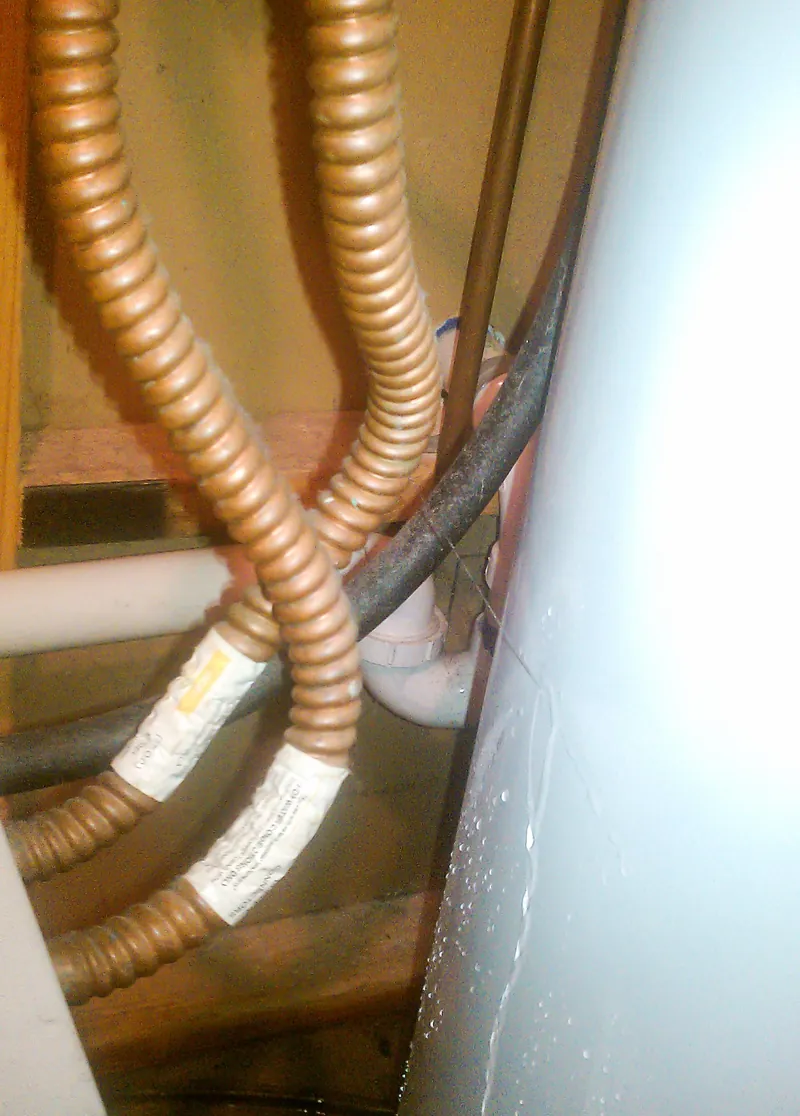

In older houses, the water heater and its connections are a common slow leak. The water heater leak page explains what to check, and the appliance leak page covers washers and fridge lines.
Can a cold snap burst pipes in a Clanton house?
It can, even here. The Clanton article describes hot, humid summers and generally mild to cool winters, and a rare hard freeze is exactly when an exposed pipe gets forgotten. Lines in crawl spaces and outside walls are usually the first to go, and the split often stays hidden until the ice melts.
The American Red Cross names pipes running through unheated areas, from the crawl space to the garage and the cabinet under the sink, as the ones at greatest risk. When temperatures drop hard, a slow trickle of cold water at a tap on an exposed run helps. To thaw a frozen line, a hair dryer or electric heating pad is safe to use; a torch or open flame is not.
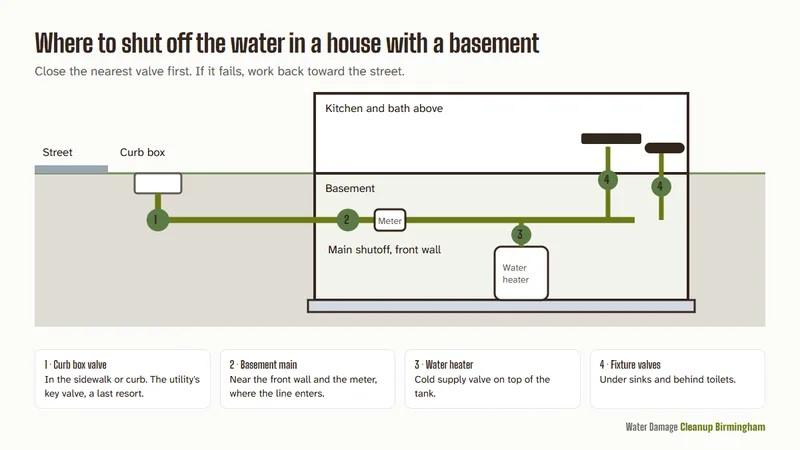
A split pipe often leaks only on thaw, so find your main valve before the cold arrives. The burst pipe page goes through the next steps, and the prevention guide covers insulation and hose bibs.
Will insurance pay for Walnut Creek flood water in Clanton?
A standard homeowners policy will not. Triple-I explains that flood is left out of standard home and renters policies and is insured separately through the NFIP or a few private companies. A burst pipe or a leaking water heater is a different matter, often covered as an accidental discharge from plumbing or an appliance.
The NAIC agrees on the split: roof and plumbing leaks are usually covered, ground water and rain runoff usually are not. Triple-I adds that a sewer backup needs its own endorsement. Do not wait for a forecast to buy flood cover: the FEMA flood insurance manual holds a new NFIP policy for 30 days, with limited exceptions.
For a covered claim, Alabama's claim standards, Ala. Admin. Code r. 482-1-125, call for the insurer to acknowledge your notice within 15 days (rule .06). Within 30 days after proofs of loss, or the period in your policy, you should hear whether the claim is accepted or denied, with written updates every 45 days if the review runs longer (rule .07).
The Alabama Department of Insurance takes complaints. The insurance claims guide lays out the paperwork step by step.
What should you do first after water gets into a Clanton home?
Get everyone away from the water, cut power to wet rooms if you can reach the panel from dry ground, and record the damage before cleanup. Mold is the clock you are racing, and the EPA wants soaked materials dry 24 to 48 hours after they got wet, a tall order in a humid Alabama summer.
- For a pipe or appliance leak, turn the main valve off, or the pump breaker if the house is on a well.
- For creek water, wait until it falls, then go in with rubber boots, gloves and eye protection.
- Take photos of each room, the high-water line and every damaged item before moving anything.
- Tell your insurer, and your flood carrier if you have one, as soon as you can.
- Hold on to receipts and damaged items until the adjuster has seen them.
When the creek has gone down, the CDC is fine with an ordinary cleaner on counters and hard floors. Bleach is optional, at 1 cup or less to a gallon, and must never meet ammonia.
Restoration teams differ in where they go and what they do, so confirm with the one you reach. The water mitigation page explains the first visit.
Sources: Wikipedia on Clanton, Alabama (Goose Pond, 1871 name, 1873 incorporation, climate, 2020 census, peach crop) and Chilton County, Alabama (area, landscape, Grantville courthouse, rural share, housing units, owner occupancy), and on Lay Dam (1914 dam, Lay Lake size and shoreline); National Weather Service gauge WCCA1, Walnut Creek above Clanton (flood categories, impacts, historic crests); Ready.gov on floods; American Red Cross on frozen pipes; Triple-I on covered disasters; NAIC homeowners guide; FEMA NFIP Flood Insurance Manual, April 2024; Alabama Department of Insurance claim standards, Ala. Admin. Code r. 482-1-125 (.06, .07); Alabama Department of Insurance; CDC page on mold and health (cleaning after a flood); EPA brief guide to mold and moisture (drying time).