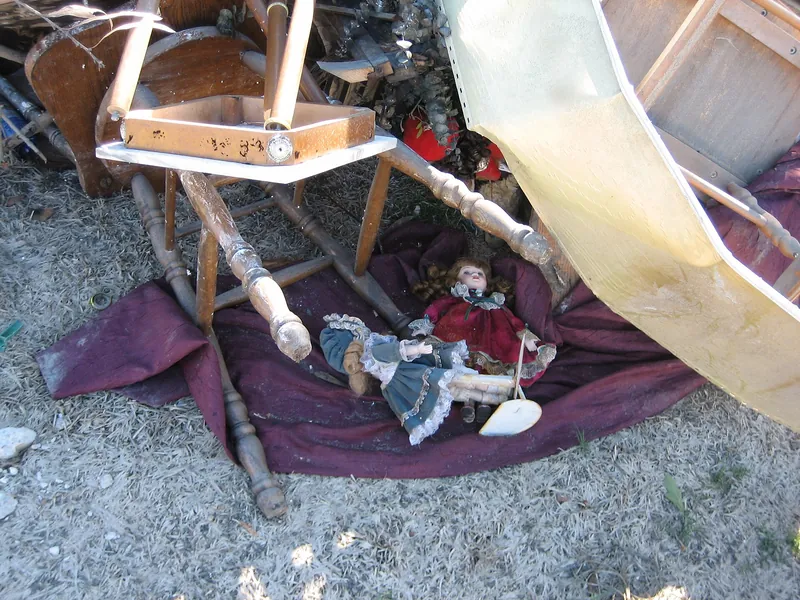
The short version
Stop every drain in the house first: sewer backup cleanup in Birmingham goes better when no more wastewater goes down, people leave the area and the damage is photographed. Sewage is Category 3, so soaked porous materials usually go. Report it to whoever runs your sewer and to your agent; backup coverage is usually a separate endorsement.
Sewage came up through my drain in Birmingham: what should I do?
Stop all water use in the house. Sewer backup cleanup in Birmingham begins with not adding to the problem: any toilet flush, shower or dishwasher cycle drains into the same blocked line and comes back out at the lowest fixture. Next, get everyone out of the affected area and take pictures before anything is moved.
- Shut down every drain. Tape a sign on toilets, sinks, the tub and the washer so no one runs water by habit.
- Move people and pets away. Keep children, older relatives and anyone with asthma or a weak immune system out of that part of the house.
- Leave wet outlets and cords alone. If sewage has reached wiring or the panel, have an electrician or the electric utility cut the power first.
- Photograph the drain, the depth of the water and each damaged item before cleaning or tossing anything.
- Get a plumber out to locate the blockage and say whether it sits in your pipe or the public sewer.
- Report the backup to whoever runs your sewer, then call your insurance agent.
Sewage removal is one part of the work covered on the flood cleanup page. If water came in through a wall crack, a window well or the sump pit rather than a drain, the basement flooding page and the sump pump failure page are the better fit.
Why does sewage come out of the lowest drain in the house?
Because wastewater follows gravity and pressure to the first opening it can reach. When the public main overfills or your own sewer lateral clogs, the flow reverses up the pipe and spills from the lowest fixture below that level, which in many homes is a floor drain, a lower-level toilet or a shower.
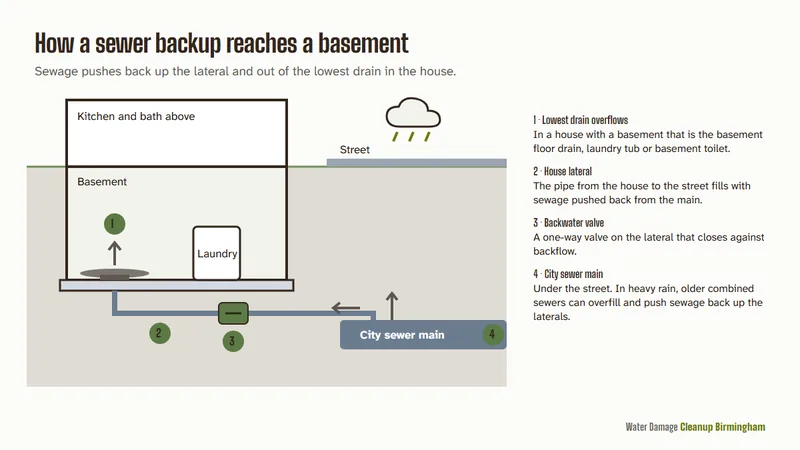
Upstairs fixtures stay dry unless the backup rises very high. That is why a house on a sloping lot, with a lower level or bonus room tucked into the hill, can take a backup while the main floor never sees a drop.
A slow tub on its own is often just a clog in that fixture. When the floor drain, the lower toilet and the laundry standpipe all gurgle or fill together, the blockage sits further down the line, and a plumber's sewer camera can usually pin down where.
Finished lower levels lose the most. Carpet, a guest bed, a home gym or stored boxes near the drain can be soaked before anyone notices, and soft items that touch sewage are usually not worth saving.
Why do Birmingham sewers back up after heavy rain?
Heavy storms push extra water into the system faster than the pipes can carry it away. Wikipedia describes Birmingham as humid subtropical with abundant rainfall, and notes that cold fronts in spring and fall often bring strong to severe thunderstorms, with November and early December forming a second severe weather season.
The creek gauges show how quickly that rain piles up. Village Creek at Avenue W in Ensley hit 14.8 feet on December 3, 1983, the highest crest on the NWS gauge, and reached 14.22 feet on June 20, 2021, above its 13-foot moderate flood stage.
Valley Creek at Center Street crested at 12.89 feet on September 15, 2024, past its 11-foot minor flood stage, according to the NWS gauge page. Rain heavy enough to push a creek that high also soaks the ground the sewer lines run through.
Age adds to it. The Birmingham article says a federal consent decree required repairs to an aging sewer system after residents sued over pollution in local waterways. In any older system, rain can slip in through cracked pipes and loose joints, and the homes with the lowest drains feel it first.
Who do I call about a sewer backup in Jefferson County and nearby towns?
Call the agency that bills you for sewer service, then your insurance agent. Wikipedia says Jefferson County Environmental Services provides sanitary sewer service across the Birmingham metro, while Bessemer runs its own water and sewer system. Shelby, St. Clair, Tuscaloosa and other counties are served by their own cities or utilities.
Tell the sewer agency the date and time the backup started, which drains overflowed and whether neighbors had the same problem. Ask for a report or reference number and write it down. If a crew comes out, note what they found and whether the trouble was in the public main.
No reimbursement program for Birmingham area sewer backups appears in the public sources this site relies on, so do not assume the agency will pay for cleanup. Ask it directly how it handles backup reports, and keep your photos and the plumber's notes.
Homes on a septic system are a different case. If a tank or drain field floods and wastewater comes back into the house, call a septic contractor rather than a sewer agency. The Jefferson County article covers the long history of the county-owned sewer overhaul that began in 1996.
Is the clog in my sewer lateral or the public main?
A plumber can usually tell you, and the answer shapes who pays for the pipe repair. In many places the property owner is responsible for the lateral from the house to the main, and the public agency owns the main. Where that line falls can vary, so ask your sewer agency how it applies at your address.
- One fixture backs up: the clog is probably in that fixture or its branch pipe.
- All lower drains back up on a dry day: roots, grease, wipes or a sagging section in your lateral are common causes.
- Backups come with heavy rain and the neighbors have them too: the public main may be surcharged.
- The cleanout in the yard is spilling over: the blockage is likely downstream of it, toward the street.
Ask the plumber for the camera video or a written note showing where the blockage was. The sewer agency and your insurer may both ask for it.
If the problem is in your own lateral, the plumber can clear it with a cable or a water jetter, and may recommend a repair if the pipe is broken or bellied. Keep that recommendation with photos, since the cause of the backup can affect how a claim is reviewed.
How dangerous is sewage water inside a house?
Treat it as a health hazard from the first minute. Sewage sits in Category 3 under the IICRC S500 standard, the grossly contaminated group it shares with rising water from rivers and streams. The EPA says that when damage comes from sewage or other contaminated water, a professional experienced with that kind of cleanup should be called in.
If you have to go near it, the CDC recommends rubber boots, gloves and goggles, with windows open for fresh air. The CDC also warns never to mix bleach with ammonia or any other cleaner.
Mold becomes a second problem once wet drywall and framing sit for a few days. According to the CDC, mold exposure can cause a stuffy nose, wheezing, coughing, burning eyes or a skin rash, that people with asthma or a mold allergy may react severely, and that people with chronic lung disease or weak immune systems can develop lung infections.
See a doctor if anyone feels ill after contact with sewage. The kids and pets cleanup safety page covers keeping a household safe during the work, and the mold after water damage guide covers what follows.
What has to be thrown out after a sewage backup?
Most porous material that soaked up sewage. Hard, sealed surfaces can be cleaned and disinfected, but carpet, pad, insulation and the lower part of the drywall usually go. That is what Category 3 means in practice. A restoration team will look at each material, yet planning for those losses saves surprises later.
| Item or surface | Likely outcome | Why | Do this first |
|---|---|---|---|
| Wall-to-wall carpet and pad | Pulled up and bagged for disposal | Fibers and foam trap sewage where cleaning cannot reach | Photograph it and keep a cut piece for the adjuster |
| Drywall, paneling and wall insulation | Cut out to a line above the stain | Paper-faced board and batts wick dirty water upward | Measure and photograph the highest water mark |
| Slab, block walls and tile | Scrubbed and disinfected in place | Sealed, hard surfaces can be cleaned | Wait for dry readings before any paint or sealer |
| Couches, mattresses and cardboard boxes | Usually thrown out | Padding and paper absorb sewage and cannot be sanitized well | List each item with its rough age and cost |
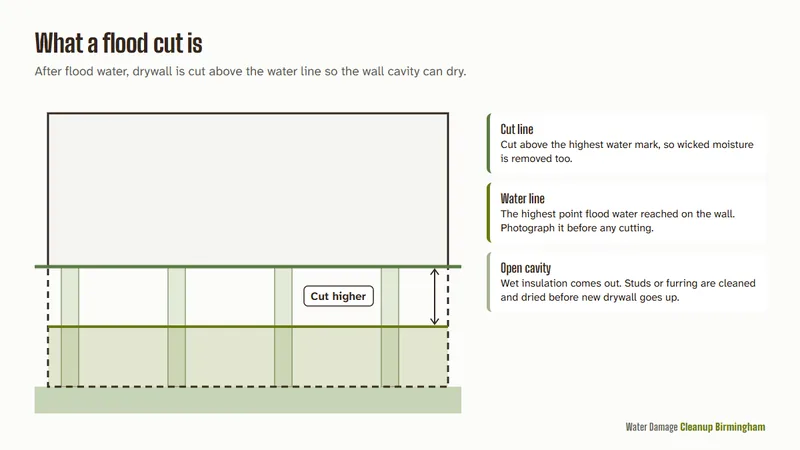
The wet carpet page and the wet drywall page explain the decisions for each material in more detail.
How do restoration teams clean and disinfect after a sewer backup?
The usual order is containment, removal, tear-out, disinfection and drying. Each step limits how far contamination travels through the house. Methods and equipment vary from one company to another, so ask the restoration team you reach to put the scope of work in writing before anyone starts.
- Seal off the affected rooms with plastic sheeting and set one path in and out.
- Pump out the liquid and remove solids from floors and drains.
- Tear out soaked porous materials, bag them and haul them away.
- Clean and disinfect concrete, framing and any hard belongings that can be kept.
- Dry the structure with dehumidifiers and air movers, logging moisture readings until targets are reached.
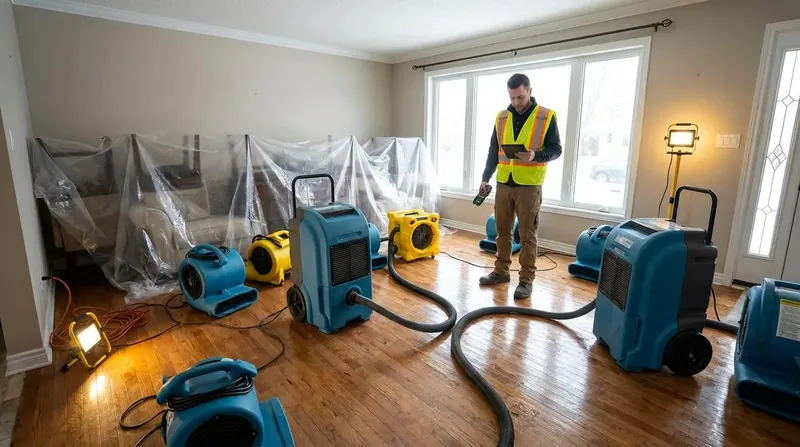
Birmingham's humid summers make the EPA target harder to hit: dry wet materials in 24 to 48 hours and keep indoor humidity under 60 percent. The water mitigation page covers early stabilization, and the guide to choosing a restoration company has questions worth asking before you sign.
Will homeowners insurance pay for a sewer backup in Alabama?
Not on a standard policy by itself, in most cases. Per Triple-I, backed-up sewage falls outside both an ordinary homeowners form and a flood policy. Owners buy that protection on its own or as an add-on endorsement, which Triple-I describes as typically inexpensive. Check your declarations page for a water backup or sewer backup line.
Outside flood water is its own question. Standard homeowners and renters policies exclude flooding, Triple-I notes, and that coverage comes from the NFIP or a small number of private insurers.
When you file, Triple-I recommends guarding the home against further harm, holding on to every receipt, and leaving ruined belongings in place for the adjuster to inspect.
Alabama Department of Insurance claim standards, Ala. Admin. Code r. 482-1-125, give the insurer 15 days from notice to confirm it has your claim, unless it pays first (rule .06). Under rule .07, you must hear whether it is accepted or denied in 30 days after proofs of loss, or the period your policy sets, with letters every 45 days if the investigation runs longer. The Alabama Department of Insurance handles consumer complaints, and the insurance claims guide walks through the rest.
How can I stop sewage from backing up into my house again?
Close the path and keep the pipe clear. A backwater valve installed on the lateral lets wastewater leave but shuts when flow turns back toward the house. A plumber can tell you whether your line has room for one and whether your sewer agency or city requires a permit to add it.
- Ask a plumber about a backwater valve, or a floor drain plug if only one drain is at risk.
- Throw bacon fat, flushable wipes and paper towels instead of rinsing or flushing them; that mix is what clogs a lateral on a dry day.
- Have the lateral scoped if large trees grow near the line or backups keep returning.
- Store keepsakes and paperwork on shelves, never on the floor near a lower-level drain.
- Add a sewer backup endorsement before spring storm season and confirm its limit with your agent.
The water damage prevention guide covers other ways to protect a lower level, and the Birmingham flooding page explains how local creeks behave in heavy rain. If a smell lingers after cleanup, see the water damage smell guide.
Sources: Wikipedia, Birmingham, Alabama (climate and utilities); Wikipedia, Jefferson County, Alabama (sewer system); NWS gauge, Village Creek at Avenue W, Ensley; NWS gauge, Valley Creek at Center Street; IICRC S500 category definitions (sewage); EPA: cleaning up after contaminated water; EPA moisture and humidity guidance; CDC mold health and protective gear advice; Triple-I: which disasters a homeowners policy covers; Triple-I guide to settling disaster claims; Ala. Admin. Code r. 482-1-125-.06; Ala. Admin. Code r. 482-1-125-.07.