For Tuscaloosa, Vance, Brookwood and Coaling
For water damage Tuscaloosa homeowners and renters face, shut off the water, stay out of river or sewer water, photograph every room and start drying. Per the EPA, soaked materials should be dried out in 24 to 48 hours. Flood water from the river falls under a flood policy. ZIPs run from 35401 Tuscaloosa to 35490 Vance.
Which Tuscaloosa addresses do you take requests from?
Seventeen ZIP codes cover the water damage Tuscaloosa homes, rentals and shops report, along with nearby towns in the county: 35401 Tuscaloosa, 35402 Tuscaloosa, 35403 Tuscaloosa, 35404 Tuscaloosa, 35405 Tuscaloosa, 35406 Tuscaloosa, 35407 Tuscaloosa, 35440 Abernant, 35444 Brookwood, 35449 Coaling, 35453 Coaling, 35456 Tuscaloosa, 35468 Kellerman, 35478 Peterson, 35486 Tuscaloosa, 35487 Tuscaloosa and 35490 Vance.
Eight of those are post office box or single-organization codes: 35402, 35403, 35407, 35486, 35440 Abernant, 35449 Coaling, 35468 Kellerman and 35478 Peterson. If your mail goes to one of them, give the street address of the damaged building so the restoration team can place it on a map.
Tuscaloosa is the county seat and sits about 60 miles southwest of Birmingham on the fall line of the Black Warrior River, per the Tuscaloosa article on Wikipedia. Across the river, the Northport page takes the north bank.
Toward Birmingham, see the Bessemer and McCalla page, and to the southeast in Bibb County, the Centreville and Brent page. Every code on the site sits on the ZIP code list.
Does Tuscaloosa flood when the Black Warrior River rises?
Yes, along the low ground beside the river. The Black Warrior is held back by a chain of locks and dams, and Oliver Lock and Dam sits just west of downtown, according to the Black Warrior River article. The National Weather Service gauge there lists the riverfront businesses and parks that go under first.
The Oliver Lock and Dam gauge, TODA1, reads in feet of elevation rather than depth, so the plain categories are easier to follow than the raw numbers.
| River level at Oliver Lock | What the NWS lists | Example crest |
|---|---|---|
| Moderate flood stage | Moderate category on the gauge | December 28, 2018 |
| Major flood stage | Considerable flooding of industrial and commercial property along Jack Warner Parkway | January 6, 1949 |
| A little above major | The park at Manderson Landing floods | March 29, 1951 and April 13, 1979 |
| Highest listed crest | Extensive business and industrial flooding along Jack Warner Parkway | February 22, 1961 |
Upstream, the Holt Lock and Dam gauge, TCLA1, passed minor flood stage on February 11, 2020 and again on March 23, 2022. At that level the NWS expects some flooding of low-lying areas.
A full river also slows the creeks and storm drains that empty into it, so yards and low streets can hold water well away from the bank. The flooding page explains how gauge readings work across the region.
What did the April 2011 tornado do to Tuscaloosa houses?
It tore roofs off and leveled whole blocks, leaving rain free to pour into what remained. The 2011 Tuscaloosa-Birmingham tornado article describes a high-end EF4 on April 27, 2011, and says it was the third tornado to hit the city in a decade, and the second in two weeks.
The same article traces the path through Rosedale and Forest Lake, where poorly anchored homes were swept away, then the Cedar Crest subdivision and Alberta City, where block-foundation houses were flattened. Holt took heavy damage after that. The National Weather Service put the top winds at 190 mph, per the Tuscaloosa article.
A house that stays standing after a storm like that still loses shingles, flashing and windows. Rain that follows soaks attic insulation and ceilings for days if the openings stay open.
Tarp or board the holes once it is safe, photograph them first, and have the attic checked. The storm roof leak page covers the cleanup, and the tornado history page sets this storm beside others that hit the region.
Who handles a leak in a Tuscaloosa student rental?
The tenant reports it and protects belongings, and the owner or landlord usually arranges the repair and drying. That split matters here, because the Tuscaloosa County article says 41.1 percent of occupied homes in the county were rented in 2020, and the University of Alabama enrolls about 40,000 students.
Apartments and split duplexes share pipes, walls and ceilings, so one leak can reach two or three units. Tell the landlord or property manager in writing, with photos and the time you found it. Renters insurance usually covers your own things, not the walls, so check your policy as well.
The city counted 47,465 housing units in 2020 and 14.0 percent of them stood empty, per Wikipedia. A slow leak in an empty unit can run unnoticed between semesters until a neighbor smells it.
Owners who leave a place vacant over a break should shut the main valve. The renters and condos guide explains who pays for what.
Can a winter freeze burst pipes in a Tuscaloosa home?
It can, even with mild winters. The Tuscaloosa article says the low drops to freezing or below on 46 days in an average year, and January and February are the wettest months. A cold snap after weeks of rain is enough to split a supply line in a crawl space or outside wall.
Supply lines that run through unheated spots freeze first. The American Red Cross puts sink cabinets, garages, attic runs and the crawl space under the floor on its risk list. Before a cold-weather trip, its advice is a thermostat held at 55 F or higher around the clock, plus a thin cold trickle from any tap fed by an exposed pipe.
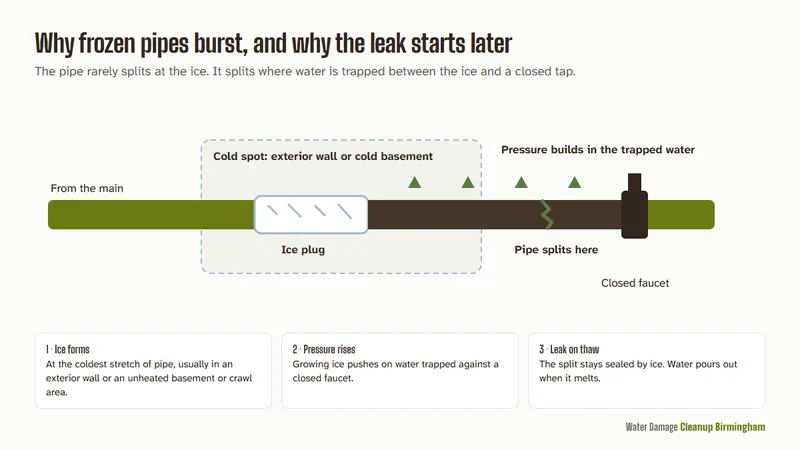
Find the main valve before you warm a frozen line, in case it has already cracked. Gentle heat from a hair dryer or heating pad is the Red Cross method; a torch or propane heater is not. The burst pipe page walks through what happens after the split.
Who runs Tuscaloosa water and sewer, and what if sewage backs up?
The city does. Wikipedia says Tuscaloosa owns its water and sewer utility, drawing on three lakes and about 720 miles of mains, with a customer base of nearly 200,000 across the metro area. Lake Tuscaloosa, formed by damming the North River, is the county's main drinking water source, per the Lake Tuscaloosa article.
A blocked or overloaded sewer line pushes waste back toward the house, and it comes out wherever the plumbing sits lowest, such as a shower on a slab or a ground-floor toilet. Sewage and rising river water both count as Category 3 under the IICRC S500 standard.
The EPA advises calling a professional experienced with contaminated water for that kind of damage. Keep children and pets out of the room and stop using sinks and toilets until a plumber clears the line.
For a break in the street, contact the city utility. The sewer backup cleanup page has the full steps.
Will insurance pay for river or storm water in a Tuscaloosa house?
The path the water took decides most of it. Wind damage that lets rain into the attic is normally handled under a homeowners policy. Water rising from the Black Warrior River or running across the ground is flood, which Triple-I says standard home and renters policies exclude.
Water from a split pipe in the house or a hole in the shingles is usually inside the policy, the NAIC explains, but seepage from the ground and rain running off a yard usually sit outside it. Backed-up sewers call for a separate endorsement. Per the FEMA NFIP manual, federal flood cover bought new starts after 30 days, with limited exceptions, so buy it well before a wet season.
Alabama Department of Insurance claim standards set the clock. Under Ala. Admin. Code r. 482-1-125-.06, an insurer has 15 days from notice of your claim to confirm it got it, unless it pays first. Rule 482-1-125-.07 says you must hear whether it is accepted or denied in 30 days after proofs of loss, or the policy's own period, with letters every 45 days if it needs longer.
The Alabama Department of Insurance takes complaints, and our Alabama claims guide covers photos, receipts and estimates.
What should you do first after water damage in Tuscaloosa?
Get people out of danger, cut off the water, and take pictures before anything is moved. Then start drying as early as you safely can. Treat water from the river, a flooded street or a sewer drain as contaminated, and keep bare hands and feet out of it.
- Stay away from water near outlets, cords or the breaker panel, and have an electrician check a panel that got wet.
- Shut the water off at the house main; for one failed toilet or washer, its own supply valve is enough.
- Keep off flooded roads near the river; Ready.gov notes that moving water at six inches can topple an adult.
- Photograph each room, the water line on the walls and any storm holes in the roof.
- Report the loss to your insurer or landlord and keep receipts for tarps, fans and rented equipment.
- Ask a restoration team for a written drying plan and an itemized estimate before work starts.
To keep mold from taking hold, the EPA asks that soaked drywall, pad and furniture be dried in 24 to 48 hours, and that indoor humidity stay below 60 percent. Triple-I suggests reasonable steps to stop more damage while holding big repairs until the adjuster sees the house.
Each restoration team chooses where it works, so ask whether your street is inside that area. The water removal page explains the pump-out stage.
Sources: Wikipedia on Tuscaloosa, Alabama (location, fall line, freezing days, wettest months, housing units and vacancy, enrollment, water and sewer utility, tornado winds), Tuscaloosa County, Alabama (renter share), Black Warrior River (locks and dams, Oliver Lock), Lake Tuscaloosa and the 2011 Tuscaloosa-Birmingham tornado (date, rating, path); National Weather Service gauges TODA1 and TCLA1 (flood categories, impacts and crests); American Red Cross on frozen pipes; IICRC S500; EPA mold cleanup and EPA mold and moisture guide; Triple-I on covered disasters and settling claims; NAIC homeowners insurance; FEMA NFIP manual; Alabama Department of Insurance claim standards, Ala. Admin. Code r. 482-1-125-.06 and 482-1-125-.07; Alabama Department of Insurance; Ready.gov floods.