The short version
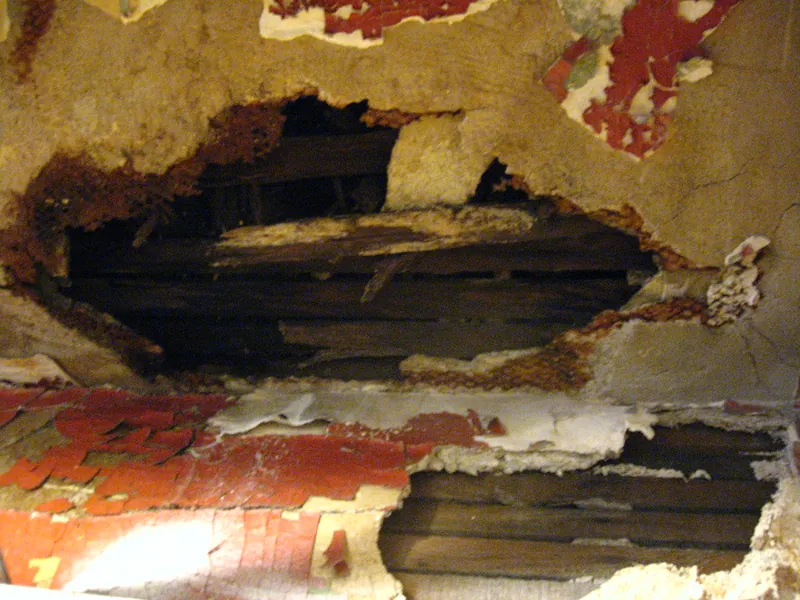
The Birmingham tornado record includes the 1977 Smithfield F5, the 1998 F5, the April 27, 2011 Tuscaloosa to Birmingham EF4 and the 2021 Fultondale EF3. Each opened roofs, windows and walls, and the rain that followed soaked ceilings and framing. Stay clear of downed lines, photograph the damage, cover openings, and get soaked rooms drying in the first 24 to 48 hours so mold has less chance to start.
What tornadoes have hit Birmingham?
Five tornadoes stand out in the record for the Birmingham area: an F4 in 1956, the Smithfield F5 on April 4, 1977, an F5 west of the city in 1998, the Tuscaloosa to Birmingham EF4 on April 27, 2011, and the Fultondale EF3 on January 25, 2021. Most crossed the same northern and western edge of Jefferson County.
The Wikipedia article on Birmingham places the city in the heart of Dixie Alley, a name for the stretch of Central Alabama where tornadoes come often. It says spring cold fronts bring strong storms and occasional tornadoes, and that November and early December form a second severe weather season.
| Date | Tornado | Rating | Places named in the record |
|---|---|---|---|
| 1956 | 1956 tornado | F4 | McDonald Chapel, Edgewater, northern Birmingham, Fultondale, Tarrant |
| Apr 4, 1977 | Smithfield tornado | F5 | Northern Jefferson County, Hayes Highland, Tarrant |
| 1998 | Oak Grove to Birmingham tornado | F5 | Rock Creek, Sylvan Springs, Edgewater, McDonald Chapel |
| Apr 27, 2011 | Tuscaloosa to Birmingham tornado | EF4 | Tuscaloosa, Holt, Concord, Pleasant Grove, Pratt City, Fultondale |
| Jan 25, 2021 | Fultondale tornado | EF3 | Fultondale, Center Point |
The 1956 and 1998 rows come from the 1977 outbreak article. Owners in those areas can read the North Birmingham and Center Point page and the Gardendale and Fultondale page.
This site is the local water damage restoration line and information resource for the Birmingham area. It does no roofing.
What happened in the 1977 Birmingham tornado?
On the afternoon of April 4, 1977, a violent tornado formed about 4 miles northwest of Birmingham near US 78 and moved northeast through northern Jefferson County. It reached F5 strength in Hayes Highland, near the I-65 and US 31 interchange, on streets named Smithfield, which gave the storm its name.
The outbreak article says hundreds of homes there were destroyed, many swept away even though they were well built. Ted Fujita surveyed the damage from an airplane, rated it F5 and at first thought about an F6. Daniel Payne College, near the touchdown point, closed for good after the damage.
What the 1977 storm showed about hillside houses
One line in that article matters for anyone who owns a house cut into a slope. Some homes built into hillsides had their cinder-block basement walls swept away. A basement wall that cracks or shifts in a lesser storm is an open door for the runoff that follows, because the uphill side of a hillside basement already holds back wet soil.
If your house sits on a slope, walk the lower level after any severe storm. Look for new cracks, damp block, water at the floor-wall joint and a sump pump that lost power. The basement flooding page covers how water finds those openings.
What happened in the Tuscaloosa Birmingham tornado in 2011?
On April 27, 2011, a high-end EF4 tornado touched down in Greene County at about 4:43 p.m., tore through Tuscaloosa, crossed the forests in between and reached the western and northern Birmingham suburbs around 6:00 p.m. The National Weather Service measured a path of 80.68 miles and a top width of 1.5 miles.
The article on the Tuscaloosa to Birmingham tornado puts the estimated top winds at 190 mph and says the tornado was on the ground for roughly an hour and a half. It caused about $2.4 billion in damage, the costliest tornado in Alabama history. Some survey teams argued for an EF5 rating, but the final rating stayed high-end EF4.
In Jefferson County the storm hit Concord, Pleasant Grove and McDonald Chapel, then Pratt City inside the city limits and Fultondale along I-65 and US 31. It weakened and lifted 2 miles north of Tarrant. The Fairfield and Pleasant Grove page and the Tuscaloosa page cover those communities.
Homes at the edge of the 2011 path
The article describes a four-sided brick home in McDonald Chapel that lost its roof while none of its outer walls fell. That is the kind of house most likely to need water work later: the frame still stands, but every rain after the storm pours straight into ceilings, insulation and floors.
The same April day produced other storms across the region. The 2011 Super Outbreak article describes a high-end EF4 that ran a 47-mile path through downtown Cullman, and an EF4 from the same supercell as the Birmingham storm that struck Shoal Creek Valley in St. Clair County. See the Cullman page and the Pell City and Moody page.
What happened in the 2021 Fultondale tornado?
Late on January 25, 2021, an EF3 tornado touched down at 11:40 p.m. and lifted at 11:55 p.m. after a 10.41-mile path through Fultondale and Center Point. It reached a width of 900 yards and winds estimated as high as 150 mph on Oak Street and New Castle Road, according to Wikipedia.
The Fultondale tornado article reads like a list of the ways a house opens to the weather. At its first touchdown it partly deroofed a home and stripped off its gutter. Farther along it shattered storefront windows, deroofed houses on Nelda Circle, collapsed a garage, and pushed garage doors inward and damaged porches near Sunhill Road.
It also tracked just north of the 2011 path, so some Fultondale owners rebuilt twice. The article says that two years later several destroyed homes on New Castle Road had not been replaced and rebuilding was still going on across the city.
Why a winter tornado is hard on a damaged house
A January storm leaves a damaged house exposed to cold rain, and sometimes to a freeze, for the weeks it takes to line up a roofer. Pipes in a wall that lost its sheathing, or in a crawl space with a torn vent cover, sit in outside air.
If heat is off because the power or gas is out, drain the lines or keep a trickle running where it is safe to do so. Water left standing in a split supply line can freeze, then leak again on the thaw. The burst pipe page explains what to check.
How does tornado damage turn into water damage inside a house?
Wind opens the building and rain does the rest. Lifted shingles, torn decking, broken windows, peeled siding, ripped gutters and punctures from limbs all let water in, often for days after the storm. A house that lost power also loses its sump pump, so a lower level can flood from groundwater too.
| Storm damage | Where the water goes | What to check | Related page |
|---|---|---|---|
| Missing shingles or decking | Attic insulation, then ceilings | Stains, sagging drywall, wet insulation | Storm roof leaks |
| Broken windows or doors | Sills, wall cavities, floors below | Swollen trim, cupped boards, wet carpet pad | Wet floors |
| Peeled siding or torn gutters | Sheathing, studs, the foundation edge | Damp drywall on outside walls, pooling at the base | Water behind siding |
| Power loss | Basement or crawl space through the sump pit | Pump running, pit level, wet floor-wall joint | Sump pump failure |
The IICRC S500 standard puts rising creek water and outside surface water in Category 3, its most contaminated class. Storm runoff that crosses the yard and pushes in through a basement wall falls in that group, so soaked carpet pad and drywall down there usually come out.
What should you do first after a tornado damages your roof?
Protect people before property, then slow the water. Ready.gov tells storm survivors to steer around downed lines and to put on sturdy shoes, gloves and long pants before cleanup. When the area is safe, record the damage, close the openings and start drying what got wet, ideally in the first 24 to 48 hours.
- Watch for lines and gas. The Ready.gov tornado page says to stay clear of downed power and utility lines and to follow local officials.
- Kill the circuits that feed soaked rooms, but only from a dry spot at the panel, and let an electrician decide when they go back on.
- Close the main water valve if a pipe broke, as the emergency water damage page explains.
- Photograph the roof, walls and every wet room before anything is moved. Triple-I says to keep damaged items until the adjuster sees them.
- Cover openings to stop more rain. According to Triple-I, an owner should limit further damage with sensible temporary fixes and leave big permanent repairs until the adjuster has inspected. Save every tarp and fan receipt.
- Report the loss to your insurer and log the claim number, dates and names.
- Start drying. The EPA says mold is far less likely if wet areas dry in the first 24 to 48 hours.
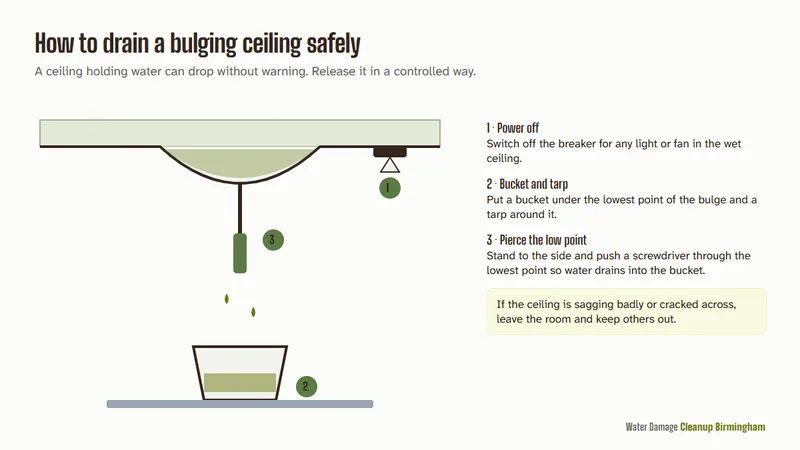
Ready.gov also says to use a mask when cleaning mold or debris. The ceiling water damage page explains what to do when the ceiling below a damaged roof starts to sag.
Does homeowners insurance cover tornado and rain damage in Alabama?
Rain that blows in through a storm opening is treated very differently from flood water. According to the NAIC, a roof leak is the sort of water damage a homeowners policy typically pays for, while ground water and rain runoff usually are not covered. Your own policy wording settles the details.
Triple-I says flood is excluded from a standard homeowners or renters form and is bought as a separate policy, while sewer backup is added through an endorsement. It adds that damage from lack of maintenance is not covered, so a roof that was already failing may be argued over.
Alabama sets claim timing in the Department of Insurance claim standards. Under Ala. Admin. Code r. 482-1-125-.06, an insurer acknowledges a claim in 15 days unless it pays in that time. Under 482-1-125-.07, after proofs of loss you are told whether the claim is accepted or denied in 30 days or the period the policy sets.
If the investigation needs more time, the insurer must say why and send updates every 45 days while it stays open. The insurance claims guide covers the paperwork, and the claim denied page covers what to do if the answer is no.
How long does a storm-soaked Birmingham house take to dry?
It depends on how long rain came in before the roof was covered and how much soaked into insulation, drywall and framing. A single wet ceiling may dry in days with fans and a dehumidifier. A house open to rain for a week often needs insulation and drywall removed so the framing can dry.
Birmingham has a humid subtropical climate with hot, humid summers, according to the city's Wikipedia article. Damp air slows evaporation, so dehumidifiers matter as much as fans. The EPA wants indoor relative humidity held below 60 percent and calls a reading from 30 to 50 percent ideal.
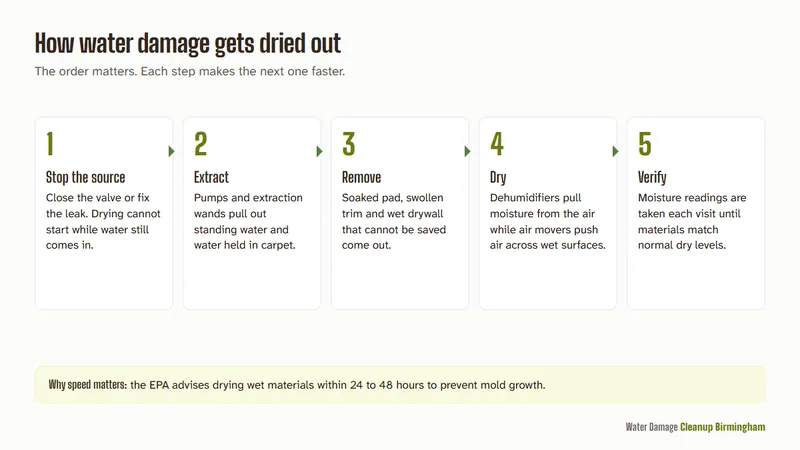
Ask whoever does the drying to take moisture readings at the start and on each visit, and to share them. Those readings show when it is safe to close walls and when to stop paying for equipment. The structural drying page explains the readings, and the mold after water damage guide helps if spots show up on drywall or framing.
Restoration teams differ in what they handle after a tornado. Some dry and remove damaged materials, some also rebuild, and many leave roofing to a roofer. Confirm the scope directly with the restoration team you reach before work begins.
Sources: Wikipedia, Birmingham, Alabama (Dixie Alley, spring and November to early December storm seasons, F5 tornadoes of 1977 and 1998, humid subtropical climate); Wikipedia, Tornado outbreak of April 4 to 5, 1977 (Smithfield F5 track, hillside basement walls, Daniel Payne College, 1956, 1998 and 2011 tornadoes); Wikipedia, 2011 Tuscaloosa to Birmingham tornado (touchdown time, 80.68-mile path, 1.5-mile width, 190 mph, $2.4 billion, McDonald Chapel brick home); Wikipedia, 2011 Super Outbreak (Cullman and Shoal Creek Valley tornadoes); Wikipedia, 2021 Fultondale tornado (times, 10.41-mile path, 900-yard width, 150 mph, roof, gutter, window and garage damage, rebuilding); Ready.gov, tornadoes (power lines, cleanup gear, masks); the IICRC S500 standard (Category 3 surface water); the EPA brief guide on mold and moisture (drying window and humidity band); NAIC, homeowners insurance (roof leaks versus runoff); Triple-I, which disasters are covered (flood, sewer backup, maintenance); Triple-I, settling insurance claims after a disaster (protect the property, photos, keep items, receipts); Ala. Admin. Code r. 482-1-125-.06 and 482-1-125-.07 (Alabama claim timelines).