The short version
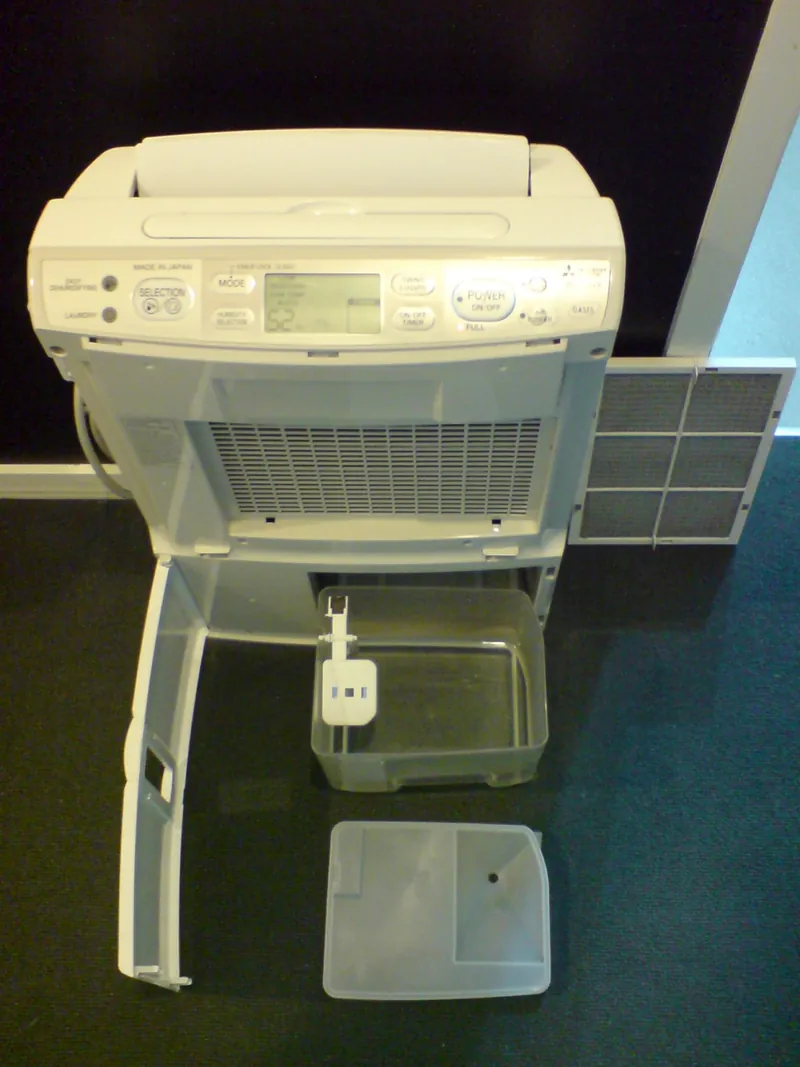
Structural drying in Birmingham pulls water out of framing, subfloor, plaster, drywall and concrete with dehumidifiers, air movers and repeated moisture readings. Sticky summer air slows evaporation, so the wet area is usually closed off and dehumidified. Per EPA mold guidance, soaked materials belong dry inside a 24 to 48 hour window, and walls should be closed only once readings match a dry reference.
When does a Birmingham house need structural drying?
Structural drying in Birmingham is needed once water has gone deeper than the surface: into studs, joists, subfloor, plaster, drywall, insulation or a concrete floor. Most leaks that ran for more than a few minutes, or dripped down to a lower level, reach that far. Towels and a mop never touch that hidden moisture.
Typical starting points around the metro include a washer hose that burst on a second floor, a water heater that let go in a garage, a sump pit that overflowed during a summer storm, or creek water that crossed a backyard and came under a basement door.
The restoration team you reach picks its own equipment and methods. What follows explains how drying usually works so the meter numbers and the plan make sense when you see them.
Why does Birmingham humidity slow down structural drying?
Evaporation needs air that can still hold more water. Wikipedia calls Birmingham's climate humid subtropical and says summers are hot with high humidity. On a muggy day the outside air is already close to full, so a soaked wall gives up its water slowly unless the room is sealed and run through a dehumidifier.
A breeze through open windows can help on a crisp, dry day in October, which the same article describes as a season with lower humidity than spring. In July, that same open window can feed damp air right back into the drywall.
That is why restoration teams usually build a closed drying chamber around the wet area, sometimes with plastic sheeting. Inside it, dehumidifiers keep the air dry enough to keep drawing water out of the framing. Your air conditioner, if the system was not flooded, also pulls some moisture as it runs.
Which parts of a house hold water the longest?
Thick, layered and touching materials hold water the longest. The bottom plate of a wall, the seams in subfloor panels, the wood under a tub or cabinet, and the joint between a basement slab and its wall can stay wet for days after the paint and carpet feel dry to your hand.
| Material | Where water tends to sit | A question for the restoration team |
|---|---|---|
| Drywall and batt insulation | Above the stain line and in insulation pressed against the board | How high up the wall are readings still elevated? |
| Older plaster walls | Behind the plaster, on the wood strips it was keyed to | Can this dry in place, or must a section be opened? |
| Subfloor, joists and sill | Panel edges, under vinyl or wood flooring, joist ends on the foundation | Will you take readings from below as well as above? |
| Slab and block walls | Block cores and the joint where floor meets wall | How will you track the concrete from visit to visit? |
These are common patterns, not a diagnosis of your home, and testing methods vary by restoration team. Mention plaster walls or a finished basement on the first call so the plan accounts for them. The wet drywall page covers wallboard in more detail, and the ceiling water damage page covers leaks from above.
What can you do for a wet room before help arrives?
Shut off the water, get standing water off the floor, and lift soft things up and away. Those steps stop the soaked area from growing. Leave walls, flooring and built-ins where they are unless they are unsafe, because a restoration team needs to measure the damage before deciding what comes out.
- Turn off the fixture stop under the leak, and use the house main when no closer valve works. Our emergency water damage page lists the first moves in order.
- Kill power to wet rooms at the panel only when the panel and the floor in front of it are both dry. If either is wet, leave it for an electrician.
- Soak up pooled water with a wet vacuum, mop or old towels, and dump the vacuum outside.
- Set furniture legs on foil or scraps of wood and pull area rugs off wet floors so dyes do not bleed.
- Photograph everything, including the high water mark, before anything is moved.
Running the air conditioner helps if it was not exposed to the water. The water removal page explains how pooled water gets taken out before drying begins.
How do air movers and dehumidifiers work as a pair?
Air movers push air across wet surfaces so water evaporates faster, and dehumidifiers trap that water and pump it to a drain or tank. Either one alone falls short. Fans by themselves just make the room more humid, and a dehumidifier in still air leaves wet surfaces sitting untouched.
Where the machines go matters as much as how many there are. Air movers are often aimed low along walls, under cabinet toe kicks, or into a wall cavity through small drilled holes. Carpet may be lifted at one corner so air can move under it.
The equipment runs warm and loud, and it is meant to run without breaks. Ask the restoration team before unplugging anything, since a few hours off can let the room air turn damp again. The water mitigation page explains the steps that come before this stage.
How are hillside basements and crawl spaces dried?
Slowly, because soil, block and concrete keep feeding moisture back into the space. A basement cut into a slope has earth pressed against one or more walls, so drying it only lasts if the path the water took is closed too. Crawl spaces add tight access and joists close to damp ground.
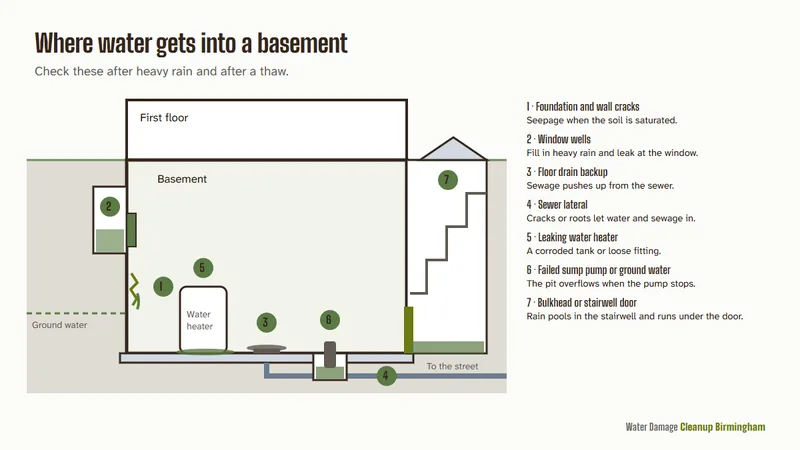
The ridges that frame the city are part of the picture. Wikipedia says Mountain Brook was laid out in 1929 along Red Mountain and Shades Mountain with estate-sized lots on winding roads, and that Homewood drew buyers over Red Mountain starting in 1926. If your house steps down a hillside, tell the restoration team which walls are below grade.
In a finished lower level, the first call is usually what gets removed so air reaches framing and block: wet pad, the bottom of the drywall, soaked insulation. In a crawl space, a restoration team may lay a vapor barrier and run a dehumidifier there. See basement flooding in Birmingham and sump pump failure for the causes.
What readings prove the framing and subfloor are dry?
Readings that match a dry reference are the only real proof. A restoration team first measures the same kind of material in a room the water never touched, then retests marked points in the wet area on each visit. When the wet points read like the reference, that material is dry and the walls can close.
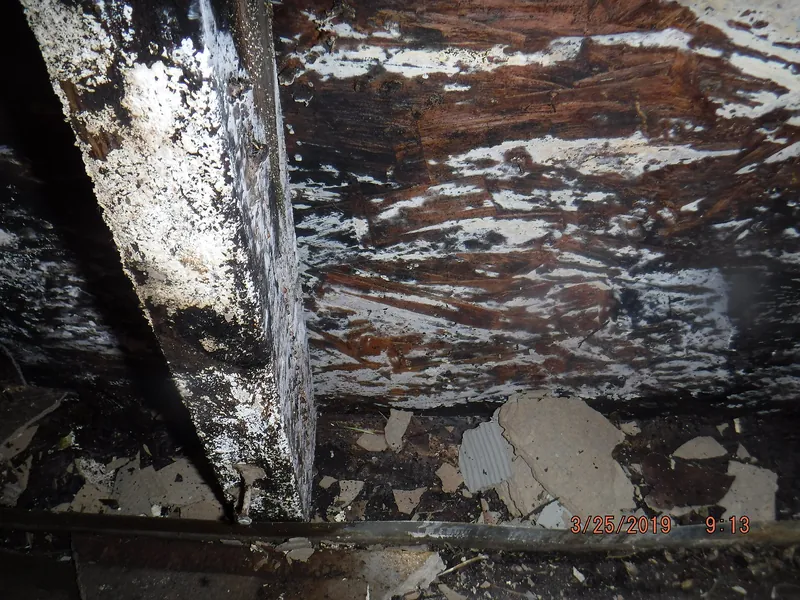

Ask for the moisture log at every visit. A useful log shows the date, the location, the material and the number, so you can watch the readings drop.
Hold on to that log after the equipment leaves. If a soft spot, odor or stain shows up months later, it records what the framing read when it was closed in. Warped boards are covered on our water damaged floors page.
How long does structural drying take in a Birmingham home?
No honest answer comes without testing first. The clock is set by the soak time, the materials involved, the indoor humidity and whether the source is truly fixed. A quick catch on drywall dries far sooner than a basement where water stood for a day before anyone noticed.
Things that tend to stretch a job include plaster on wood lath, hardwood laid over plank subfloor, layers of old flooring, block walls, a crawl space with a dirt floor, and humid summer weather.
Things that tend to shorten it include a fast start, removing wet pad and baseboards early so air can reach the wall, and leaving the equipment running untouched. If a restoration team names a number of days before taking a single reading, ask what it is based on.
Can a hard freeze leave hidden water inside Birmingham walls?
Yes, and it often shows up late. Wikipedia counts an average of 47 days a year in Birmingham with a low at or below freezing. A pipe in an exterior wall, attic or crawl space can split while frozen and leak only once the ice melts, sometimes after water has soaked the cavity for hours.
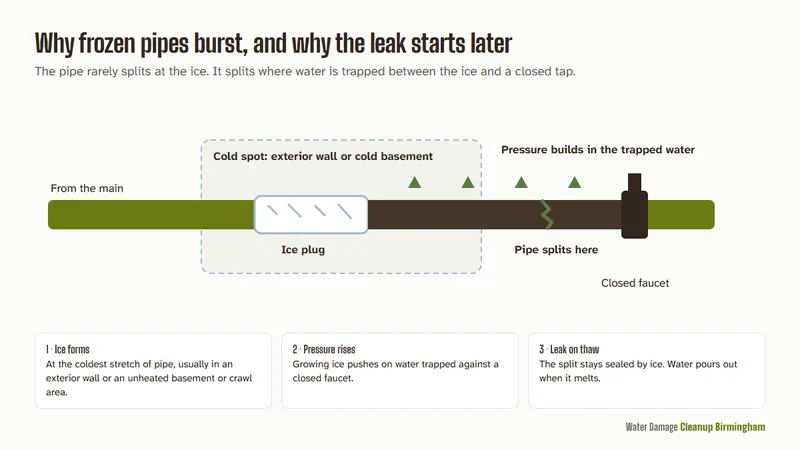
Wall cavities like that need drying from the inside, often through a small opening or a section of removed drywall. The American Red Cross lists pipes in crawl spaces, attics, garages, basements and kitchen cabinets as the most exposed, and its advice for a cold trip away is a thermostat set to 55 F or warmer. The burst pipe page has more.
How much does structural drying cost?
There is no Birmingham price survey we can point to, so national numbers are the closest guide. Fixr's January 31, 2025 cost page shows most restoration work landing from $1,200 to $5,000 and a $3,000 average across the country. Drying is one part of that total, and the materials involved change the math.
| Material | Fixr per square foot | Why it varies |
|---|---|---|
| Drywall | $1.50 to $3 | Cheap enough that cutting out the wet strip often beats drying it |
| Carpet | $4.75 to $10.50 | Whether the pad and tack strip must be replaced |
| Plaster on lath | $6.25 to $18.75 | Thick walls dry slowly and patches take skilled hands |
| Hardwood | $10 to $15 | Boards can cup or crown while drying |
Use these figures for background only; they are not what a restoration team near you will charge. Fixr also lists flat ranges by damage class, from $150 to $400 for the smallest Class 1 losses up to $1,000 to $3,000 for Class 3. The water damage restoration cost guide goes into the details.
Does Alabama homeowners insurance cover structural drying?
Usually, if the water came from a covered cause. The NAIC says damage from home plumbing or a roof leak is typically covered, but not ground water, rain runoff or snowmelt. Drying a house after a sudden pipe break is the kind of protective work an insurer generally expects to see done.
Long-term seepage is a different matter. Triple-I reminds owners that upkeep is their responsibility, and that wear, neglect, mold and pests fall outside a standard policy. A drip that seeped behind a shower wall for months may be handled differently from a sudden burst line. Flood and sewer backup need their own coverage.
Alabama's rule, Ala. Admin. Code r. 482-1-125, gives the insurer 15 days to acknowledge a claim. If it needs more time after proofs of loss, it must say why, then write again every 45 days while the investigation stays open. Keep the drying log for the adjuster, and see the insurance claims guide and the mold after water damage guide.
Sources: Wikipedia, Birmingham, Alabama (humid subtropical climate, October humidity, freezing days); Wikipedia, Mountain Brook (1929 layout on Red and Shades mountains); Wikipedia, Homewood (1926 development over Red Mountain); American Red Cross on pipes at risk and the 55 F setting; Fixr cost guide, January 31, 2025 update (per-material and damage class ranges); NAIC consumer guide to homeowners coverage; Triple-I on maintenance, mold and pest exclusions; Ala. Admin. Code r. 482-1-125-.06 (acknowledgment); Ala. Admin. Code r. 482-1-125-.07 (status letters, 45-day updates); EPA brief guide on mold and moisture (drying window, humidity range).