At a glance
The most common signs of water damage in a Birmingham house are a ceiling stain that grows after storms, damp basement or crawl space walls after heavy rain, bubbling paint, cupped floors, a musty room, and a water meter that moves with every tap off. A spot that feels cool, damp or keeps spreading means the leak is still active.
What early signs of water damage should you look for?
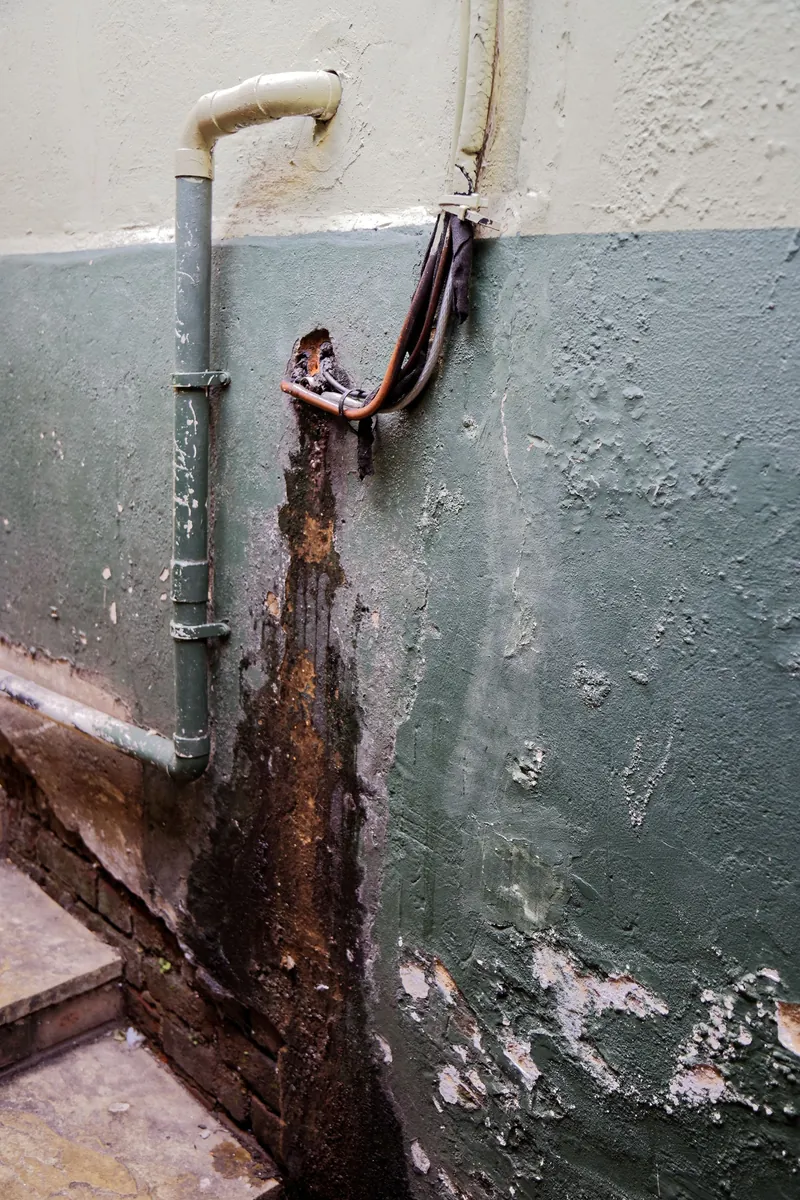
The earliest signs of water damage are usually small: paint that blisters, a baseboard that swells or pulls away, a tan ring overhead, grout that stays dark, or a closet that smells like a damp towel. Any one of them can show up weeks before you see a drip or a puddle.
What matters most is change. A mark that grows between Sunday and Wednesday, a soft spot that was firm last month, or caulk that keeps splitting at the tub edge means water is still reaching that spot. Press the area with the back of your hand; cool or damp usually means an active leak.
Some wet surfaces are not leaks. The EPA moisture control page explains that cooler air holds less moisture, so water beads on cold window glass; heavy condensation there points to humidity running too high indoors rather than a broken pipe.
What does a water stain on the ceiling usually mean?
A ring with a darker edge means water reached the drywall or plaster from above, dried, and left minerals behind. Under a bathroom, suspect a toilet seal, a shower pan or a supply line. On a top floor near an outside wall or a chimney, the roof, flashing or a vent boot is the usual source.
Timing narrows it down. A stain that grows after thunderstorms points to the roof, and Wikipedia's Birmingham article notes that spring cold fronts bring strong to severe thunderstorms and that November and early December form a secondary severe weather season. A stain that grows after showers points to the bathroom above.
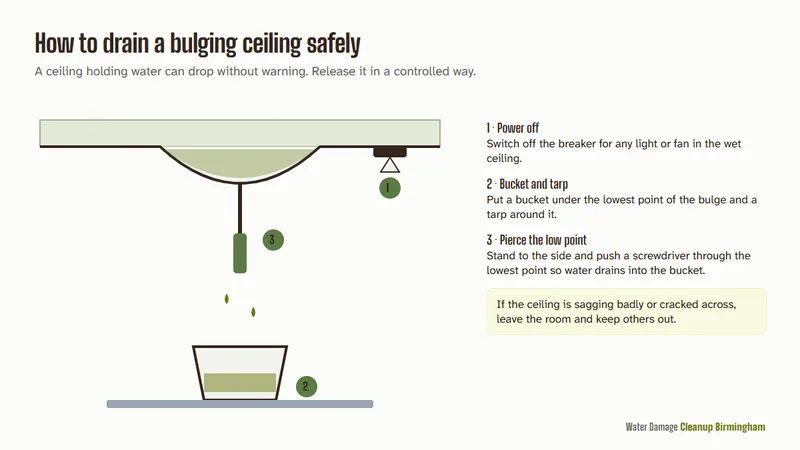
Keep everyone out from under a ceiling that sags or bulges. The ceiling water damage page covers repairs, and storm roof leaks covers stains that follow wind and hail.
How can you tell water is getting into a basement or crawl space?
Look low after a heavy rain. Dark patches on block or poured walls, a wet line where the floor meets the wall, puddles near the floor drain or sump pit, white mineral crust on masonry, and paneling that bows are all signs. In a crawl space, look for standing water, sagging insulation and wet soil.
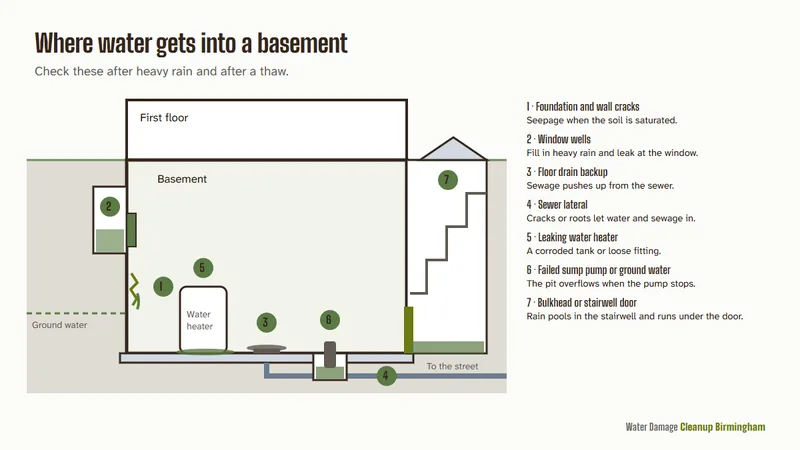
On a hillside lot, the uphill wall usually takes runoff first. The EPA links basement water to missing gutters and to ground that slopes toward the house, and it suggests a plastic cover over dirt crawl space floors to keep ground moisture out.
Water that rises out of the floor drain during a downpour is a sewer backup and should be treated as contaminated. The basement flooding, sump pump failure and sewer backup cleanup pages cover each case.
What do water-damaged walls and floors look like?
Walls show bubbled or peeling paint, soft drywall that dents under a thumb, brown streaks below windows, and baseboards that swell or split. Floors show cupped or crowned hardwood boards, laminate with lifted seams, loose tile, and carpet that stays cold or damp along one wall. The table pairs each sign with a likely cause.
| What you notice | Common cause | What to check next |
|---|---|---|
| Paint bubbles low on a wall behind a sink or tub | Drain or supply leak inside the wall | Open the cabinet and look at the shutoff valves and trap |
| Streaks below a window after wind-driven rain | Failed window flashing or caulk | Check the sill and the siding above it |
| Hardwood boards cupping near the kitchen | Dishwasher or fridge line leak | Pull the kick plate and look underneath |
| Floor soft or spongy beside the toilet | Wax ring or supply line leak | Look at the subfloor from below if you can |
| Carpet damp along an outside basement wall | Water seeping through the foundation | Check gutters and grading outside that wall |
| Baseboard swollen near the water heater | Tank, valve or fitting leak | Look at the top fittings and the relief valve line |
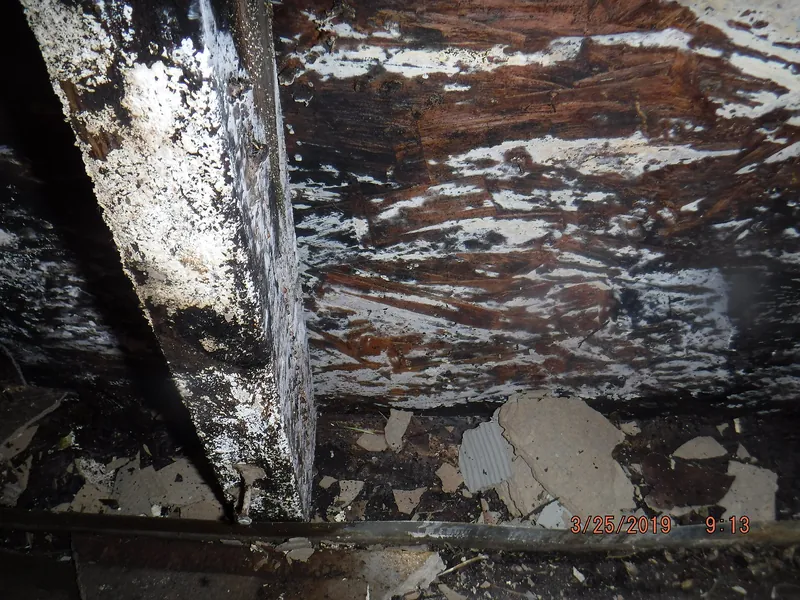

For the repair side, see wet drywall, water-damaged floors and wet carpet.
How do you know a pipe burst after a Birmingham freeze?
Look for low or no water pressure while it is still cold, frost on an exposed pipe, then a hiss, a spreading wet spot or a sudden puddle once temperatures climb. A pipe usually splits while frozen and leaks when the ice melts. Wikipedia's Birmingham article counts 47 days a year, on average, with a low at or below freezing.
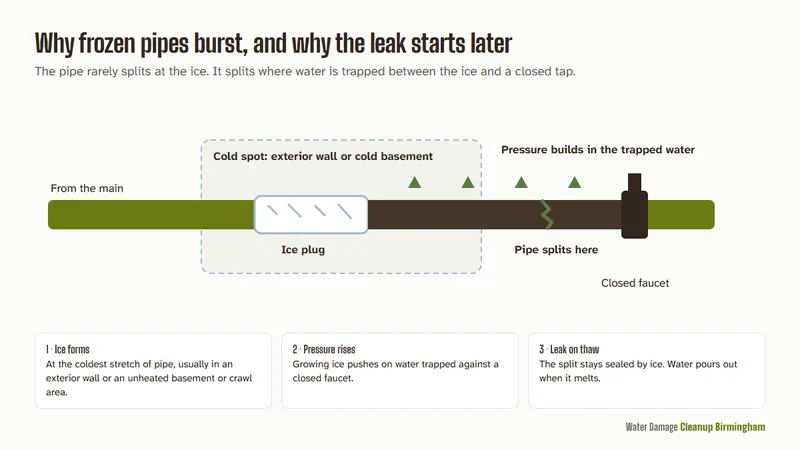
The American Red Cross names supply pipes in crawl spaces, basements, attics, garages and kitchen cabinets as the ones most at risk. Check those spots first after a cold night, and look at walls that back onto a garage or porch.
If a faucet only trickles, thaw the line gently with warm towels, a heating pad or a hair dryer, as the Red Cross describes; it rules out blowtorches and any other open flame. The burst pipe water damage page covers the cleanup.
How do you find a hidden leak with your water meter?
Turn off every faucet, appliance and irrigation line, read the meter, wait two hours without using any water, and read it again. EPA WaterSense treats any movement on the dial as a likely leak. No other check this cheap finds water you cannot see.
- Find the meter near the curb or property line and note the reading or take a photo.
- Leave all water off for two hours, including the ice maker, washer and sprinklers.
- Read it again. Any change means water is going somewhere.
- Test the toilets. Put food coloring in each tank and wait 10 minutes, as WaterSense describes. Dye that reaches the bowl means a leaking flapper; flush afterward.
- Close the house shutoff valve and repeat. If the meter still moves, the leak is likely in the service line between the meter and the house.
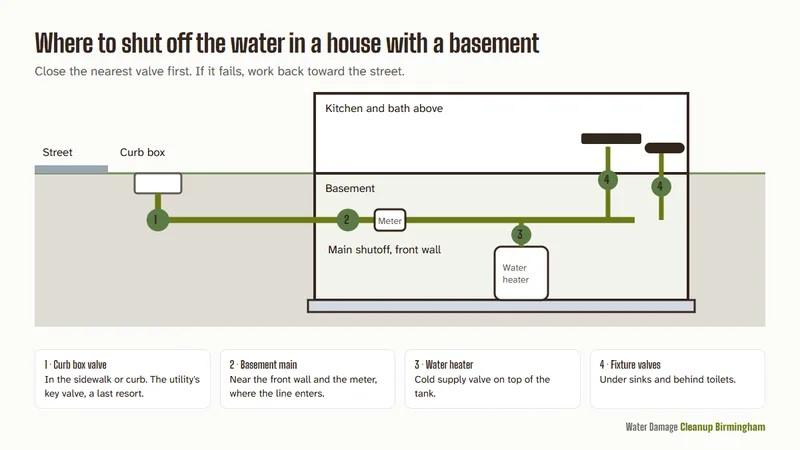
WaterSense also suggests looking at a cold month: when a household of four uses more than 12,000 gallons in a January or February, serious leaks are possible. If a leak ran up a bill, the utility leak adjustment page explains what to ask the water restoration team.
Which fixtures and appliances leak most often?
WaterSense names worn toilet flappers, dripping faucets and other leaking valves as the most common household leaks. For water damage, the bigger risks are hoses and lines that fail under pressure: washer hoses, dishwasher supply lines, refrigerator ice maker lines, water heaters, and the seals around tubs and showers.
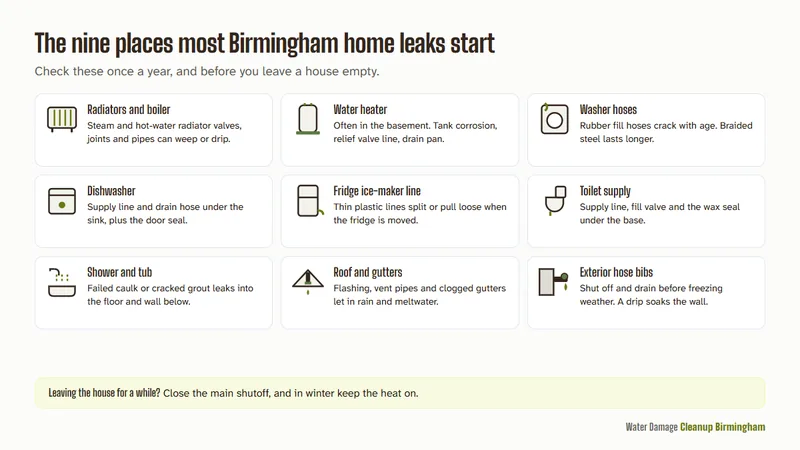
Leaks in a typical home waste upward of 9,300 gallons over a year, per WaterSense. A regular walk-through catches the quiet ones: a damp cabinet floor, rust on a water heater fitting, or a stain under the fridge.
See appliance leak water damage, water heater leaks and bathroom and kitchen leaks for what to do once you find one.
What does a musty smell in one room tell you?
It usually means something in that room has stayed damp long enough for mold or mildew to start, even if nothing shows. Common sources are the back of a closet on an outside wall, under a sink, behind a washer, or a carpet pad that soaked up a spill. Follow your nose to the strongest spot.
Humid Birmingham summers make this worse. Wikipedia's Birmingham article describes hot summers with high humidity, and the EPA brief guide says a home should sit below 60 percent relative humidity, and ideally in the 30 to 50 percent band. Set a small humidity gauge in the musty room and compare it with the rest of the house.
Soaked materials left wet beyond 24 to 48 hours give mold its opening, per the EPA. The water damage smell guide and the guide to mold after water damage go deeper.
What should you check after a storm or creek flood in Birmingham?
Walk the outside first: missing shingles, lifted flashing, broken windows, dented gutters, and siding that pulled loose. Then check inside under each of those spots for new stains, damp insulation in the attic and wet carpet along outside walls. Photograph everything before any repairs for an insurance claim.
Creek water rises fast here. The National Weather Service gauge on Valley Creek at Center Street sets minor flood stage at 11 feet and recorded a crest of 12.89 feet on September 15, 2024. Stay out of moving water: Ready.gov says a depth of six inches is enough to knock you off your feet.
Water from a creek or overland flow is Category 3, grossly contaminated, under the IICRC S500 standard. Look for a water line on walls, mud on floors and wet drywall above the carpet. The Birmingham flooding and tornado history pages explain local storm and flood patterns.
Which signs mean you should get help right away?
Call for help when water is still flowing and you cannot stop it, when a ceiling sags, when water touches outlets or the panel, when sewage or creek water is involved, or when more than one room is wet. A plumber stops a leak; a restoration team handles extraction and drying.
- Shut off the water at the fixture valve or the main.
- Kill the breaker for wet rooms, but only if the panel is somewhere dry.
- Photograph the damage and the source before you move anything.
- Remove standing water and run fans if the water was clean and the area is safe.
- Call a plumber for the leak, and a restoration team if walls, floors or the basement are soaked.
The emergency water damage page covers the first visit, and home inspection and water damage explains what inspectors look for when buying.
Sources: EPA moisture control page (condensation, gutters, grading, crawl spaces); EPA WaterSense Fix a Leak Week (meter test, toilet dye test, winter use, household leak volume); EPA mold and moisture brief guide (drying window, humidity targets); American Red Cross, frozen pipes; NWS, Valley Creek at Center Street; Ready.gov, floods; IICRC S500 (Category 3 water); Wikipedia, Birmingham, Alabama (climate, severe weather, freeze days).