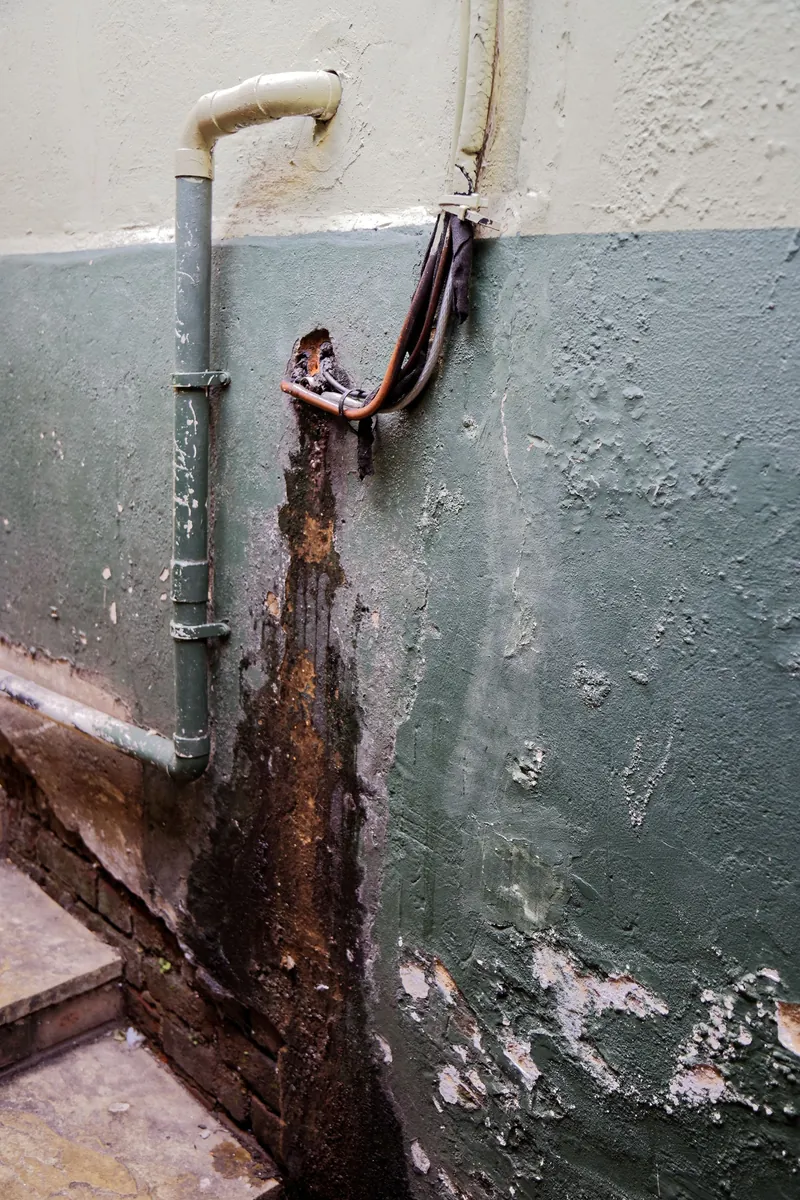
For Haleyville, Double Springs and Winston County
For water damage restoration in Haleyville, AL, Double Springs or elsewhere in Winston County, shut the water off, keep away from wet outlets and photograph each room. Wet materials need drying in the first 24 to 48 hours, the EPA advises, and Sipsey Fork or lake water calls for a flood policy. ZIPs: 35540, 35541, 35551, 35553, 35565, 35572, 35575, 35577.
Which Haleyville and Double Springs addresses do you take requests from?
Eight ZIP codes cover requests for water damage restoration in Haleyville, AL, Double Springs and the rest of Winston County: 35540 Addison, 35541 Arley, 35551 Delmar, 35553 Double Springs, 35565 Haleyville, 35572 Houston, 35575 Lynn and 35577 Natural Bridge. Delmar's 35551 serves post office boxes only, so give the road address of the building that got wet.
Haleyville is the only city in the county, and a sliver of its western limits reaches into Marion County, the Haleyville article on Wikipedia notes. It had 4,361 residents in the 2020 census. Double Springs, the county seat 19 miles to the southeast, had 1,119, and the Winston County article puts the whole county at 23,540.
South over the county line, the Jasper and Fayette page covers Walker County. Cullman County borders Winston on the east, and the Cullman page takes it from there. Closer to Birmingham on I-65, see the Gardendale and Fultondale page, or check any code on the ZIP code list.
Does the Sipsey Fork flood near Double Springs?
Yes, and it can climb far past its banks. The National Weather Service gauge on the Sipsey Fork near Grayson, in Winston County, marks bankfull at 16 feet and minor flooding at 24 feet. Its highest listed crest is 44.27 feet, set on March 16, 1973, which the NWS calls the flood of record.
| Sipsey Fork near Grayson | NWS category | What the NWS lists at that stage |
|---|---|---|
| 16 ft | Action | River is bankfull and spills over along some stretches |
| 24 ft | Minor flood | The lower parking lot at the gauge site starts to go under; cars there are likely to be damaged |
| 38 ft | Above minor | Water reaches the footbridge and the road bridge over the river |
| 45 ft | Above minor | Water nears the stairs of the upper parking lot |
Big rises on the GRAA1 gauge tend to come in the cool months. After the 1973 record, its list shows 41.81 feet on December 25, 2015, 38.29 feet on December 18, 1967 and 36.78 feet on January 23, 1999. The NWS sets no moderate or major category for this site.
How does the Bankhead forest feed the river?
The Sipsey Fork is Alabama's only National Wild and Scenic River, and it runs through the Bankhead National Forest, which wraps around Double Springs. Wikipedia calls the forest the land of a thousand waterfalls, with swift streams and limestone bluffs. Steep, rocky ground like that sends rain into the channels quickly.
If a creek or river reaches your floor, treat it as Category 3 water under the IICRC S500 standard. Do not drive through it, either. A car can be swept off by one foot of moving water, according to Ready.gov. The flood cleanup page explains what comes out after that kind of water.
Why does rain run toward houses on Haleyville's hills?
Because the town sits on a ridge where the ground drops away in several directions. Haleyville lies on the Tennessee Valley Divide in the Appalachian foothills, and Wikipedia describes its sand-and-clay soil as very sensitive to water. That is why the area is cut by so many creeks and small valleys, and why runoff moves fast.
The divide splits the city three ways. The north half drains toward the Tennessee River, the southwest quarter toward the Tombigbee and the southeast quarter toward the Black Warrior, so two houses a short drive apart can shed water to different river systems.
On a sloped lot, the wall facing uphill takes the runoff. Walk the yard in a hard rain and watch where water collects against the foundation. Downspouts that dump next to the house, soil that slopes back toward it and crawl space vents set low in the wall are the usual entry points.
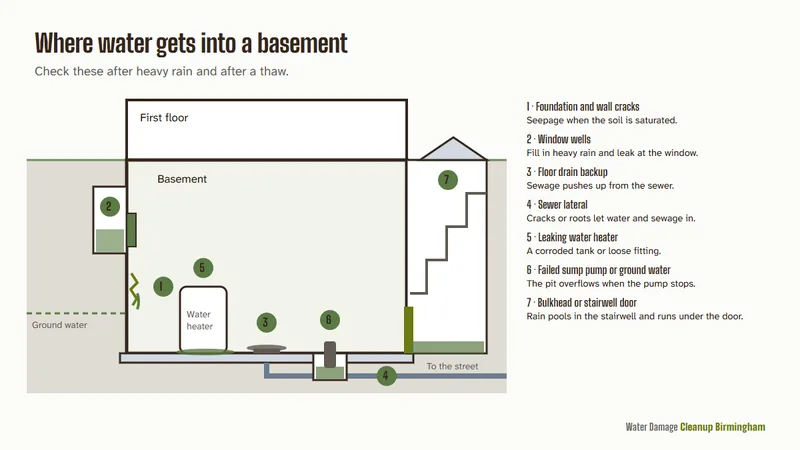
If your house has a basement or a dug-out lower level, the basement flooding page covers drains, cracks and grading. A pump that quits in a storm is its own problem, covered on the sump pump failure page.
Why do empty houses in Winston County leak the longest?
Because nobody is there to hear the drip. At the 2020 census, 24.4 percent of Winston County's 13,015 housing units stood vacant, the county article says. Haleyville's rate was 13.8 percent of 2,098 units, and Double Springs' was 13.4 percent of 494. A split line in an empty house can run for days.
Older owners are a big part of these towns. Wikipedia counts 25.3 percent of Double Springs residents and 21.0 percent of Haleyville residents at 65 or older. If you look after a parent's house or a family place that sits empty, set up a regular visit and learn where the main valve is.
A slow leak under a floor rots wood from below long before the surface shows it. Check the crawl space after any plumbing repair, and look for soft spots near the tub, toilet and kitchen sink.
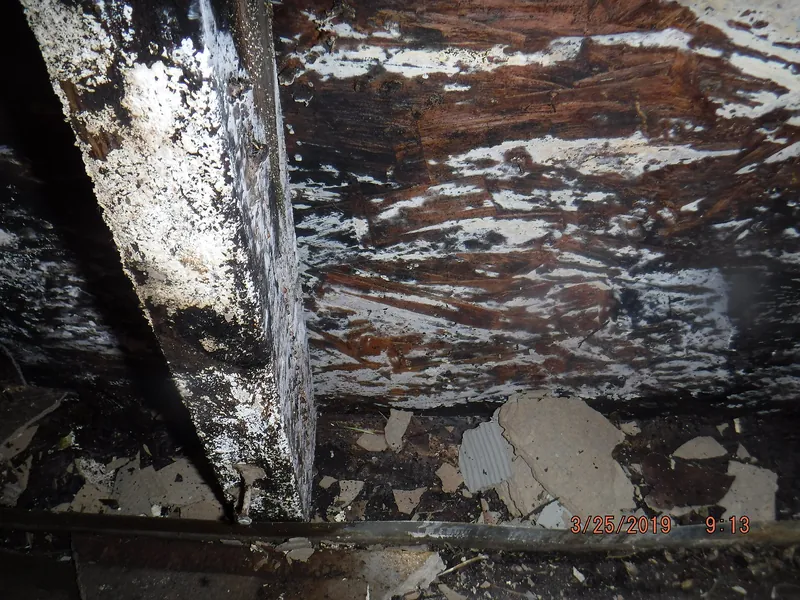

For drips you can see, the bathroom and kitchen leak page lists what to check first. Floors that have already cupped or gone soft are covered on the water-damaged floors page.
What should Smith Lake owners near Arley and Addison check in winter?
Check the heat, the supply lines and the water heater before you leave a lake house for the season. Lewis Smith Lake is the deepest lake in Alabama, with over 500 miles of shoreline, and Addison, Arley and Double Springs are among the Winston County towns near it, per the Lewis Smith Lake article.
Wikipedia says the lake stayed fairly undeveloped for its first two decades, then saw rapid growth in recreation during the 1980s and 1990s because it is close to Birmingham and Huntsville. If yours is a weekend place that sits closed for weeks at a time, the plumbing needs a plan before cold weather.
Freeze risk is highest for supply lines running through crawl spaces, attics, garages and kitchen cabinets, by the American Red Cross count. Leaving for a cold spell? Set the thermostat to 55 F or warmer and hold it there around the clock, the Red Cross says. For an iced line, it suggests a hair dryer, a heating pad or towels dipped in hot water, and it rules out torches and every other open flame.
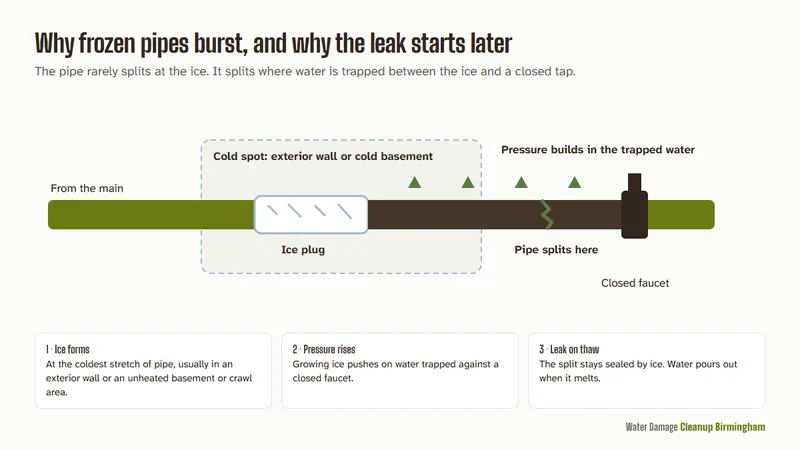
Water already spraying from a cracked line? The burst pipe page walks through what to do next. The prevention guide lists steps for closing up a house you will not see for a while.
Will insurance pay for Sipsey Fork, lake or pipe water in Winston County?
That depends on where the water came from. The NAIC explains that water from a failed pipe or a roof leak is the kind a home policy normally pays for, while ground water and rain runoff fall outside it. Triple-I adds that flood is excluded from standard homeowners and renters policies.
Water from the Sipsey Fork, a creek or a rising lake is covered only by a stand-alone flood policy, and a sewer that backs up into the house calls for an add-on endorsement. The FEMA flood insurance manual sets a 30-day waiting period on a new NFIP policy, with limited exceptions, so the time to buy is long before the winter rains arrive.
Once you report a claim, Alabama Department of Insurance claim standards under Ala. Admin. Code r. 482-1-125 give the insurer 15 days to acknowledge it, unless it pays first (rule .06). Within 30 days after proofs of loss, or the period the policy sets, you must be told whether the claim is accepted or denied (rule .07).
If the insurer needs more time, it must say why and then write every 45 days while the investigation stays open. The Alabama Department of Insurance takes complaints when a claim stalls. Read the insurance claims guide before you file, and the denied claim page if the answer is no.
What should you do first after water gets into a Haleyville home?
Stop the flow at the valve, keep away from anything electrical that got wet, and take pictures before you move or toss anything. Drying comes next. Mold can take hold if soaked materials stay wet past the first 24 to 48 hours, the EPA says, and it wants indoor humidity under 60 percent, ideally between 30 and 50.
- Turn the main valve off, or just the valve feeding the fixture or appliance that failed.
- Keep your hands off the breaker panel if the floor in front of it is under water.
- Stay home if the Sipsey Fork or a creek covers the road. Per Ready.gov, a current just six inches deep is enough to knock someone over.
- Take photos of each wet room, and set ruined belongings aside for the adjuster instead of hauling them off.
- Call in the claim, notify a landlord in writing if you rent, and file away receipts for anything you buy, like fans, tarps or a pump.
- Get written bids, each with materials and prices broken out item by item.
What should wait until the adjuster visits?
Triple-I suggests guarding the house against more harm, such as a tarp over a hole, while saving big, lasting repairs for after the adjuster's inspection. Winston County is spread out, so confirm the restoration team you reach serves your road. To see how the work is done, read about water removal and structural drying, and use the guide to choosing a company for questions to ask.
Sources: Wikipedia on Haleyville, Alabama (2020 census, Marion County portion, Tennessee Valley Divide, soil, 1968 9-1-1 system), Double Springs, Alabama (county seat, 2020 census, Bankhead National Forest), Winston County, Alabama (2020 census, housing vacancy, adjacent counties, towns), William B. Bankhead National Forest (Sipsey Fork, terrain) and Lewis Smith Lake (depth, shoreline, nearby towns, growth); NWS gauge GRAA1, Sipsey Fork near Grayson (action and flood stages, impacts, crests); IICRC S500 water categories; Ready.gov on floods; American Red Cross on frozen pipes; NAIC consumer page on home policies; Triple-I disaster coverage article (flood exclusion, sewer endorsement); FEMA NFIP Flood Insurance Manual, April 2024 (30-day wait); Alabama Department of Insurance claim standards, Ala. Admin. Code r. 482-1-125 (.06, .07); Alabama Department of Insurance; EPA mold and moisture guide; Triple-I, settling claims.