The short version
With storm damage in Birmingham, AL, wait out the warning, check each wet room for a sagging ceiling or soaked wiring, catch the drips and photograph it all. A roofer, tree crew or glass shop seals the house; a restoration team dries what got wet. Yard or creek water in a lower level is Category 3, and the EPA target for drying is 24 to 48 hours.
A storm opened my roof and rain is coming through. What comes first?
Stay sheltered until the warning expires, then deal with people, power and water in that order. For storm damage in Birmingham, AL, that means checking each wet room from the hallway, cutting power to soaked circuits from a dry spot, catching the drips and photographing everything before you move it or throw it out.
- Wait for the all clear. Ready.gov tells people under a tornado warning to keep away from windows, doors and outside walls, so leave the leak alone until the storm has moved on.
- Look before you step in. From the doorway, watch for a ceiling hanging low, water near outlets or light fixtures, glass on the floor and any gas odor.
- Shut off soaked circuits. Flip the breakers that serve wet rooms, but only while you stand on dry ground at the panel.
- Collect the water. Put buckets, coolers or storage bins under each drip and pull rugs and bedding out of the wet zone.
- Make a photo record. Shoot the outside of the house, limbs on the roof, broken panes and every wet ceiling, wall and floor inside.
- Close the opening, then dry. A roofer, tree crew or glass shop seals the house; a restoration team deals with the water that already got in.
Our parent page on emergency water damage restoration in Birmingham walks through what a first visit after storm damage usually covers. Ready.gov also says to keep well clear of downed power lines and broken utility lines once you go outside.
How often do severe storms hit the Birmingham area?
Often, and in more than one season. The Wikipedia article on Birmingham says cold fronts in spring and fall often bring strong to severe thunderstorms and occasional tornadoes, and it names November and early December as a secondary severe weather season. Summer storms tend to arrive in the afternoon or evening.
The same article places Birmingham in the heart of Dixie Alley, a name used for the high rate of tornadoes in Central Alabama. It adds that tropical storms and hurricanes occasionally reach the city in late summer and fall because of its distance from the Central Gulf Coast.
Ready.gov lists damaging winds, tornadoes, large hail and flash flooding among the hazards thunderstorms bring. Its tornado guidance says the Southeast and the Midwest face a higher tornado risk than other parts of the country.
For a single storm, that can mean shingles lost in the first gusts and hours of heavy rain afterward. The Birmingham flooding page covers the separate problem of creeks and streets overflowing in the same weather.
What do past Birmingham tornadoes show about rain getting inside?
They show that the wind damage is only the first half of the loss. A house with its roof peeled back, windows broken or siding torn away is open to every shower that follows. Even the weakest damage in a tornado path can leave a roof partly uncovered, and the rain finds that gap before any repair crew arrives.
The Birmingham article notes two F5 tornadoes in the greater metro, one through the northern suburbs in 1977 and one through the western suburbs in 1998, plus an EF4 that was part of the April 2011 outbreak. The full story of those storms is on the Birmingham tornado history page.
A more recent example shows the water side clearly. The article on the 2021 Fultondale tornado says it struck Fultondale and Center Point late on January 25, 2021, and that even its first EF0 damage partly deroofed a home and stripped off its gutter. Further along the path, it shattered storefront windows and deroofed homes.
Owners in Gardendale and Fultondale or North Birmingham and Center Point can read more about their own areas on those pages.
Where does wind-driven rain get into a house besides the shingles?
Through any part of the outer shell that a gust, hailstone or limb has broken. Lost shingles get noticed first, but rain also pushes past lifted flashing, popped vent boots, cracked window glass, torn siding and gutters that overflow behind the fascia. Each route soaks a different part of the house and calls for a different trade to close it.
| What the storm broke | Where the water shows up inside | Move or cover first | Trade that seals it |
|---|---|---|---|
| Shingles or decking blown loose | Attic insulation, then stains on upstairs ceilings | Beds, electronics and boxes under the stain | Roofer |
| Limb punched through the roof | A steady pour into the room directly below the hole | Everything in that room; keep people out | Tree crew first, then a roofer |
| Vent boot or flashing lifted | A drip along a pipe, chimney or wall joint | The ceiling and wall next to the drip | Roofer or mason |
| Window glass cracked or blown out | Sills, the wall below the window and the floor in front of it | Curtains, rugs and furniture near the glass | Glass shop or board-up service |
| Siding torn or gutters bent | Inside the wall, or downstairs if water pools at the foundation | Items stored against outside walls | Siding or gutter contractor |
This site does not cover roofing, tree or siding work. Once the shell is closed, the ceiling water damage page, the wet drywall page and the topic on water trapped behind siding pick up the inside work.
Why is my ceiling sagging or stained after the storm?
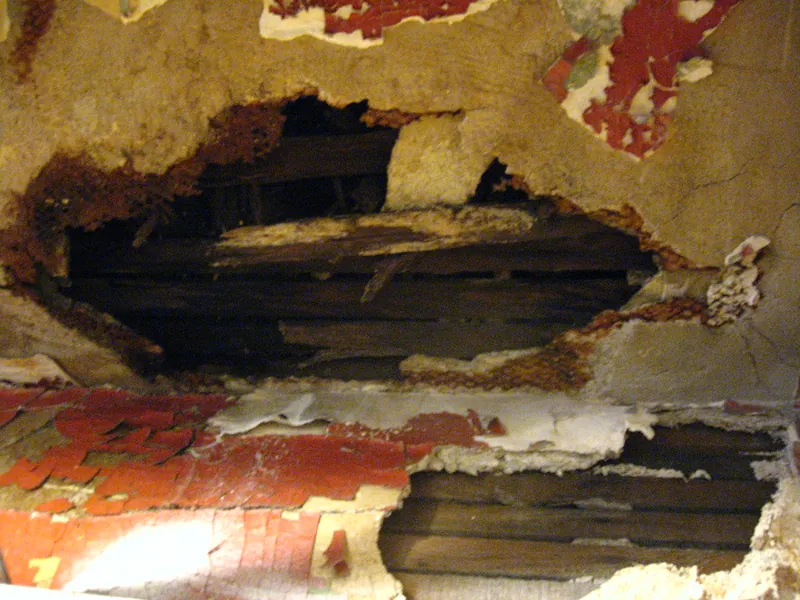
Rain is collecting above the ceiling faster than it can drain or soak through. Wet insulation and drywall grow heavy, and a bubble in the paint or a low spot in the middle of the room means water is pooled up there. A ring that appears days later marks where moisture finally worked its way to the surface.
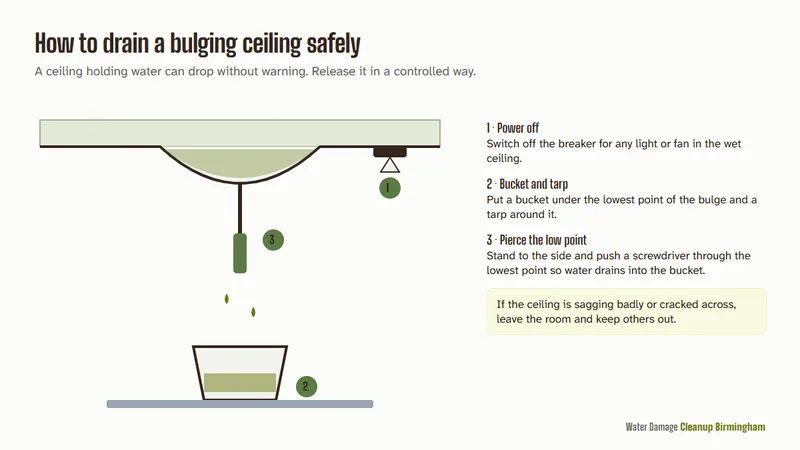
Do not stand under a ceiling that droops. If you decide to drain it, kill the breaker for that room first. A bucket goes beneath the lowest spot, and one small puncture there lets the water leave as a controlled trickle rather than a collapse.
If your house has plaster ceilings, treat them with extra care. Plaster can hold a load of water and then drop in large, heavy pieces, so keep children and pets out until someone has looked at it.
Write down the storm date and the day each stain showed up. Adjusters and roofers both ask for that sequence when they look at storm damage.
What should I look for after a storm if nothing is dripping yet?
Check the house from the top down in the first day or two after a strong storm, even when every ceiling looks dry. Wind can loosen shingles just enough that the next rain gets underneath. Look for damp or flattened insulation, dark streaks on the roof boards, wet sills and fresh marks on upstairs ceilings.
In the attic, use a flashlight to find daylight through the decking, drips along roofing nails and wet framing beside chimneys and vent pipes. A dark streak running down a rafter often traces back to lifted flashing.
Downstairs, push gently on wall surfaces below any window that took the brunt of the gusts. A spot that gives, feels chilly or looks swollen suggests rain slid down behind the paint.
If your house sits on a slope with a lower level dug into the hill, walk that level too, since runoff from the yard can reach it while the roof leaks upstairs. The guide to signs of water damage helps separate a new damp spot from an old stain, and the prevention guide covers gutters and grading before the next storm season.
Should I call a roofer or a water damage company first?
Usually both, with the roofer, tree crew or glass shop first to stop new rain. After that, a restoration team can meter the wet areas, pull out insulation or ceiling panels that will not recover and set drying equipment on the framing. Fans and dehumidifiers under an open roof only help until the next band of rain moves through.
Climbing onto a wet roof to spread a tarp is one of the more dangerous jobs people try after a storm. Loose granules, wind and slick shingles make footing poor, so a homeowner is better off guarding belongings indoors.
What each restoration team handles varies. Some coordinate with roofers and some only work indoors, so ask what the first visit includes, get the plan in writing and confirm it with the restoration team directly.
For picking up after a tornado, Ready.gov lists sturdy thick-soled footwear, long pants and work gloves as the gear to wear. The water mitigation page explains how a restoration team keeps wet damage from spreading, and before signing anything, run through the questions in our restoration company checklist. If many belongings need to leave the house, a contents pack-out moves them out for cleaning and storage.
What if storm runoff or a creek also flooded the lower level?
Then you are dealing with two kinds of water. Rain through a roof opening often starts out fairly clean, but water that flows in from the yard or a creek is outside surface water. The IICRC S500 standard puts that in Category 3, grossly contaminated, which changes how floors, walls and belongings are handled.
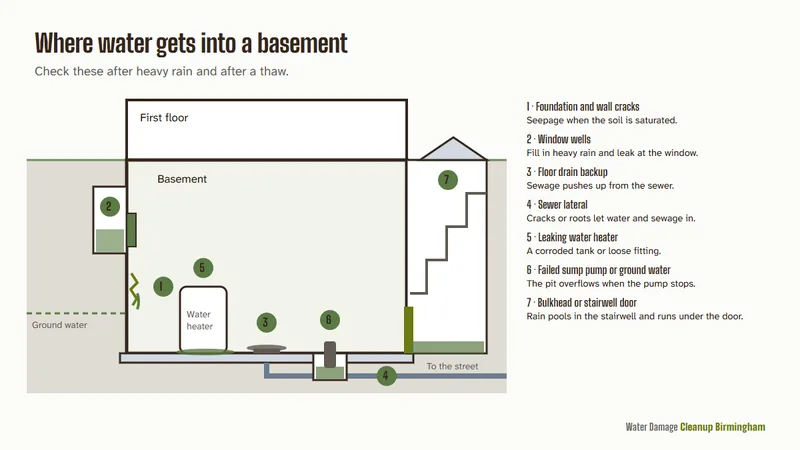
Birmingham creeks can rise quickly in these storms. National Weather Service records for Shades Creek near Homewood list a minor flood stage of 14 feet and a crest of 18.79 feet on May 4, 2021.
Never walk or drive through moving water. Ready.gov puts it plainly: moving water half a foot deep can take your legs out, and a foot of it can carry off a car.
Storms also cut power, and a sump pump stops with it. See the pages on basement flooding in Birmingham and a sump pump that fails in a storm for those routes.
Does homeowners insurance cover storm damage leaks in Alabama?
It depends on how the water got in. The NAIC draws the line this way: a leaking roof or home plumbing is the kind of water loss policies typically pay for, and ground water, rain runoff and snow-melt are the kind they typically leave out. Your own policy wording decides the claim, so read it before repairs.
Triple-I advises contacting your agent or insurer right away, taking reasonable steps to stop further damage and saving every receipt. It also suggests holding off on major permanent repairs and keeping damaged items until the adjuster has seen them.
Standard homeowners policies exclude flood, and sewer backup cover is a separate endorsement, according to Triple-I. Under the Alabama Department of Insurance claim standards in Ala. Admin. Code r. 482-1-125, an insurer must acknowledge a claim in 15 days and give the status of acceptance or denial in 30 days after proof of loss, or the policy's own period.
The insurance claims guide covers the process step by step, and the page on denied claims explains what to do if the answer is no.
How are a soaked attic, ceiling and walls dried after a storm?
A restoration team maps where the moisture went, takes out material that will not recover, and runs dehumidifiers and air movers while checking readings against an unaffected room. Insulation that rain has packed flat is normally replaced. Board that drooped tends to be cut out; board that stayed firm with only a stain can often be dried and kept.
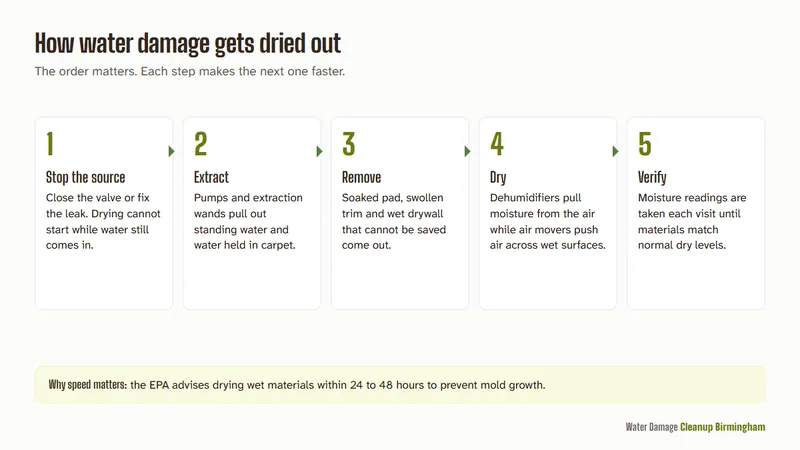
Speed matters because of mold. The EPA wants wet building materials and belongings dried in a 24 to 48 hour window, and indoor relative humidity kept under 60 percent, with 30 to 50 percent being the ideal band.
Birmingham weather works against that target. The city article describes hot summers with high humidity and highs at or above 90 degrees on 65 days a year, so opening windows often brings in more moisture than it removes.
The structural drying page explains the meters and equipment involved. If a musty smell or dark spotting shows up weeks later, read about mold after water damage.
Sources: Birmingham, Alabama (Wikipedia), climate, Dixie Alley and past tornadoes; 2021 Fultondale tornado (Wikipedia), roof, gutter and window damage; Ready.gov, severe weather hazards; Ready.gov, tornado safety, regional risk and cleanup gear; Ready.gov, moving water; NWS, Shades Creek near Homewood flood stage and crest; IICRC S500, Category 3 outside water; NAIC, what homeowners policies typically pay for; Triple-I, after-disaster claim advice; Triple-I, policy exclusions; Ala. Admin. Code r. 482-1-125, claim timelines; EPA brief guide to mold and moisture.