In brief
With a flooded basement in Birmingham AL, nobody goes down the stairs until the power to that level is off and the wiring is clear of the water. Close the main if a pipe broke, stop using drains if sewage is backing up, photograph the damage and call your insurer. The EPA goal is to dry wet areas in 24 to 48 hours, and Birmingham humidity makes a dehumidifier essential.
What should you do first with a flooded basement in Birmingham, AL?
For a flooded basement in Birmingham, AL, start with the electricity question. If water could reach an outlet, an extension cord, the furnace, the water heater or the breaker panel, stay upstairs. With power ruled out, close off a leaking pipe, hold off on every sink and toilet if sewage is climbing, get pictures, and open a claim.
- Rule out shock first. If the panel is in the wet basement, call an electrician or the power company rather than wading over to it.
- Shut off the water if a pipe is the cause. Close the main, or the cold supply valve on top of the water heater if the tank is leaking.
- Stop sending water down the drains. When dark water comes out of the floor drain, hold off on laundry, dishwashing, showers and flushing.
- Record the scene. Photograph how deep the water is, where it is coming in and what it has reached, before moving anything.
- Start the claim. Call your agent and save receipts for any pump, fan or wet vac you buy or rent.
- Line up pumping and drying. Extraction is explained on the water removal page.
If a supply line split, read burst pipe water damage. Tank failures are discussed under leaking water heaters.
Is it safe to walk into a flooded basement?
Only when you know the water cannot reach anything electrical and it is not sewage. Stay on the stairs if water is close to outlets, cords, a gas appliance or the panel, and back out at any whiff of gas or sewage, any electrical hum, or a ceiling that bows. Waiting for help costs time; an injury costs much more.
Gas appliances deserve extra care. If water covered the burner of a furnace or water heater, leave it off until a qualified technician checks it. If you smell gas, get everyone out of the house before you make any calls.
- Put on goggles, rubber gloves and rubber boots first; the CDC names all three for cleanup after a flood.
- Keep children and pets on another floor.
- Assume floor drain water and outside water are contaminated.
- Watch your footing; wet stairs and sealed concrete are slick.
How does water get into a basement built into a hillside?
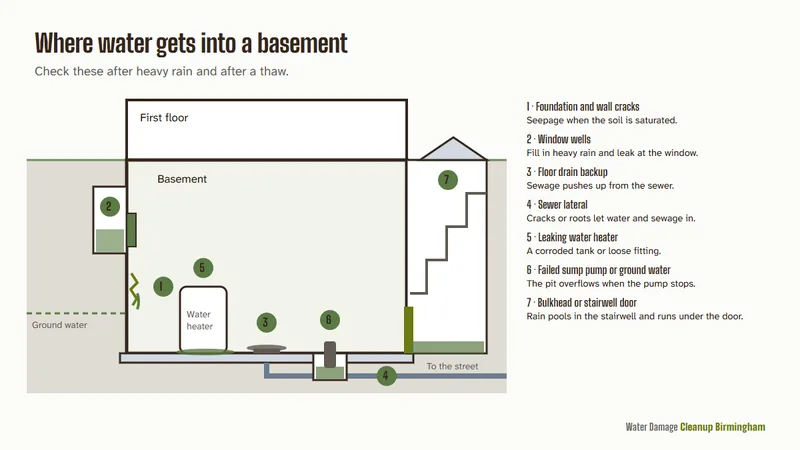
On a sloped lot, the uphill wall holds back soil that drains toward the house, so groundwater presses against it after every long rain. Water then finds cracks, the joint where the wall meets the floor, window wells and the floor drain. A stalled sump pump or a leaking pipe adds two more ways in.
Birmingham's terrain makes this a common layout. Wikipedia describes the city sitting in Jones Valley between long parallel ridges, with Red Mountain just south of downtown and Shades Mountain beyond it. If your house is set into a slope like these, watch the uphill wall first.
Note where the water shows up. A wet strip along the base of the uphill wall points to seepage at the floor joint, a puddle below a window points to a full well, and water rising in the middle of the floor points to the drain line.
Why does my basement flood after heavy rain?
Saturated soil is the usual cause. After hours of rain the ground around the foundation cannot hold more water, so it pushes through the weakest spots in the walls and floor. Clogged gutters, short downspouts and a yard that slopes toward the house send even more water to the same place.
Rain here often comes hard and fast. Wikipedia notes that most summer rain falls in afternoon and evening thunderstorms, that spring cold fronts bring strong storms, and that tropical storms occasionally reach the area in late summer and fall.
- Clean gutters after leaf fall and again in spring.
- Extend downspouts so roof water lands well away from the foundation.
- Build up soil along the walls so the ground falls away from the house.
- Cover window wells and keep their drains open.
Expect questions about the source. The NAIC says homeowners policies typically do not cover damage from ground water or rain runoff.
Why is sewage coming up through the basement floor drain?
When heavy rain overloads the sewer main in the street, the flow can reverse up the lateral pipe that serves your house. It comes out at the lowest opening in the plumbing, and in a house with a basement that is usually the floor drain. A backwater valve on the building sewer can close against that reverse flow.
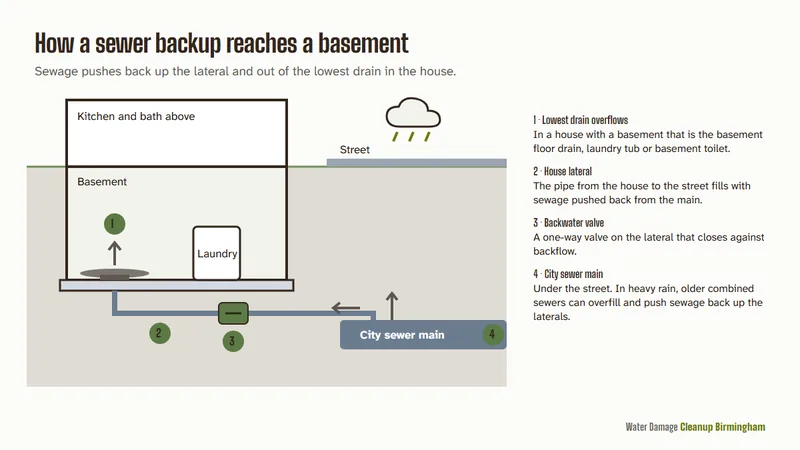
A backup on a dry day points to your own line instead: roots, grease or a broken section of pipe. A plumber with a sewer camera can tell you which. Either way, handle the water as sewage.
Coverage for this is separate. Neither a typical homeowners form nor a flood policy pays for sewer backup, per Triple-I; owners add it as an endorsement. See sewer backup cleanup for the cleanup side.
What should you check when the sump pump stops working?
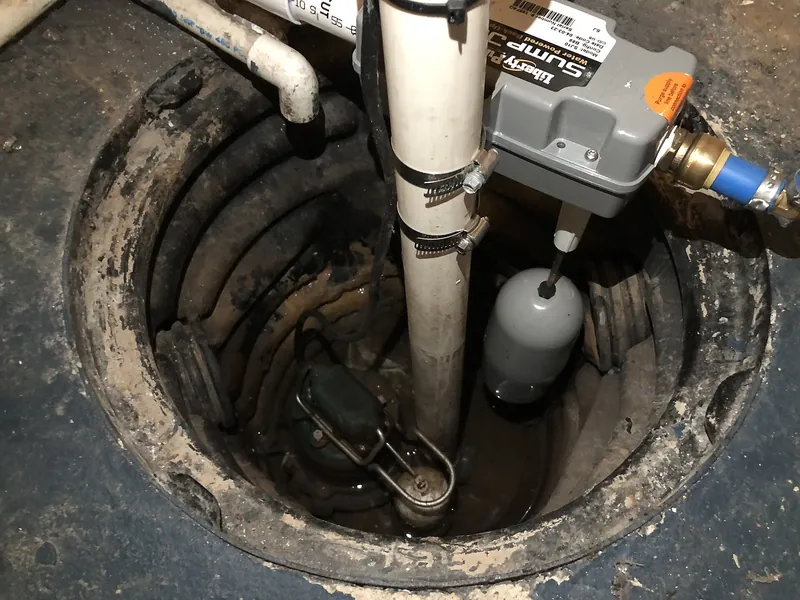
Look at power, the float and the discharge line, in that order. A pump stops when its outlet or breaker trips, when the float sticks against the pit wall or cord, when the motor fails, or when the discharge pipe clogs. In a long downpour even a working pump can fall behind, so watch the pit level too.
- Unplug the pump from a dry spot before your hands go near the water.
- Reset a tripped breaker or GFCI outlet only if you are standing dry.
- Raise the float gently by hand to see if the motor kicks on.
- Walk the discharge pipe outside and clear the outlet of leaves or soil.
Thunderstorms that knock out power also stop any pump without a backup, which is why battery backup units exist. For pump problems in more depth, read sump pump failure.
Is the water in my basement clean, gray or sewage?
Where it came from tells you, and that answer shapes what can be saved. Under the IICRC S500 standard, supply line water is Category 1 (clean), laundry and dishwasher overflow is Category 2 (gray), and sewage or rising creek water is Category 3. Clean water that sits for days can get worse.
| Source of the water | IICRC category | What cleanup usually means |
|---|---|---|
| Broken supply pipe or water heater tank | Category 1 | Pump out and dry; prompt drying saves most materials |
| Washing machine or laundry sink overflow | Category 2 | Clean and sanitize; soaked carpet pad usually comes out |
| Sewage rising from the floor drain | Category 3 | Protective gear, porous materials removed, disinfection |
| Creek water or runoff through walls and wells | Category 3 | Treated as contaminated throughout |
For sewage or outside water, the EPA recommends a professional with experience in buildings damaged by contaminated water. Outside water damage is also covered on flood cleanup.
Can Village Creek, Valley Creek or Shades Creek flood a basement?
Yes, on low ground close to the banks. These creeks drain the valleys around the city and can rise quickly in a heavy storm. Houses on low lots nearby can take overland water through doors, windows and wells, and storm drains that back up can push water into lower floors further away.
National Weather Service gauges show the range. Village Creek at Avenue W in Ensley reaches minor flood stage at 10 feet and crested at 14.22 feet on June 20, 2021. Shades Creek near Homewood has a 14-foot minor stage and hit 18.79 feet on May 4, 2021.
Valley Creek at Center Street, with minor flood stage at 11 feet, crested at 12.89 feet on September 15, 2024. Do not wade through a current in the yard; Ready.gov warns that a current only six inches deep can knock a person down.
Live levels and local history are on Birmingham flooding.
Which finished basement materials need to be torn out?
Two things decide it: the water category and the number of days materials sat wet. Wet insulation and ceiling tiles are usually replaced. Drywall may be dried in place if it has not swollen and its seams are intact, while porous finishes touched by sewage or creek water usually come out, often with a flood cut along the lower wall.
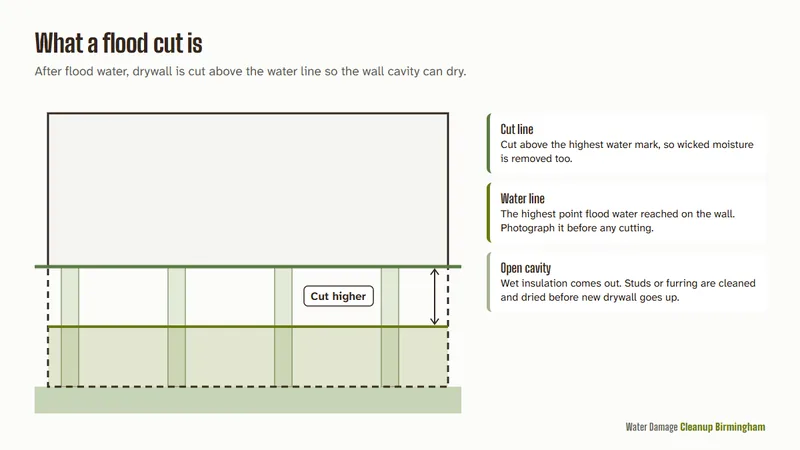
The EPA's Table 1 calls for wet fiberglass and cellulose insulation to be discarded, wet paneling to be pried away from the wall for drying, and subfloor under carpet to be cleaned and dried too. Those rules assume clean water.
Laminate, vinyl plank and carpet over a slab can hide water beneath them. See wet drywall, water-damaged floors and structural drying for each material.
Does homeowners insurance cover a flooded basement in Alabama?
The cause decides it. A sudden pipe or appliance failure is usually covered, a sewer backup usually needs an endorsement, and ground water, runoff or creek flooding usually needs a separate flood policy. Read your policy's exclusions with your agent before cleanup starts, and keep photos of everything.
FEMA says most homeowners insurance does not cover flood damage. An NFIP policy on a single-family home pays at most $250,000 for the building and $100,000 for contents, according to FloodSmart. New coverage generally does not begin until a 30-day FEMA waiting period has passed, apart from limited exceptions.
Under Ala. Admin. Code r. 482-1-125, an Alabama insurer acknowledges your claim in 15 days unless it pays first. Under rule .07, you learn whether it is accepted or denied 30 days after proofs of loss, or the policy's period. The Birmingham insurance claims guide walks through the rest.
How much does flooded basement cleanup cost?
Three things move the price: depth of the water, its category, and the amount of tear-out. For a basement with about an inch of clean water, Bob Vila gives a range of $500 to $1,500. Sewage and flood losses cost more, so get written estimates and compare them line by line.
Fixr prices extraction by the square foot, and black water costs the most at $7 to $7.50, against $4.10 to $6.50 for gray water and $3.75 to $4.25 for clean water. Drywall restoration runs $1.50 to $3 per square foot in the same source.
These are national figures, and restoration teams set their own prices. Belongings are priced on their own; see contents pack-out, and the full price breakdown is in water damage restoration cost.
How long does a basement take to dry in Birmingham humidity?
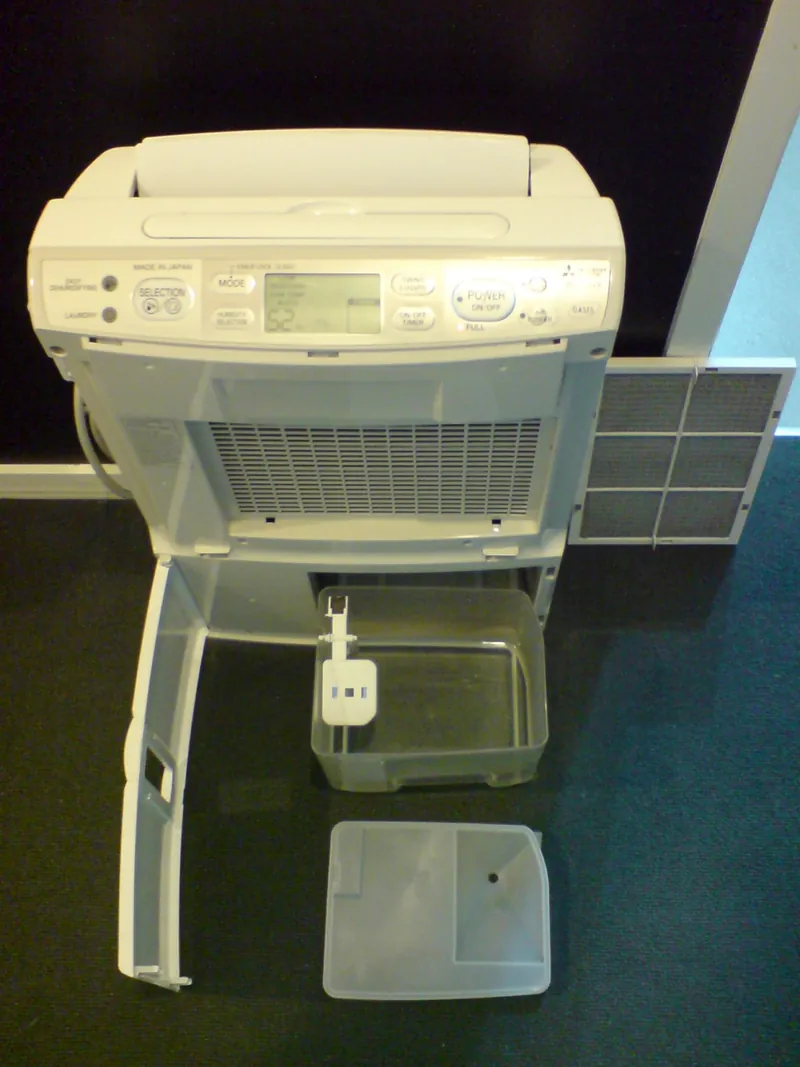
Keep windows shut, run a dehumidifier, move air across wet surfaces, and take moisture readings until they match a dry room. Opening windows on a sticky day brings more moisture in. The EPA sets a 24 to 48 hour drying goal and indoor humidity below 60 percent, ideally 30 to 50.
The local climate works against you. Wikipedia calls it humid subtropical, with hot summers and high humidity. Block walls, slabs and framing hold moisture after the surface feels dry, so get the restoration team's moisture numbers on paper before anything is closed up.

If the room smells stale a few weeks on, some material never fully dried; the page on mold after water damage explains what to look for.
How can you keep the basement from flooding again?
Close off the route the water used. Depending on the cause, that may mean regrading, longer downspouts, sealing cracks, window well covers, a backwater valve or a battery backup sump pump. Inside, check the water heater, washer hoses and any pipes along cold exterior walls before winter arrives.
- Each spring, pour a bucket of water into the sump pit and check that the float rises and the pump starts.
- Insulate pipes in crawl spaces and along outside walls.
- Store belongings on shelves in lidded bins, never directly on the slab.
- Review sewer backup and flood coverage with your agent before storm season.
Freezes happen here more than many people expect: Wikipedia counts an average of 47 days a year with a low at or below freezing. The American Red Cross lists basements and crawl spaces among the places pipes freeze most. More is on preventing water damage.
Sources: IICRC S500 standard (category definitions); EPA brief guide to mold and moisture; EPA cleanup guidance for contaminated water; EPA Table 1, insulation, paneling and subfloor; CDC mold and health page; Ready.gov floods; NAIC consumer guide to homeowners insurance; Triple-I, sewer backup and flood exclusions; FEMA flood insurance FAQ; FloodSmart NFIP limits; FEMA NFIP manual, waiting period; Ala. Admin. Code r. 482-1-125-.06 and 482-1-125-.07; Bob Vila restoration cost; Fixr restoration cost; NWS gauge ENSA1, SCHA1 and VALA1; American Red Cross, frozen pipes; Wikipedia, Birmingham, Alabama (terrain, weather).