Quick answer
Before you hire a water damage restoration company in Birmingham, ask for an itemized estimate, dated moisture readings and an insurance certificate, and read every form before you sign. Alabama rule 482-1-125 gives insurers 15 days to acknowledge a claim and 30 days after proofs of loss to state acceptance or denial. This site ranks no one.
How do I choose a water damage restoration company in Birmingham?
Choose a water damage restoration company in Birmingham on the strength of its paperwork, not its pitch. Before equipment comes off the truck, ask for a written scope by room, an itemized estimate, moisture readings with dates, proof of insurance and a plan for the rebuild. Those papers let you hold two restoration teams side by side.
- Shut off the water first. Close the main or the valve under the fixture, then start calling. The emergency water damage restoration page explains what a first visit tends to look like.
- Take pictures of every wet room and leave damaged things in place until they are photographed.
- Phone your insurer and ask whether it wants to approve the work first or has a preferred vendor list.
- Put the same questions to each restoration team, using the table below.
- Read the work authorization in full before signing.
- File every moisture log in one folder, paper or digital.
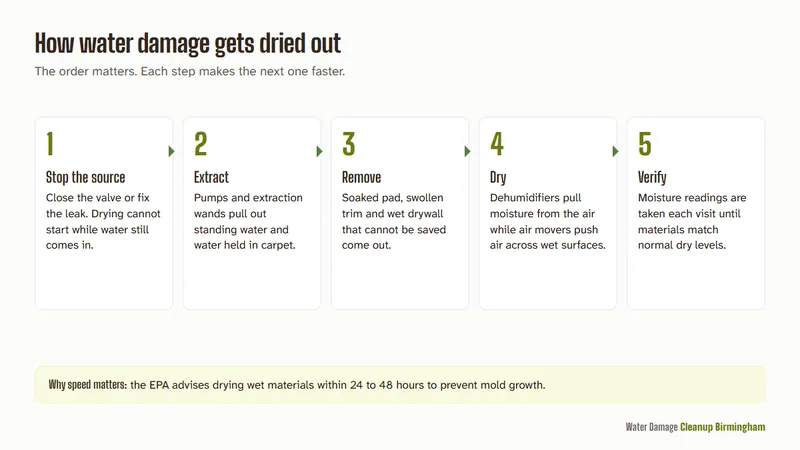
The clock is set by mold, not by the bids. The EPA wants soaked materials and furnishings dry in 24 to 48 hours. That leaves room for a couple of calls, not a long comparison while wet pad sits under the carpet.
Does this site recommend or rank Birmingham restoration teams?
No. Your call or form goes to a restoration team that accepts work in your area, and the site does not rate, rank or vouch for anyone. Vet that restoration team the way you would any company you found on your own, and the hiring choice stays yours.
Requests come in from Jefferson and Shelby counties and from Walker, St. Clair, Blount, Tuscaloosa, Bibb, Talladega, Cullman, Chilton, Etowah, Calhoun, Winston and nearby counties. Each restoration team draws its own travel map, so check that the one you reach serves your street. The service areas page lists every town.
City lines matter for permits. Wikipedia notes that Hoover sits in both Jefferson and Shelby counties, and suburbs such as Homewood and Mountain Brook or Vestavia Hills are separate cities from Birmingham. Ask which building office handles your exact address.
You can turn down any restoration team and hire a different company.
What should I ask a restoration company before it starts?
Run every restoration team through the same six questions and note what each one says. The answers reveal how a crew measures the damage, decides when to stop drying and bills its fans and dehumidifiers. A company that knows its trade replies without hedging, and nothing on this list should require a signature.
Six questions for the first call
| Question | Why it matters | What a solid reply sounds like |
|---|---|---|
| Will the estimate be itemized? | A lump sum can bury extra days of equipment rent | Labor, equipment and materials each on their own lines |
| Which water category is this? | Sewage or creek water changes what must be discarded | A category written on the scope, with the reasoning |
| What reading means dry? | Fans pulled early invite mold; fans left late add cost | Meter numbers matched to a dry wall elsewhere in the house |
| What comes out, and why? | Drywall, trim and cabinets add up quickly | Each removal tied to a reading or the water category |
| Can I see your insurance certificate? | Injuries or damage during the job need coverage | A certificate sent to you before work begins |
| Who does the rebuild? | Drying and repair are often separate contracts | A named company and its own written price |
Carpet is often the costliest line. In the national figures Fixr publishes, restoring carpet runs $4.75 to $10.50 a square foot while drywall runs $1.50 to $3, which is why it pays to ask whether the carpet can stay and be dried where it lies. Unfamiliar words on an estimate are defined in the water damage glossary.
How do I look up a restoration team's IICRC credentials?
Search for the company yourself rather than relying on a sticker on the truck. The IICRC publishes standards for inspection, cleaning and restoration, and its Global Locator lets the public look up firms and technicians that hold its credentials. The search takes a few minutes and can be done while you wait for a callback.
The IICRC also keeps a list of invalid firms that claim a status they do not hold, and it takes reports about others. If credentials weigh in your choice, check both lists.
Listen for the vocabulary. A trained technician will sort your loss into one of three classes from the IICRC S500: Category 1 for clean supply water, Category 2 for gray water such as a washer overflow, Category 3 for sewage and floodwater off a creek or river.
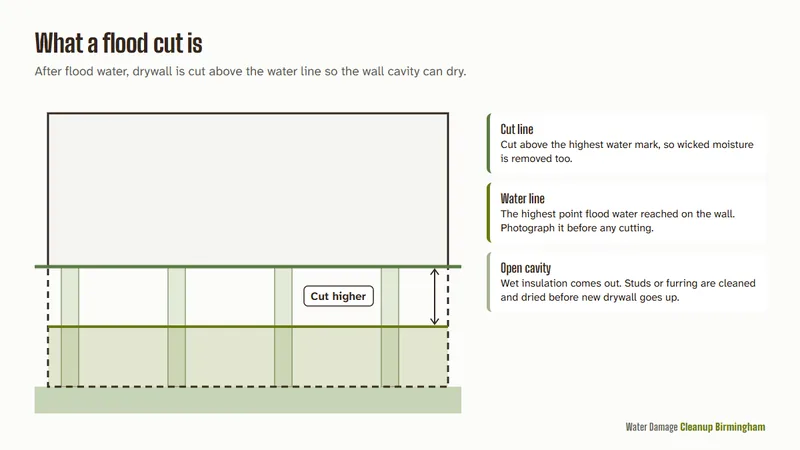
That label drives the tear-out list. Sheetrock soaked by a clean line break can usually stay and be dried; sheetrock soaked by sewage usually cannot. If a backup or floodwater did the damage, EPA guidance points to a pro with contaminated-building experience, and the sewer backup cleanup page covers that work.
A firm's listing does not tell you who walks through your door. Ask for the name of the lead technician and the training behind it.
Who handles repairs after the drying is done?
That varies, so ask before you sign. Water extraction and drying are mitigation; new drywall, flooring, cabinets and plumbing are repairs, and repairs can need a permit. Pin down which company owns each phase, how many contracts you will sign, and who books the carpenters once the dehumidifiers are gone.
Ask the restoration team which permits it expects and who pulls them. If the reply is vague, call the building office for your address, whether that is the City of Birmingham, a suburb such as Hoover or Trussville, or a county office in a rural area.
The stages make more sense in order: water mitigation, then structural drying, then water damage repair.
Which documents should I get from a restoration company?
By the end of the job you should hold four things: the signed work authorization, a scope listing each room, an itemized estimate and a moisture log with dates. Adjusters want detail. The Insurance Information Institute tells policyholders to get bids in writing, itemized by material and price.
- Work authorization. Find the payment section and any line handing your insurance proceeds to the company.
- Scope. Room by room, and it should match what you saw.
- Estimate. Every cost type listed separately, so equipment days do not hide in labor.
- Moisture log. Readings taken at the same marked spots on each visit, plus the dry target.
- Photos. The restoration team's set, and your own from before anything was removed.
Your insurer may want emergency drying started at once but permanent repairs held until the adjuster visits. Triple-I says to hold off on major permanent repairs until then, so ask before anyone pulls cabinets or flooring.
How fast does an Alabama insurer have to answer a water claim?
Alabama's claim standards, Ala. Admin. Code r. 482-1-125, give an insurer 15 days to acknowledge a first party claim unless it pays in that time. Within 30 days after it receives properly executed proofs of loss, or the period your policy sets, it must tell you whether the claim is accepted or denied.
A denial has to point to the specific policy provision, condition or exclusion it relies on, under rule 482-1-125-.07. If the insurer needs more time, it must say so with reasons in that same window, then update you 45 days later and every 45 days while the investigation stays open.
The acknowledgment rule also requires a reply in 15 days to other written questions that ask for one, and claim forms or help in 15 days. The Alabama Department of Insurance takes complaints.
The restoration team's photos and readings strengthen your file, but the policy is between you and your insurer. The Birmingham insurance claims guide covers the steps in order.
How do I compare two water damage estimates?
Lay the estimates next to each other and compare them line by line rather than by the bottom number. Confirm both cover the same rooms, name the same water category, remove about the same materials and run equipment for a similar number of days. A cheap bid that skips tear-out or the moisture log often grows later.
National figures give only a loose frame. Fixr puts a typical restoration bill somewhere from $1,200 up to $5,000, and pegs the midpoint people pay near $3,000. Sewage costs more to remove than tap water: its per-square-foot extraction range for black water ($7 to $7.50) is close to double the clean water range ($3.75 to $4.25).
Your own bill in Jefferson or Shelby County may land above or below all of that. If a line item makes no sense, have the restoration team walk you through it, and use the Birmingham water damage cost guide to see which jobs cost what.
Comparing takes time you may not have. A day for a second estimate is reasonable, but wet wood and drywall left past the EPA's 24 to 48 hour window start to invite mold, as the page on mold after water damage explains.
Why does drying take longer in a Birmingham summer?
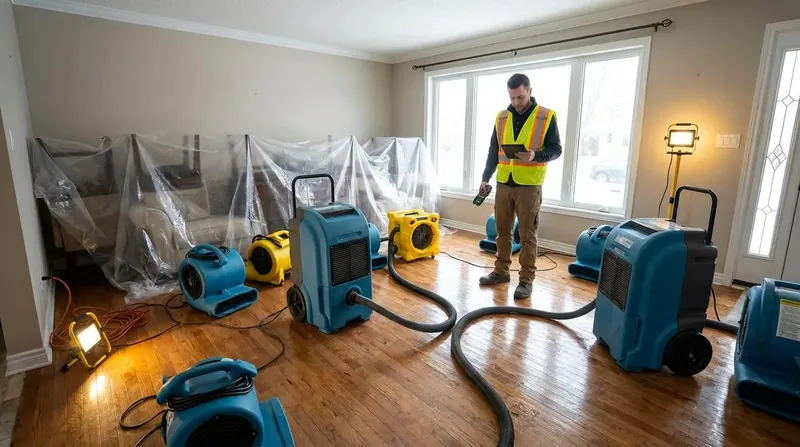
Outdoor air in a Birmingham summer is already loaded with moisture, so opening windows can slow drying instead of speeding it. The work then depends on dehumidifiers and air movers, and a careful restoration team keeps checking drywall, subfloor and framing with a meter until the numbers match a room the water never reached.
Wikipedia's Birmingham article describes a humid subtropical climate with hot, highly humid summers and frequent afternoon and evening thunderstorms. A slab, block walls or a crawl space can stay damp long after the living room feels dry.
For the house itself, EPA guidance sets 60 percent relative humidity as the upper limit and 30 to 50 percent as the sweet spot. Ask which humidity target the restoration team works toward and whether you get each day's log. The structural drying page explains the equipment.
Which red flags mean I should hire someone else?
Pressure is the biggest one. Be wary of anyone who rushes you through forms, leaves blanks on a page you are asked to sign, or will not put the scope and price in writing. A leak is urgent, but reading two pages takes a few minutes and can save months of dispute over the bill.
- A single total with no breakdown.
- Promises that insurance will cover everything, made before the adjuster visits.
- No moisture readings, or readings kept from you.
- Cash demanded up front without a signed scope.
- Walls opened with no stated reason tied to readings or the water category.
- No insurance certificate when you ask for one.
Question any charge that seems off by asking for the meter number and photo that support it. A disagreement with the insurer is a different matter: Triple-I points you first to your agent, then the claims manager, and notes that many policies include an appraisal clause in which two appraisers and an umpire settle the amount by majority.
Hiring a public adjuster costs money too. Their fee can reach 15 percent of what the claim pays, Triple-I warns, so look any candidate up with the BBB and the Alabama Department of Insurance first.
Sources: EPA on drying times and indoor humidity; EPA on contaminated water and mold cleanup; IICRC Global Locator and invalid firm list; IICRC S500 water categories; Insurance Information Institute, settling insurance claims; Ala. Admin. Code r. 482-1-125-.06; Ala. Admin. Code r. 482-1-125-.07; Alabama Department of Insurance; Fixr water damage restoration cost; Wikipedia, Birmingham, Alabama; Wikipedia, Hoover, Alabama.