For Gadsden and Etowah County
For water damage restoration in Gadsden, AL, shut off the water, keep away from wet wiring and photograph every room. The EPA says to dry within 24 to 48 hours. Coosa River and creek water needs a flood policy. ZIPs: 35901 to 35907, 35952, 35954, 35972, 35990.
Which Gadsden addresses do you take requests from?
Eleven ZIP codes cover water damage restoration in Gadsden, AL and nearby: 35901 Gadsden, 35902 Gadsden, 35903 Gadsden, 35904 Gadsden, 35905 Glencoe, 35906 Rainbow City, 35907 Southside, 35952 Altoona, 35954 Attalla, 35972 Gallant and 35990 Walnut Grove. The 35902 code serves post office boxes only, so give the street address.
Gadsden is the Etowah County seat, set on the Coosa River about 56 miles northeast of Birmingham, and it counted 33,945 people in the 2020 census, per the Gadsden article on Wikipedia. Etowah is the smallest county in Alabama by area, the Etowah County article notes, at 549 square miles.
West over the ridges, the Oneonta page covers Blount County. Down the Coosa toward Birmingham, see the Pell City and Moody page, and to the southeast the Anniston and Oxford page covers Calhoun County. All covered codes are on the ZIP code list.
Does the Coosa River flood Gadsden?
It can, and the river runs right through town. Gadsden grew up on both banks of the Coosa, between Weiss Lake upstream and Neely Henry Lake downstream. The National Weather Service gauge at Gadsden ties each flood category to what happens on the ground, from wet farm fields to houses in eastern Gadsden.
| Coosa River at Gadsden | What the NWS says happens |
|---|---|
| Minor flood stage | Low-lying farm land around Gadsden starts to go under |
| One foot above minor | Some homes in the Gadsden area begin to flood |
| Moderate flood stage | Considerable residential flooding along the river; Lonz Street to Aaron Way in eastern Gadsden is exposed |
| Major flood stage | Low parts of Highway 411 flood, with considerable flooding of homes |
| Three feet above major | Widespread, severe residential flooding in Gadsden and nearby areas |
The GAPA1 gauge page lists four crests above major flood stage: April 6, 1886, the highest on record, then July 15, 1916, April 11, 1936 and February 26, 1961. The latest crest it lists, March 4, 2019, passed the line where some homes begin to take water.
The NWS also notes that reservoir operations affect readings at this gauge. In practice, the dams above and below town shape how fast the river climbs, so follow the official forecast instead of guessing from the bank.
What did Neely Henry Dam change below Gadsden?
It turned the river south of town into a lake. Alabama Power completed the 57-foot Neely Henry Dam on June 2, 1966, and its lake spreads over 11,200 surface acres with about 339 miles of shoreline, says the Neely Henry Lake article. Every crest above major on the NWS list came before that date.
Rainbow City and Southside sit on the Coosa due south of Gadsden, the Coosa River article says. If your house is on that shoreline, keep stored items off the floor of a boathouse or lower level, and read the flood cleanup page before you start pulling out wet materials.
Why did Gadsden grow up where the river can reach it?
Because the river was its living. Gadsden began as Double Springs, a stagecoach stop John Riley built near two springs around 1825. In the late 1800s it became a river port second only to Mobile in Alabama, with riverboats carrying its trade along the Coosa.
In 1840 the Hughes brothers bought Riley's house and much of the land between Lookout Mountain, the Coosa and the mouth of Wills Creek. On July 4, 1845, the steamboat Coosa landed near the spot where the Memorial Bridge later went up, Wikipedia records.
Lookout Mountain's southern end rises just north of downtown, and Big Wills Creek is a named Coosa tributary. Rain that falls on the slopes funnels toward the creek and the river, so low lots near either one deserve the most attention in a wet spell. The regional flooding page explains how these rises build.
Do pipes freeze in Gadsden winters?
They can. Gadsden is mild by national standards, but Wikipedia says the low reaches freezing or colder on about 60 days a year and drops to 20 degrees or lower on 6.9 days. The record low is minus 6, set on January 20 and 21, 1985, and January and February are also the wettest months.
A cold snap that follows weeks of rain is hard on houses. Pipes in crawl spaces, garages, attics and kitchen cabinets on outside walls freeze first, the American Red Cross warns. Let cold water drip from faucets on exposed lines, and leave the heat at 55 degrees or higher if you travel.
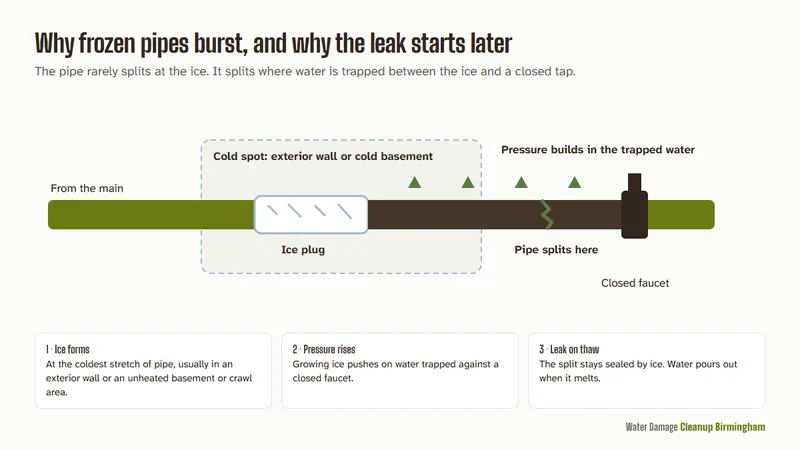
The Red Cross allows gentle heat on a frozen line, from a blow dryer, a space heater kept clear of anything that burns, or towels dipped in hot water. It rules out torches, kerosene or propane heaters and any open flame. If the pipe has already split, the burst pipe page covers the cleanup.
What kinds of Gadsden and Etowah County homes take on water?
Older houses and empty ones top the list. Gadsden's population peaked in 1960, during its years as a Goodyear and Republic Steel town, and the city had 16,730 housing units at the 2020 census. Many of those homes have roofs, supply lines and drains that have aged along with them.
Across the county, 11.3% of the 47,306 housing units stood vacant in 2020, and 71.1% of occupied homes were owner-occupied, per the Etowah County article. Nobody hears a drip in a house that stands empty, so water can spread through floors and walls long before it is found. Have someone walk through any house you leave unheated.
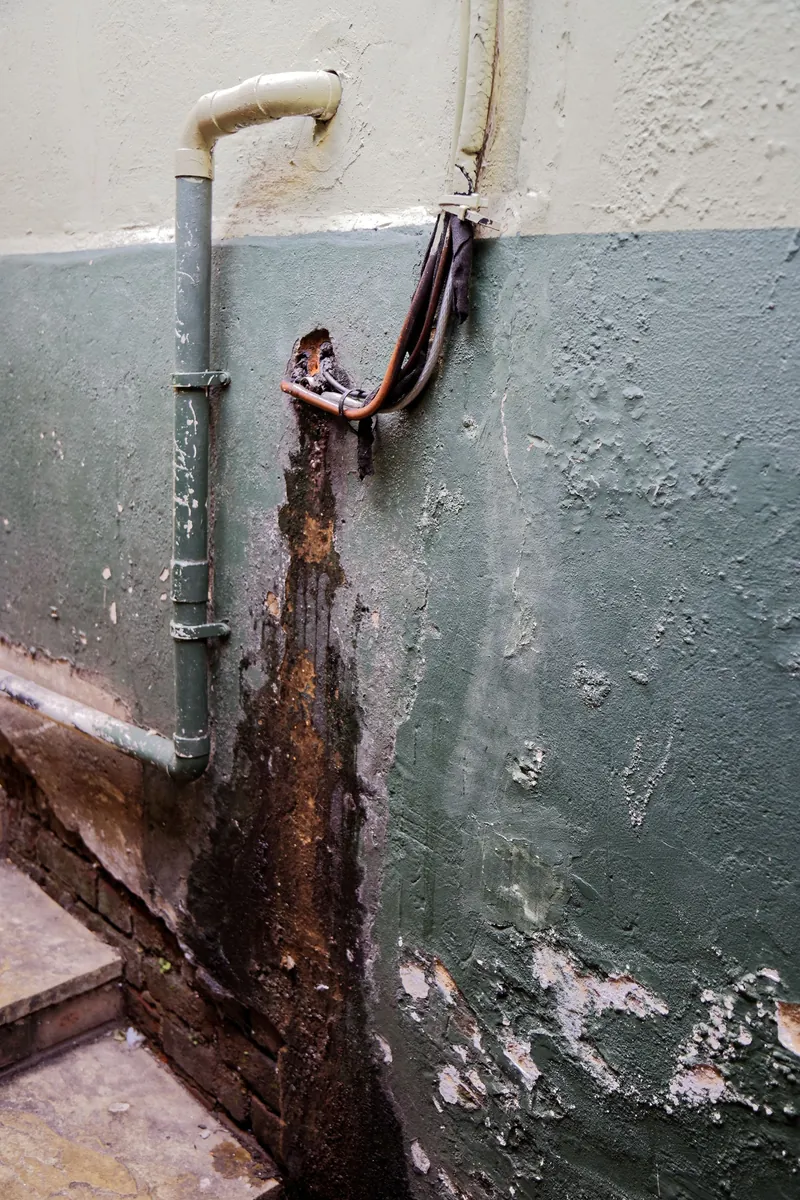

In an older house, look at the water heater, the washer hoses and the shutoff under each sink at least once a year. Clues to a hidden leak are in the signs of water damage guide, and a failing tank is covered on the water heater leak page.
Does homeowners insurance pay for Coosa River flooding in Gadsden?
Not under a standard policy. The NAIC explains that homeowners coverage typically handles water from plumbing or a roof leak but leaves out ground water and rain runoff. When the Coosa or a creek comes inside, the claim belongs to a separate flood policy.
Sewage pushed up a floor drain sits outside both policies; Triple-I says it takes a separate endorsement. Timing matters too: the FEMA flood manual holds new NFIP policies back for 30 days, with limited exceptions, so a policy bought as the Coosa climbs will not pay for that rise.
On a covered claim, Ala. Admin. Code r. 482-1-125 gives the insurer 15 days to acknowledge it (rule .06). After you send proofs of loss, it has 30 days, or the period in the policy, to say whether it accepts or denies, then must write every 45 days while an investigation stays open (rule .07).
When an insurer misses those dates, you can file a complaint with the Alabama Department of Insurance. Our insurance claims guide covers photos, estimates and proofs of loss.
What should you do first after water damage in a Gadsden home?
Stop the water, stay clear of wet wiring and photograph the damage before anything moves. Drying comes next. The EPA gives a 24 to 48 hour window for getting soaked materials dry before mold sets in, and it wants humidity held below 60 percent, ideally in the 30 to 50 range.
- Close the main valve, or the stop valve at the fixture or appliance that is leaking.
- Cut power to soaked rooms at the panel if you can reach it on dry ground.
- Do not drive through river or creek water on the road; Ready.gov warns that one foot of it moving can float a vehicle away.
- Take pictures of the high-water mark, the floors and anything ruined, then call your insurer and save every receipt.
- Treat river, creek or sewer water as Category 3 under the IICRC S500 standard and keep children and pets away from it.
Ask whoever calls back to confirm they serve your street. The water mitigation page explains early drying work.
Sources: Wikipedia on Gadsden, Alabama (location, 2020 census, history, climate, housing units), Etowah County, Alabama (area, 2020 housing), Coosa River (lakes, towns on the river, Big Wills Creek) and Neely Henry Lake (dam, lake size); NWS gauge GAPA1, Coosa River at Gadsden (flood categories, impacts, crests, reservoir note); American Red Cross on frozen pipes; NAIC on homeowners coverage; Triple-I on flood and sewer backup; FEMA NFIP manual (waiting period); Ala. Admin. Code r. 482-1-125-.06 and r. 482-1-125-.07; Alabama Department of Insurance; IICRC S500 water categories; Ready.gov on moving water; EPA brief guide to mold and moisture.