In brief
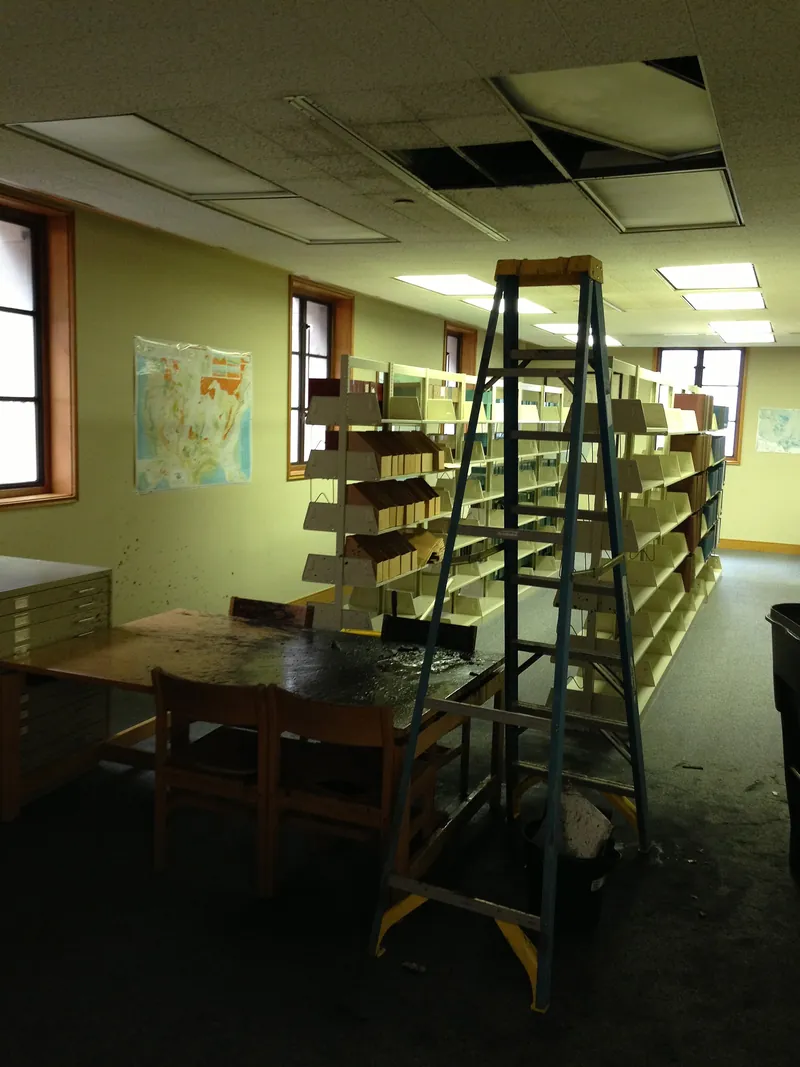
For commercial water damage in Birmingham, shut the closest valve, keep people away from wet floors and live equipment, photograph everything, and notify the owner and insurer. Storm-damaged roofs, winter freezes in empty suites and creeks in Jones Valley and Shades Valley drive many losses. Wet ceiling tiles usually get replaced, and EPA guidance is to dry materials in 24 to 48 hours.
What should a Birmingham business do first after a water leak?
With commercial water damage in Birmingham, the first job is cutting off the water at the closest valve you can reach, or getting a building engineer, plumber or sprinkler contractor there to do it. After that, clear people out of the wet zone, take pictures before cleanup, and notify the property owner and your insurer.
- Close the nearest valve. A stop under a sink or a branch valve in a ceiling can isolate one suite and keep the rest of the building running. Shut the main only if nothing closer works, and leave a flowing sprinkler head to the fire protection contractor.
- Move people back. Staff, shoppers, residents or a congregation should stay clear of puddles, sagging ceiling panels and anything plugged in. Breakers are switched off only by someone standing on a dry floor.
- Lift what matters. Get files, computers, cash drawers and low-shelf stock off the floor or onto another level.
- Document it. Photograph or film the source, the wet line on walls, stained panels and damaged stock before anyone mops.
- Make the calls. Triple-I advises contacting your agent or insurer at once and taking reasonable steps to limit further harm, then holding big permanent repairs until an adjuster has looked.
A split line is covered on burst pipe water damage, and the first hour in general is on emergency water damage restoration.
Where does water usually get into offices, stores, restaurants and churches?
Most commercial losses trace back to a short list of sources: rooftop drains and seams, fire sprinkler branches, restroom and kitchen plumbing, rooftop or closet HVAC units, and water heaters in back rooms. Each type of building leans toward a few of them, and each has a different first worry once water is on the floor.
| Building | Frequent sources | First concern |
|---|---|---|
| Office floors and medical suites | Sprinkler branches, restroom stacks, HVAC condensate lines | Records, computers and ceiling panels over desks |
| Retail stores and strip centers | Flat roof drains, shared walls, supply lines | Stock on the floor and the neighboring tenant |
| Restaurants and cafes | Dish machines, ice makers, floor drains, grease lines | Food safety and slick kitchen floors |
| Churches and fellowship halls | Older roofs, basement classrooms, kitchen plumbing | Carpet, hymnals, records and volunteers' safety |
| Apartment buildings | Upstairs units, water heaters, washer hookups | Several households and insurers at once |
| Warehouses and shops | Sprinkler mains, roof leaks, loading dock runoff | Pallets of stock and shipping schedules |
Tracking the water to its true source is the step most often rushed. A stain on a first floor ceiling can start two stories up or three bays over.
How should apartment owners handle a leak that reaches several units?
Handle it as one cause with several separate claims. The unit where the leak began, each unit below it, and the building owner may all carry different policies and different losses. Stop the water, record every affected unit on its own, and put notices to residents in writing so there is a clear record of who knew what and when.
The lease or the condominium documents usually set the split. Commonly, the roof, structure and shared plumbing fall to the owner or association, while residents look after their own furniture, clothing and electronics, but every document is worded differently.
- Send each household a written notice and keep copies.
- Photograph each unit separately, including ceilings and closets.
- Ask residents to contact their own renters or condo insurer.
- Arrange access so one restoration team can dry shared walls and floors from both sides.
Residents can find their part in the renters and condos guide, and a below-grade unit has its own page on basement apartment water damage.
What is different about a church or volunteer-run building?
Churches often have large rooms that sit empty most of the week, older roofs, basement classrooms and kitchens used on schedules. A slow leak can run for days before anyone walks in, and well-meaning volunteers may start cleanup before photos are taken or before anyone knows whether the water is clean.
The Birmingham area has a great many congregations. Wikipedia's Birmingham article lists 673 Southern Baptist Convention congregations in the metro area alone, so this kind of building is a common setting for a water loss.
- Name one person to talk to the insurer and the restoration team.
- Photograph rooms before volunteers move chairs, books or tables.
- Keep volunteers out of sewage, deep water and anything near wiring.
- Check rarely used rooms, baptistry plumbing and attic spaces after storms.
Volunteers can carry dry hymnals and records from a clean leak. When the source is sewage or outside water, the EPA recommends a professional with experience in contaminated-water buildings.
How do warehouses and industrial buildings handle water losses?
Warehouses deal in scale: high ceilings with sprinkler lines overhead, long open slabs where water spreads quickly, and pallets of stock that can soak up a leak. The losses that hurt most are often ruined inventory and missed shipments, so moving stock and keeping records of it matter as much as drying the building.
Birmingham's industrial land has deep roots in the valley floor. Wikipedia notes that Jones Valley was split by the main railroad corridor, where most of the early manufacturing started, and that steel production and processing still play a key role in the local economy.
- Photograph pallets in place, with lot numbers visible, before moving them.
- Separate wet stock from dry stock right away so cartons do not wick water upward.
- Keep forklifts and power equipment out of standing water until wiring is checked.
- Ask how a restoration team plans to dry a large slab and the base of racking.
Moving inventory and office contents is its own process, explained on contents pack-out.
Can a freeze burst pipes in an empty Birmingham office or store?
Yes: vacant suites, closed weekends and holiday shutdowns are when pipes in cold walls, ceilings and unheated back rooms freeze unnoticed. When the line splits and thaws, water can run for hours before anyone arrives. Wikipedia lists an average of 47 days a year in Birmingham with a low at or below freezing.
The American Red Cross recommends a thermostat setting of at least 55 F whenever a space sits empty in cold weather, to hold the thermostat steady day and night, and to let cold water drip from faucets on exposed pipes.
- Check the heat in any vacant suite before a cold night.
- Keep doors to restrooms and janitor closets open so warm air reaches the pipes.
- Know where the sprinkler riser and the building main are, and who has the keys.
- Walk the building the morning after a hard freeze, before staff arrive.
How freezing splits a line is covered on burst pipe water damage.
What happens when a storm or tornado opens a commercial roof?
Rain gets in wherever wind lifted the membrane, tore off flashing or broke a skylight, and it keeps coming with each storm until the opening is covered. Get the roof tarped or patched as soon as it is safe, photograph the damage from the ground and from inside, and keep receipts for every temporary repair.
Severe weather is a regular part of life here. Wikipedia describes spring cold fronts that often bring strong to severe thunderstorms, a second severe weather season in November and early December, and occasional tropical storms in late summer and fall.
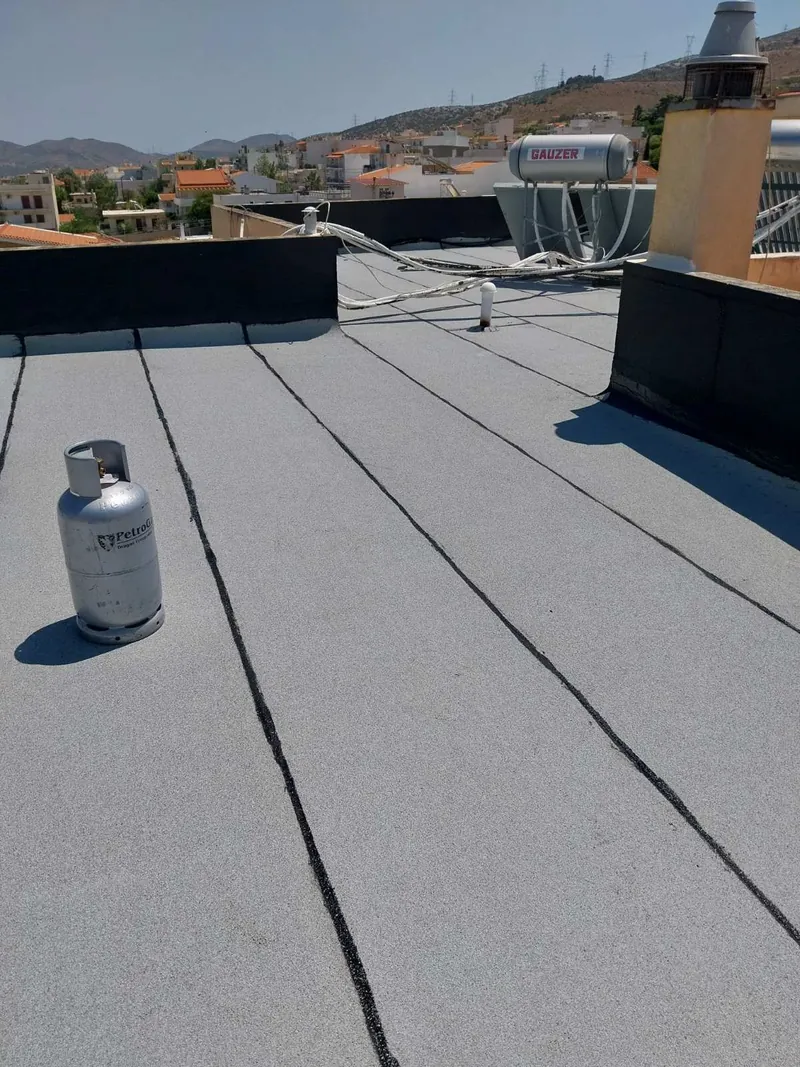

A wet roof deck means wet insulation, and wet insulation above a ceiling grid can keep dripping long after the sky clears. Ask the roofer and the drying team to check the deck and the insulation, not just the ceiling below. More is on storm and roof leaks and Birmingham tornado history.
Can a business stay open while drying equipment runs?
In many cases, yes, provided the water was clean and the wet section can be sealed off. Sheeting and zipper doors can hold the dehumidifiers and air movers inside one area while customers keep using the remainder of the space. Sewage, water near live wiring, or a ceiling that may still fall changes that answer.
Questions to settle before equipment is set up:
- Will the containment block an exit, a fire lane or a checkout line?
- Can the loudest machines run overnight or on closed days?
- Which circuits will the equipment draw from, and could it trip coolers, servers or registers?
- Who holds keys to neighboring suites if a shared wall needs drying from both sides?
The EPA's guide for commercial buildings warns against using fans until the water is known to be clean. Drying walls and slabs is described under structural drying.
Which ceiling tiles, drywall and carpet have to be replaced?
Wet ceiling tiles and soaked insulation are usually thrown out and replaced. Drywall can sometimes be dried where it stands, and carpet can sometimes be saved if drying starts quickly. The EPA's Table 1 for schools and commercial buildings sets out these choices material by material for clean water losses.
That table calls for ceiling tiles, fiberglass insulation and cellulose insulation to be discarded and replaced. Wallboard may be dried in place when there is no obvious swelling and the seams are intact. Carpet and backing should be dry in 24 to 48 hours, using extraction, dehumidifiers and fans.
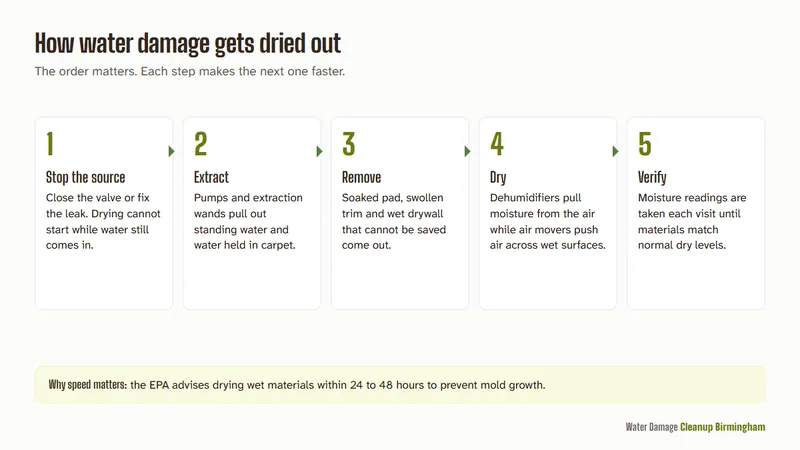
Those guidelines assume clean water. The same EPA page says that sewage or other contamination calls for protective equipment and containment, and for an experienced professional. More on each material is under wet drywall and wet carpet.
Does commercial property insurance cover water damage in Alabama?
It depends on the source and the wording of the policy. Sudden pipe, sprinkler and appliance leaks are often listed as covered perils, but commercial forms vary widely. Flood from creeks or rivers and sewer backup are commonly excluded or handled by separate coverage, so read the exclusions with your agent before you count on a payment.
On the residential side, standard homeowners and renters forms leave out flood, and sewer backup is sold as a separate endorsement, according to Triple-I. Ask your agent whether your commercial policy follows the same pattern, and whether your landlord's policy or yours covers the build-out.
Alabama's claim standards, Ala. Admin. Code r. 482-1-125, require an insurer to acknowledge a first-party claim in 15 days unless it pays sooner. Under 482-1-125-.07, the claimant hears whether the claim is accepted or denied 30 days after proofs of loss, or the policy's period, with 45-day updates if more time is needed.
The Alabama Department of Insurance takes complaints. More detail is in the insurance claims guide.
Which Birmingham business areas sit near flood-prone creeks?
Birmingham's early manufacturing grew up along the railroad corridor in Jones Valley, which Village Creek and Valley Creek drain. Over the mountain, Shades Creek runs through Irondale, Mountain Brook, Homewood and Hoover. During heavy rain these creeks can climb quickly, and low lots, loading docks and below-grade rooms near them take water first.
National Weather Service gauges show how high they can go. Valley Creek at Center Street has a minor flood stage of 11 feet and crested at 12.89 feet on September 15, 2024. Shades Creek near Homewood lists minor flood stage at 14 feet and a top crest of 19.88 feet on September 16, 2004.
Check the FEMA flood zone for the property and talk with your agent about flood cover while skies are clear. Creek water counts as Category 3 under the IICRC S500 standard. See flood cleanup and Birmingham flooding for more.
When does a wet commercial building turn into a mold problem?
When materials stay wet too long. The EPA target is a dry space in 24 to 48 hours, with relative humidity held below 60 percent and ideally in the 30 to 50 percent band. Hidden spots behind wall panels, under carpet and above ceiling grids are where mold usually starts in a business.
Birmingham's humid summers make that harder. Wikipedia describes a humid subtropical climate, with hot, humid summer months and afternoon and evening thunderstorms. Air conditioning that runs only during business hours can let humidity climb overnight in a drying space.
The CDC lists coughing, wheezing, a stuffy nose and skin rash among mold symptoms, and warns that people with asthma or a mold allergy can react severely, which matters for staff and customers alike. Read more on mold after water damage.
What should a business ask a restoration team before work begins?
Ask whether the restoration team handles buildings of your size and use, who will be on site, how moisture readings will be shared, and how the work will be priced. Commercial jobs differ widely, and restoration teams differ on what they take on, so get the scope in writing and confirm every detail directly.
- Have you worked in buildings like mine, such as a restaurant, a church or an occupied apartment building?
- Will you give me daily moisture readings and photos for the insurer?
- How will containment, noise and power use affect my hours?
- Is pricing itemized line by line, as Triple-I suggests for written bids?
- Who handles rebuilding, and is that a separate contract?
A fuller list is in choosing a restoration company, and repairs after drying are on water damage repair. Towns covered are on the service areas page, and terms such as Category 3 are in the glossary.
Sources: Triple-I, settling claims after a disaster; Triple-I, flood and sewer backup exclusions; EPA, Mold Remediation in Schools and Commercial Buildings, Table 1; EPA brief guide to mold and moisture; EPA cleanup guidance for contaminated water; CDC mold and health page; American Red Cross, frozen pipes; IICRC S500 standard (category definitions); Ala. Admin. Code r. 482-1-125-.06 and 482-1-125-.07; Alabama Department of Insurance; NWS gauge VALA1, Valley Creek at Center Street; NWS gauge SCHA1, Shades Creek near Homewood; Wikipedia on Birmingham's climate, geography, industry and congregations; Wikipedia on Shades Creek.