The short version
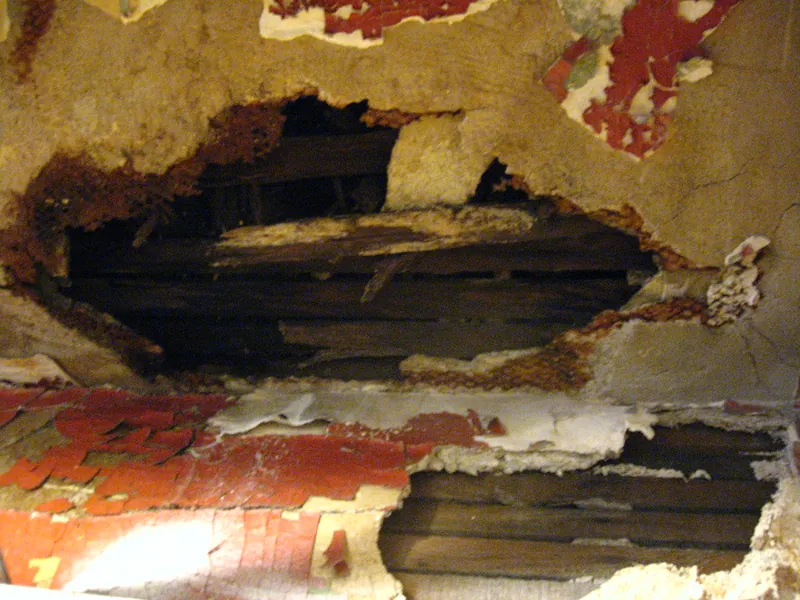
Shut the nearest valve or the house main the moment a burst pipe in Birmingham shows itself, open a low tap so the lines drain, and photograph the damage while it is still wet. Fixing the line is plumbing work; pulling out the water and drying the framing falls to a restoration team. The EPA target is soaked materials dried out in 24 to 48 hours, which keeps mold from taking hold.
A pipe just burst in my Birmingham house: what should I do first?
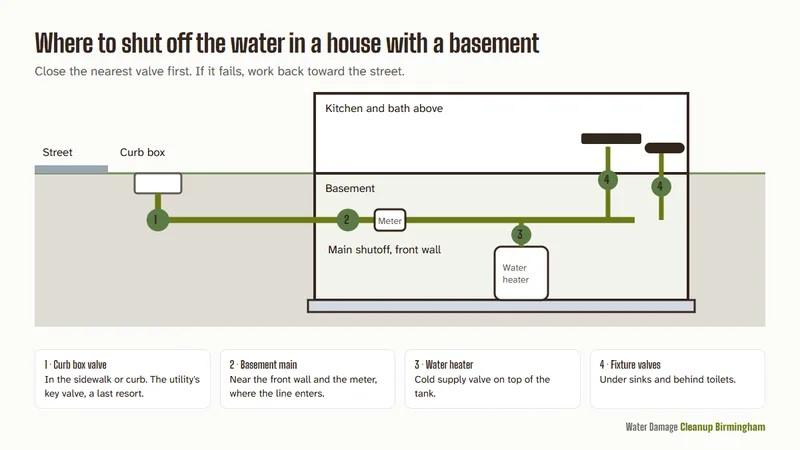
Close a valve. A cracked supply line keeps feeding water into the walls and floors for as long as the system stays pressurized, so a burst pipe in Birmingham is a shutoff problem before it is a cleanup problem. Use the stop under the fixture if the break is visible, or the house main if you cannot see it.
- Turn off the water. Look where the service line comes in, often a crawl space wall, lower-level corner or utility room, and turn the handle clockwise.
- Keep clear of wet wiring. Flip the breaker for the soaked area only if the floor at the panel is dry. If water has reached the panel, leave the shutoff to an electrician or the electric utility on your bill.
- Let the pipes empty. A cold faucet opened on the lowest floor sends the water still trapped in the plumbing down a drain instead of out through the crack.
- Record the scene on video before moving anything.
- Call a plumber to repair the line, then report the loss to your insurance agent.
- Arrange extraction and drying with a restoration team once the flow has stopped.
If the water has reached more than one room, the emergency water damage restoration page sets out what a restoration team tends to handle on arrival. Water dripping through a light fixture or a sagging spot overhead belongs on the ceiling water damage page.
How often does Birmingham get cold enough to freeze pipes?
More often than the mild reputation suggests. Wikipedia's climate section says Birmingham averages 47 days a year with a low at or below freezing, and about 1.4 days when the high never climbs above freezing. Those rare all-day freezes are when pipes in crawl spaces and outside walls are most at risk.
January is the coldest month, with a daily mean of 43.8 F according to the same article. The record low of minus 10 F dates to February 13, 1899, and the 1993 Storm of the Century left 10.3 inches of snow on March 13, 1993, the city's highest daily snowfall on record.
Houses in a mild climate are not always built with deep cold in mind. A supply line run along an uninsulated wall or through an open crawl space may go years without trouble, then split during the one night that stays well below freezing.
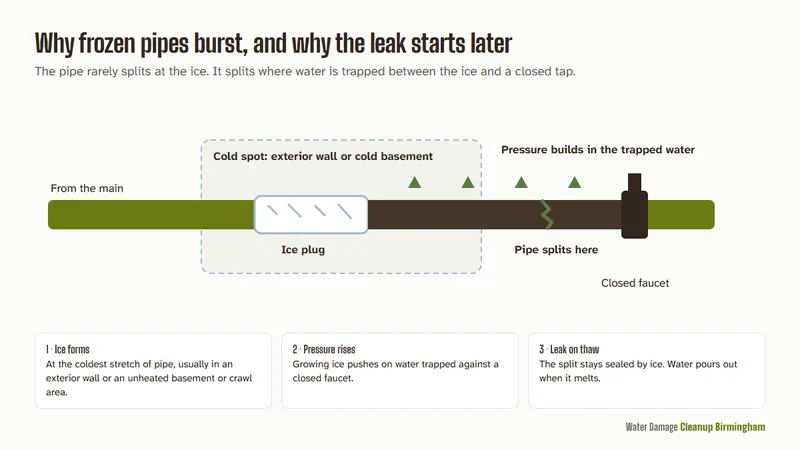
The ice plug itself rarely breaks the pipe. It traps a short column of water between the ice and a closed faucet, and as more ice forms, pressure in that column climbs until a fitting or seam gives way.
That is why so many Birmingham pipe breaks are found on the first warm afternoon after a freeze. The crack was there overnight, but it stayed sealed until the ice let go.
Which pipes freeze first in Birmingham crawl spaces and exterior walls?
The ones farthest from the heat. Red Cross guidance names kitchen cabinet lines and supply pipes running through unheated interior spaces, such as a crawl space, attic, garage or basement, as the ones at greatest risk. Whatever the age of the house, those are the runs a hard freeze reaches first.
| Pipe location | Why it gets cold | What you may notice | First call |
|---|---|---|---|
| Crawl space under an older house | Open vents, gaps in the skirting or block wall, no pipe insulation | A hissing sound under the floor, or a cold, soft spot in the room above | Plumber |
| Kitchen or bath sink on an outside wall | Thin insulation between the line and the brick or siding | One faucet gives nothing, then the cabinet floor turns wet | Plumber, then a drying team |
| Garage wall or the floor over a garage | An unheated garage tracks the outdoor temperature | Water on the garage floor, or a stain on the ceiling below a bonus room | Plumber, then a drying team |
| Hose bib and its feed line | A hose left connected holds water in the valve body | Water running down the foundation or into the crawl space at the first thaw | Plumber |
On hillside lots, a lower level cut into the slope often has its own exposed corners and outside walls. When a line breaks inside a finished wall, the wet drywall page explains what usually gets cut out, and the basement flooding page covers water pooling on a lower floor.
How can I thaw a frozen pipe safely?
Open the faucet the frozen line feeds, then apply mild heat beginning near the faucet and moving back toward the blockage. The Red Cross approves four kinds of gentle heat: hot, wet towels wrapped on the line, a hair dryer, an electric heating pad, or a portable space heater placed well clear of anything flammable.
- Keep the faucet open while you work. Moving water helps melt the rest of the ice, and a growing stream tells you the line is clearing.
- Keep fire out of it. Red Cross guidance rules out any open flame, which means no blowtorch, no charcoal stove and no heater that burns propane or kerosene.
- If a split is already visible, shut the main before you warm the pipe, or the thaw will simply start the leak.
- A frozen run hidden inside a wall is a job for a plumber, who can open the drywall without cutting into wiring.
Once flow returns, try every tap in the house. One that still runs dry points to a second frozen section somewhere else.
For a week or so after a thaw, check nearby rooms for a musty odor, a floor that gives underfoot or a stain that grows. The signs of water damage guide lists the less obvious clues.
What happens if a pipe bursts while the house is empty?
The water runs until someone notices, which can mean days. A break in a vacation house, an inherited property or a rental between tenants can spread through every level below the leak, soaking subfloor, joists and insulation along the way. A short trip during a cold snap carries the same risk.
Before you leave in cold weather, keep the heat set no lower than 55 F day and night, as Red Cross guidance advises, and let cold water drip from faucets fed by exposed pipes. A furnace that fails or a breaker that trips undoes both steps, so ask someone to look in on the house.
Some owners shut off the main and drain the system entirely before a long absence. A plumber can show you how on your own setup.
Check your policy too. Upkeep is the owner's job, and Triple-I notes that policies will not cover damage caused by lack of maintenance. Many policies also set conditions for homes left vacant, so read that section before winter. Renters and condo owners have a separate set of questions, covered on the renters and condos page.
Is the leak on my side or a water main in the street?
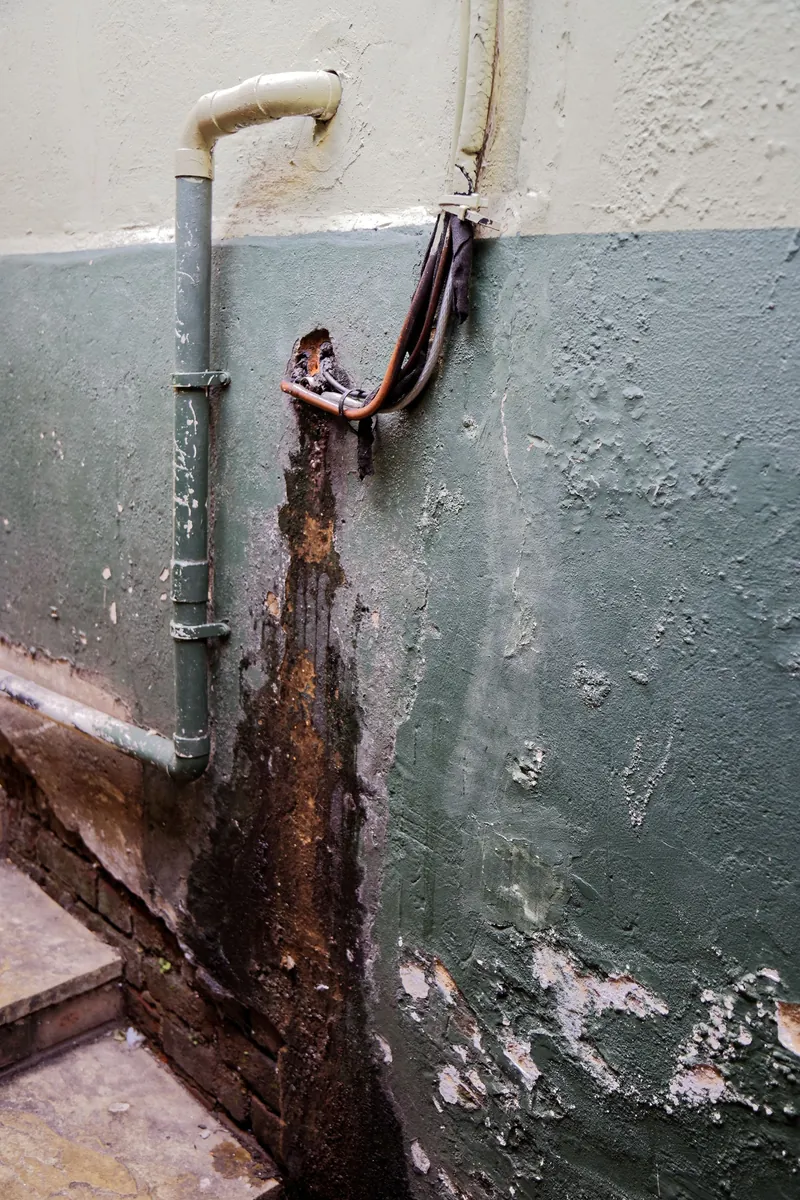
Shut your own main valve and watch the water. If it keeps bubbling up in the yard, running along the curb or seeping into the crawl space with your valve closed, the leak is likely on the utility's side of the meter. That one test sorts the call between a plumber and the water restoration team.

Wikipedia says the Birmingham Water Works Board serves all of Jefferson County plus northern Shelby and western St. Clair counties, and that Bessemer runs its own water and sewer system. Outside those areas, the restoration team is the one named on your bill.
Report a suspected main break to that restoration team, and photograph where the water is entering the house. Note the time you found it and who you spoke with.
Water that has crossed soil, lawn or pavement is no longer clean. Wear gloves and rubber boots, and see the water removal page for how a flooded crawl space or lower level is pumped out. If a bill jumps after a leak, the utility leak adjustment page explains what to ask.
Does homeowners insurance cover a burst pipe in Alabama?
In most cases, if the break was sudden and accidental. According to Triple-I, standard homeowners forms list accidental discharge of water from plumbing or a household appliance as a named peril, and freezing of those systems as another. A leak that dripped for months, or a vacant house left unheated, can be treated differently.
The NAIC draws the line by source. A leak from the plumbing inside the house is the kind usually covered. Water that soaks up through the soil, washes in as yard runoff or comes from snowmelt usually is not. Ask the plumber to save the failed fitting or section of pipe, since an adjuster may want to see it.
These losses are common. Triple-I figures show that in a typical year about one in 60 insured homes has a property damage claim tied to water damage or freezing. For 2019 through 2023, those claims averaged $15,400.
Alabama claim deadlines
Alabama Department of Insurance claim standards, Ala. Admin. Code r. 482-1-125, set the clock. Under rule 482-1-125-.06, the insurer has 15 days after notice of your claim to acknowledge it, unless payment goes out first, and 15 days to answer to other written messages from you that ask for a response.
Rule 482-1-125-.07 says you must be told whether the claim is accepted or denied in 30 days after the insurer receives proofs of loss, or the number of days in the policy, and a denial must name the provision it relies on. If more time is needed, the insurer must say why, then write again 45 days later and every 45 days while the investigation stays open.
The Alabama Department of Insurance takes complaints. For the full claim timeline, read the Birmingham water damage insurance claims guide.
What should I document for a burst pipe claim?
Document both the damage and what you did to keep it from growing. Triple-I advises contacting your agent promptly, taking reasonable steps to protect the property, and photographing or filming everything. Keep damaged items until the adjuster has seen them, and hold off on major permanent repairs until the assessment is done.
- A walk-through video of each room, followed by close photos of the crack, the stain lines and every ruined item.
- The broken fitting or length of pipe, which the plumber can tag with the date and its location.
- A room-by-room list of lost belongings, with a rough purchase year and price for each.
- Every receipt tied to the leak: rented fans, a dehumidifier, shop vacuum bags, a motel night, meals out.
- Written bids that itemize materials and prices one line at a time, which Triple-I suggests asking for.
When the offer looks low, Triple-I says to talk with your agent or the claim department manager first, and notes that many policies allow an independent appraisal. Public adjusters may take up to 15 percent of the payout, Triple-I adds, so check one with the state insurance department before signing.
How does a restoration team dry a house after a pipe break?
A supply line carries clean water, which the IICRC S500 standard classes as Category 1. That can change if it sits for a while or runs through a dirty crawl space, so a restoration team checks before deciding what can be saved. The work then follows a set order: extract, remove, dry, measure, repair.
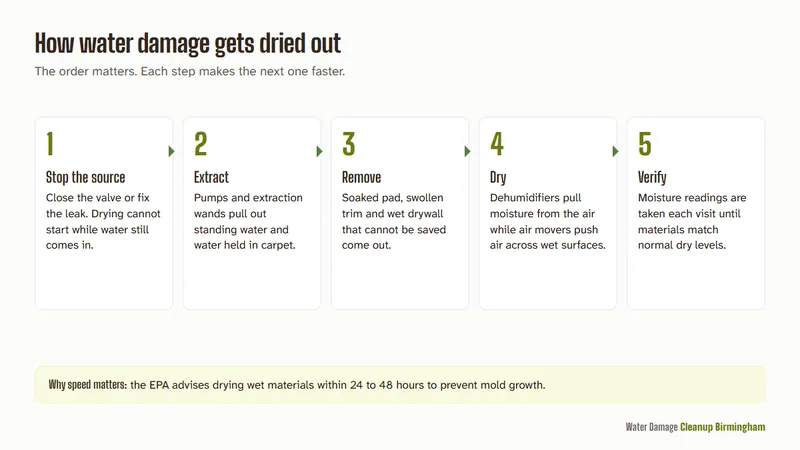
- Extract the standing water with pumps where it is deep and wands on carpet and hard floors.
- Tear out what cannot be saved, usually carpet pad, wet batts of insulation and baseboard that has swelled.
- Run dehumidifiers and air movers, with the number of units matched to how much of the house is wet.
- Check the meters on every visit and keep a written log until the subfloor, studs and drywall reach dry readings.
Birmingham's humid climate slows that process, so the EPA's guidance matters: aim to have soaked building materials and contents dry in the first 24 to 48 hours, and keep indoor relative humidity below 60 percent, ideally somewhere between 30 and 50 percent. The structural drying page covers moisture targets. What each visit covers varies from one restoration team to the next, so ask for the plan in writing.
How do I protect Birmingham pipes before the next hard freeze?
Keep heat on the plumbing and water moving through it on the coldest nights. The Red Cross steps for an empty house, a thermostat at 55 F or higher around the clock and a drip from faucets on exposed lines, work just as well for an occupied Birmingham home when forecasters call for a deep freeze.
- Open sink cabinet doors on outside walls on bitter nights so warm room air reaches the pipes.
- Wrap exposed lines in the crawl space, garage and any unheated lower-level corner with foam pipe sleeves.
- Disconnect garden hoses in the fall and close the inside shutoff for each outdoor faucet if you have one.
- Seal gaps in crawl space skirting, foundation vents and around the rim joist where cold air gets in.
- Find the main valve on a calm day and turn it once, so a stuck handle is not discovered during a leak.
The water damage prevention guide has a seasonal checklist for the rest of the house.
Sources: Wikipedia, Birmingham, Alabama (climate and utilities); Red Cross: preventing and thawing frozen pipes; Triple-I: which disasters a homeowners policy covers; Triple-I homeowners and renters claim statistics; Triple-I guide to settling disaster claims; NAIC homeowners insurance consumer guide; Ala. Admin. Code r. 482-1-125-.06; Ala. Admin. Code r. 482-1-125-.07; IICRC S500 category definitions; EPA drying and humidity advice.