The short version
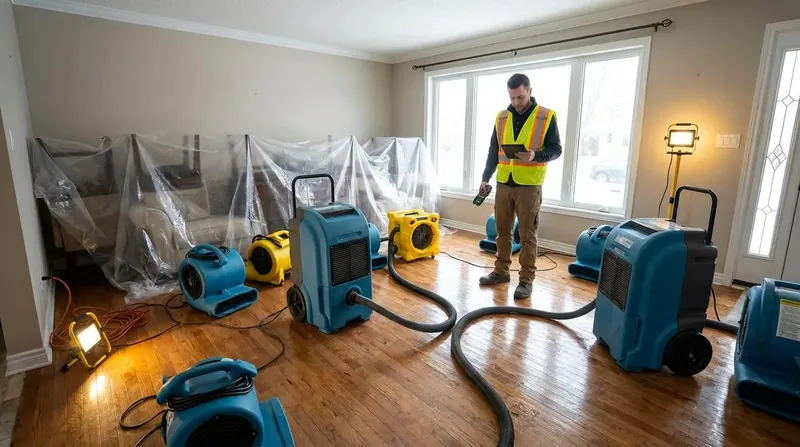
Water mitigation in Birmingham is the urgent first stage after a leak or flood. The supply gets closed, pooled water is pulled up, ruined materials come out, and a restoration team dries the structure while logging meter readings. EPA mold guidance gives wet materials a 24 to 48 hour drying window. Muggy Birmingham summers slow drying, so go by the readings, not by touch.
What does water mitigation in Birmingham involve?
Water mitigation in Birmingham means the protective work done right after a leak or flood so the damage stops growing. Once the water source is shut off, the job is to pull out standing water, take out soaked materials that cannot be dried, and run drying equipment until meter readings confirm the structure is dry.
Most calls start with something small that ran too long. A toilet supply line lets go overnight, a sump pump stalls in a thunderstorm, a crawl space pipe splits in a cold snap, or a downpour pushes water through a hillside basement wall.
When you call, you reach a local water damage restoration team, which sets its own scope, schedule and pricing. This page lays out the usual order of work so you know what to expect and what to ask.
Where does mitigation end and the rebuild begin?
Mitigation is the emergency half of a water loss: it stops the spread and dries the building. Restoration, or the rebuild, comes later and puts back the drywall, flooring, trim and cabinets that had to go. One company may do both halves, or only the first, and insurers often write them as two estimates.
| Point of comparison | Mitigation | Rebuild |
|---|---|---|
| Main goal | Halt the spread and get moisture out of the house | Make the rooms look and work as they did before |
| Typical equipment | Extractors, pumps, air movers, dehumidifiers, moisture meters | Drywall, joint compound, paint, flooring, trim, cabinets |
| Finish line | Wet materials read the same as dry ones in an untouched room | A final walkthrough of the finished space |
| Timing with the claim | Protective steps are expected without delay | Major permanent work usually waits for the adjuster |
That bottom row comes from Triple-I guidance for policyholders. The rest is a general picture of how these jobs run, and no two restoration teams work exactly alike. Say early on whether you want drying only or the whole project. The second half is covered on our water damage repair page for Birmingham.
What should you do before a mitigation team gets to your Birmingham home?
Stop the water, keep away from anything electrical, and take photos before you start cleaning. None of that costs money, and each step helps. Closing the valve keeps the wet area from growing, and early photos give your adjuster a clear record of the loss as you found it.
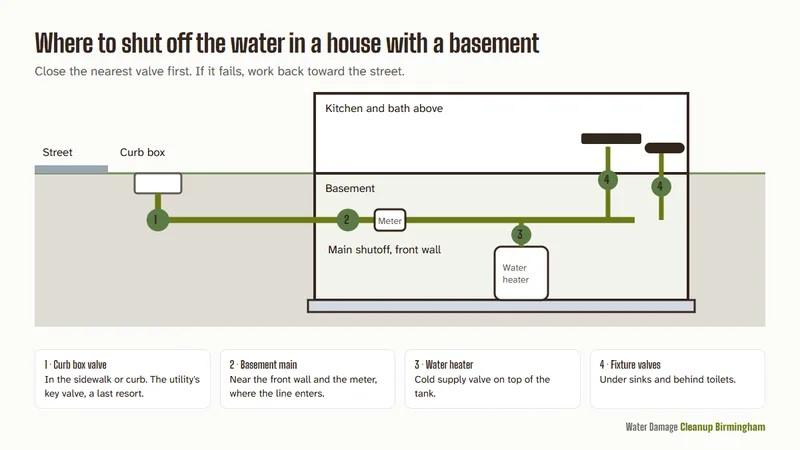
- Close the main water valve. It is usually where the service line comes into the house: in a basement, a crawl space, a utility closet or near the water heater. Our emergency water damage page covers the next moves.
- Treat wet wiring as live. If water reaches outlets, cords, a furnace or the breaker panel, stay out of that room and have an electrician or the power company shut it off.
- Take pictures first. Get each room from the doorway, the source up close, and the height the water reached on walls and furniture.
- Carry out what you can lift. Move papers, photos and electronics somewhere dry.
- Report the loss. Phone the insurance company, jot the claim number on paper you keep handy, and log every conversation and visit with its date.
Ice in a pipe that has not split yet calls for low, steady warmth. The American Red Cross names a hair dryer, a heating pad or hot wet towels as safe choices and rules out torches and any other open flame. The burst pipe page picks up from there.
What happens when the mitigation crew shows up?
That opening visit is mostly measuring and removing water. A restoration team usually checks that the leak is stopped, decides how contaminated the water is, maps the wet area with moisture meters, extracts what is pooled, pulls out soaked pad or drywall, and sets air movers and dehumidifiers running before leaving.
Expect the wet zone to be larger than the stain you can see. Water travels under baseboards and cabinets, wicks up drywall, and spreads through carpet pad, so ask the technician to mark where each reading was taken. Later readings should come from those same points.
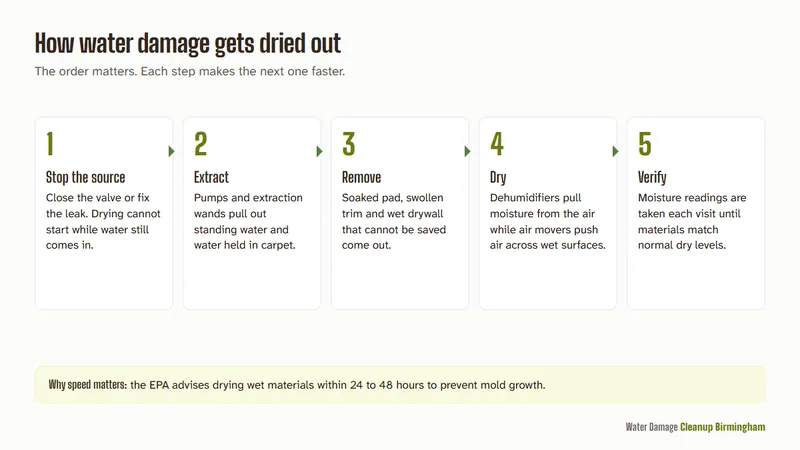
The pumping and vacuuming side of the job has its own page on water removal in Birmingham. Before the crew leaves on day one, ask for the starting readings and photos in writing, because later choices about equipment days and tear-out get compared against them.
Does clean water, grey water or sewage change mitigation?
Yes, the type of water steers most of the plan. In the IICRC S500 standard, Category 1 is clean, Category 2 is grey and Category 3 is grossly contaminated. Clean supply-line water can often be dried where it sits, grey water needs cleaning first, and sewage or outside floodwater usually means soaked porous materials go.
| Category | A Birmingham-area example | Common response |
|---|---|---|
| 1, clean | A supply pipe in an exterior wall that split during a hard freeze | Often dried in place |
| 2, grey | Dishwasher or washing machine water spreading across a kitchen | Surfaces cleaned, some soft items thrown out, then drying |
| 3, grossly contaminated | Creek water across a yard into a basement, or sewage up through a floor drain | Porous materials removed, hard surfaces sanitized |
The category labels come from the standard, and the examples are ours. Clean water left sitting for days can degrade into a dirtier category. For a house hit by sewage or other dirty water, EPA cleanup guidance points owners to a professional with experience in that kind of damage.
Backups through drains are explained on sewer backup cleanup, and water that came over the ground from a creek or street is covered on flood cleanup in Birmingham.
How quickly does water mitigation need to start to prevent mold?
As soon as the water is off and the space is safe to enter. EPA guidance on mold sets a 24 to 48 hour target for getting soaked materials and belongings dry. Hitting that target depends on extraction and dehumidifiers getting going early, and every lost day tends to mean more tear-out later.
Drying ends when the meters say it does, not on a calendar date. A restoration team tests the same material in a part of the house the water missed, and the job is done when the wet area matches that dry reference.
A low-cost hygrometer lets you watch the room air yourself. Aim for a reading in the 30 to 50 percent band the EPA prefers, and treat anything at 60 percent or higher as too damp. Drying framing, subfloor and concrete is explained in more depth on the structural drying page.
Why do Birmingham's humid summers make mitigation harder?
Wet materials dry by giving moisture to the air, and muggy air has little room to take it. Wikipedia describes Birmingham's climate as humid subtropical, with hot summers and high humidity. Opening windows on a sticky afternoon can let more water vapor into a soaked room than leaves it.
So restoration teams generally keep the house closed and let dehumidifiers do the work. The machines dry the room air, and that drier air then draws moisture out of drywall, framing and carpet.
The same article says most summer rain in Birmingham comes from thunderstorms, mostly in the afternoon and evening. A leak that started in one storm can be refilled by the next, so a temporary roof cover or tarp is part of mitigation after storm damage. Our page on storm roof leaks covers that side.
Which Birmingham floods and storms lead people to need water mitigation?
Fast creek rises in Jones Valley and Shades Valley cause many of them. NWS gauge records show Village Creek at Avenue W in Ensley cresting at 14.8 feet on December 3, 1983, and Shades Creek near Homewood reaching 19.88 feet on September 16, 2004. Water at those levels finds low floors, garages and basements.
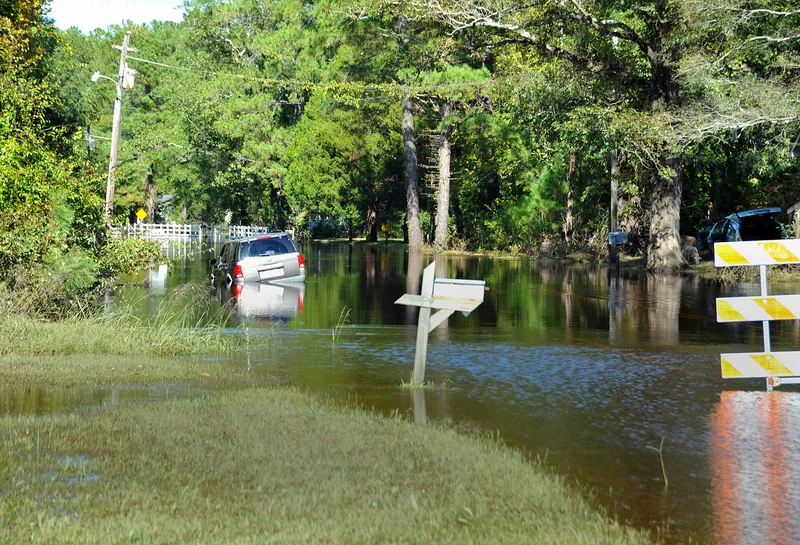

Those are not one-time events. Shades Creek near Homewood crested at 18.79 feet on May 4, 2021, according to the same NWS gauge history, well over its 14 foot minor flood stage. Valley Creek at Center Street reached 12.89 feet on September 15, 2024, above its 11 foot minor stage.
Severe weather adds roof and window damage. Wikipedia places Birmingham in Dixie Alley and notes F5 tornadoes in the northern suburbs in 1977 and the western suburbs in 1998, plus an EF4 in April 2011. Keep out of flooded streets on the way home; per Ready.gov, a current six inches deep is enough to knock an adult over. More history is on Birmingham flooding.
Will an Alabama homeowners policy pay for mitigation?
Often, when the policy covers the cause of the water. Triple-I asks policyholders to protect the house from more harm right away while leaving big permanent fixes until an adjuster has assessed the loss. Extraction and drying fall on the protective side of that line, so insurers generally expect them early.
The cause carries the most weight. NAIC consumer guidance draws the line this way: plumbing leaks and roof leaks are usually paid, while rising ground water, storm runoff and snowmelt are left out. Triple-I adds that flood coverage is a separate policy and that sewer backup is bought as its own endorsement.
- Save every receipt, including fans, tarps and trash bags you bought.
- Keep damaged items until the adjuster has seen them.
Alabama's claim standards, Ala. Admin. Code r. 482-1-125, require an insurer to acknowledge a first party claim in 15 days unless it pays in that time. After proofs of loss, the claimant is told the status of acceptance or denial in 30 days or the period the policy sets. Our insurance claims guide goes further.
What does water mitigation cost in Birmingham?
We know of no Birmingham price survey to cite, so national guides are the closest yardstick. Fixr's January 31, 2025 update gives a typical span of $1,200 to $5,000 for restoration, averaging $3,000 nationwide. An actual quote turns on the water category, the square footage and the amount of material removed.
- Per square foot to extract clean water, Fixr lists $3.75 to $4.25.
- For grey water, its per square foot range rises to $4.10 to $6.50.
- For black water, Fixr shows $7 to $7.50 per square foot.
- Fixr also prices jobs by damage class: a Class 1 job runs $150 to $400, Class 2 from $500 to $1,000, and Class 3 from $1,000 to $3,000.
Read these as context, not as what any restoration team here will charge. Triple-I numbers show what is at stake: water damage or freezing leads to a claim at roughly one insured home out of 60 each year, and from 2019 through 2023 the average one cost $15,400. See the restoration cost guide for more.
What should you ask before signing a mitigation work order?
Find out what the paperwork covers, how drying equipment is charged by the day, what moisture reading counts as finished, and whether your signature also hands that company the rebuild. A work authorization binds you like any contract, and some carry an assignment of insurance benefits or lien language.
- Does this cover drying only, or drying and the rebuild?
- How are equipment days counted, and what would raise the price?
- Who covers the gap if the insurance payment is less than the bill?
- Will I receive dated moisture readings and photos when drying ends?
Ask for bids on paper with each material and its price on a separate line, as Triple-I suggests. We never sign anything for you. Our guide to choosing a restoration company in Birmingham has more questions, and the mold guide explains what happens if growth turns up behind an opened wall.
Sources: Fixr restoration costs, updated January 31, 2025; NWS gauge ENSA1, Village Creek in Ensley; NWS gauge SCHA1, Shades Creek near Homewood; NWS gauge VALA1, Valley Creek at Center Street; Wikipedia article on Birmingham (climate, Dixie Alley, tornadoes); EPA mold and moisture guide (24 to 48 hours, humidity targets, 10 square feet); EPA guidance on contaminated water cleanup; CDC on mold and health; Red Cross frozen pipe advice; Ready.gov flood safety; Ala. Admin. Code r. 482-1-125-.06 and 482-1-125-.07; Triple-I on flood and sewer backup coverage; Triple-I claim settlement advice; NAIC homeowners coverage basics; Triple-I water and freezing claim figures; IICRC S500 (Category 1, 2 and 3 definitions).