The short version
Flood cleanup Birmingham AL homeowners face begins with one rule: water from a creek, a river or street runoff counts as Category 3. Anything porous it soaked, from drywall and insulation to carpet and sofas, is removed; studs, slab and tile get cleaned, disinfected and tested dry before rebuilding. Flood is excluded from a standard homeowners policy, so the claim normally runs through NFIP or private flood coverage.
How is flood cleanup in Birmingham AL different from a pipe leak cleanup?
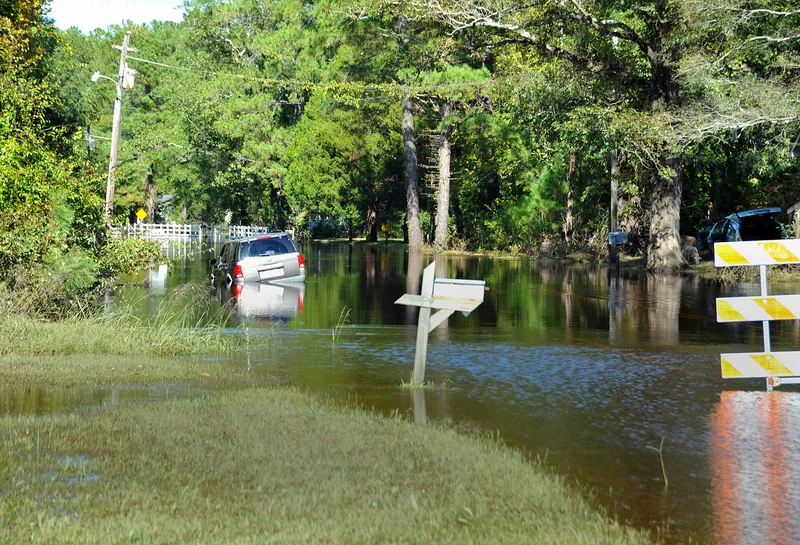
A broken pipe releases treated water from inside the house. Flood water arrives from outdoors, out of a creek, a river or runoff across the street and yard, and it brings silt, sewage, oil and chemicals with it. That changes the job: contaminated materials are removed and surfaces disinfected before any drying starts.
Flood cleanup Birmingham AL homeowners face is graded under the IICRC S500 standard, which puts creek and river water that rises into a building, and surface water flowing in from outdoors, in Category 3 alongside sewage. That rating decides how much drywall, insulation, flooring and furniture leaves the house.
A clean-water leak from a supply line is a lighter job. The water removal page covers that kind of loss, and the emergency water damage page lists the first moves for any leak.
When is it safe to go back into a flooded house?
Wait for three things: an all-clear from local officials, water that has stopped climbing, and electricity shut off to every flooded room. Leave right away if you smell gas or the structure looks unsound. Dress for contaminated water, because flood water carries sewage and debris even when it looks clear.
- Respect moving water. Ready.gov warns that moving water knocks people down at a depth of only six inches, and that one foot of it is enough to carry off a vehicle. Turn around at any flooded dip in the road.
- Treat wet wiring as live. Keep away from the panel and any outlet or cord that is under water until an electrician or the power company has cut service.
- Get out if you smell gas. Call the gas utility once you are outdoors and well away from the house.
- Wear protection. The CDC advises boots, gloves and eye protection for this work, plus open windows for fresh air.
Keep children and pets somewhere else until the mud is gone and hard surfaces are cleaned. The kids and pets cleanup safety page covers that in more depth.
Where does flood water come from around Birmingham?
Most flooding in the Birmingham area comes from small creeks and rivers that rise fast in heavy rain, plus runoff that overwhelms streets, ditches and storm drains. Jones Valley drains to Village Creek and Valley Creek, Shades Creek runs along the north edge of Shades Mountain, and the Cahaba River rises near Trussville.
The Wikipedia article on Birmingham describes the city sitting in Jones Valley between long ridges, with the valley drained by Village Creek and Valley Creek into the Black Warrior River. Water off the ridges reaches the valley floor quickly.
The Shades Creek article traces the creek from Red Mountain through Irondale, Mountain Brook, Homewood, Hoover and Bessemer, and notes that a 2021 watershed management plan listed stormwater management and poor flood management among the main problems facing the creek. The Cahaba River article places its headwaters near Trussville and Birmingham, with the river passing through Leeds and Irondale.
Farther out, the Black Warrior River runs past Cordova and Tuscaloosa, and the Coosa River past Gadsden and Childersburg. The Birmingham flooding page looks at each creek, and the town pages for West End and Ensley and Homewood and Mountain Brook cover the neighborhoods along them.
How high have Birmingham creeks and rivers crested?
National Weather Service gauges show how far local streams can climb. Village Creek in Ensley reached 14.8 feet in December 1983, above its 13-foot moderate flood stage. Shades Creek near Homewood hit 19.88 feet in September 2004, and the Cahaba at Trussville reached 19 feet in May 2003.
| NWS gauge | Minor flood stage | Notable crest | Date |
|---|---|---|---|
| Village Creek at Avenue W, Ensley | 10 ft | 14.8 ft (highest listed) | Dec 3, 1983 |
| Shades Creek near Homewood | 14 ft | 19.88 ft | Sept 16, 2004 |
| Valley Creek at Center Street | 11 ft | 12.89 ft | Sept 15, 2024 |
| Cahaba River at Trussville | Not set | 19 ft | May 7, 2003 |
| Black Warrior River at Cordova | 22 ft | 41.5 ft | Mar 14, 1909 |
Recent years have been active too. Shades Creek near Homewood crested at 18.79 feet on May 4, 2021 and 17.09 feet on October 7, 2021, and Village Creek in Ensley reached 14.22 feet on June 20, 2021. Each gauge page on the NWS site shows live readings during a storm.
What should you do first once the flood water goes down?
Start with safety and records, not scrubbing. Confirm that power and gas are off, put on boots and gloves, and photograph every room, the waterline on the walls and each damaged item. Then call your flood insurer to open the claim and ask for a restoration team that handles Category 3 cleanup.
- Keep power off. Have an electrician check any panel, outlet or appliance that sat in water before it is used again.
- Document it all. Take wide shots and close-ups, measure the water line on the wall, and list damaged belongings with model numbers where you can.
- Open the claim. Triple-I tells policyholders to call right away and to hold on to ruined items so the adjuster can inspect them.
- Protect what is left. Move dry belongings to a clean, dry room and keep receipts for anything you buy to stop more damage.
- Get the mud out. Shovel silt out while it is still soft, wearing protective gear, if the house is safe to enter.
- Request a restoration team. Explain that the water came from outside so the right equipment and protective gear are sent.
The insurance claims guide explains how the paperwork moves after that first call.
What gets torn out after outside water comes into a house?
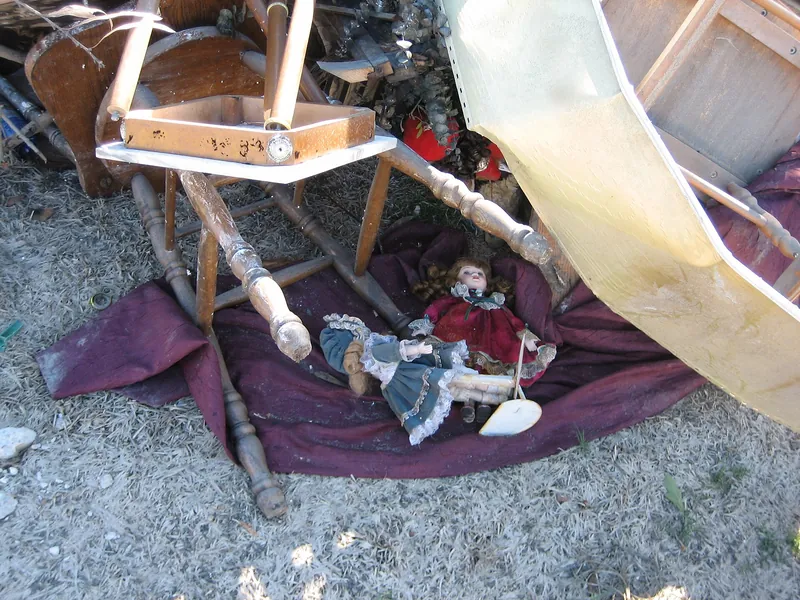
Because flood water is Category 3, absorbent materials it touched usually have to go. That means carpet and pad, wet drywall and the insulation behind it, upholstered furniture and mattresses. Hard surfaces such as studs, concrete, tile and metal are cleaned, disinfected and dried, then checked with a moisture meter before anything is rebuilt.
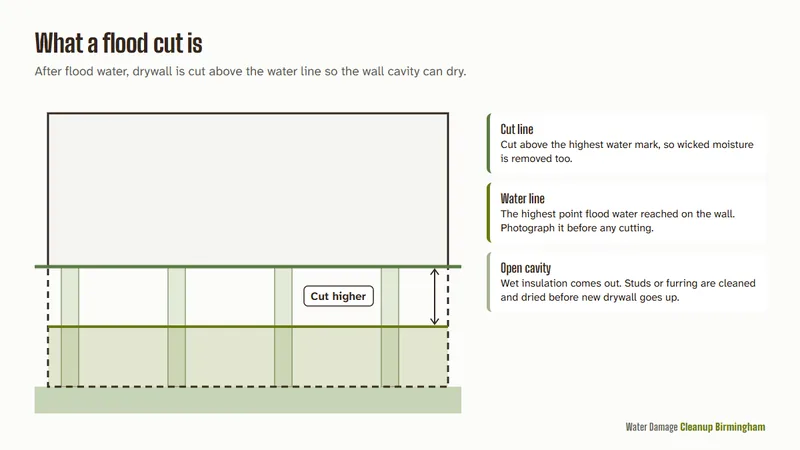
Restoration teams often make a flood cut, a straight line cut across the wall a little above the highest water mark. Everything below it comes out, and the framing is left open so it can dry and be treated.
The wet drywall page explains how cut heights are chosen, and the contents pack-out page covers moving salvageable belongings out for cleaning.

How do you disinfect a house after a flood?
Clean hard surfaces first with soap and water or a household cleaner to lift the mud, then disinfect. For that step the CDC caps the solution at one cup of household bleach per gallon of water. Never let bleach meet ammonia or another cleaning product, open the windows, and keep gloves, boots and goggles on.
The CDC also urges a complete, quick dry-out after a flood, in the first 24 to 48 hours where possible. Its guidance is to discard carpet and upholstered pieces that got soaked and cannot be dried promptly.
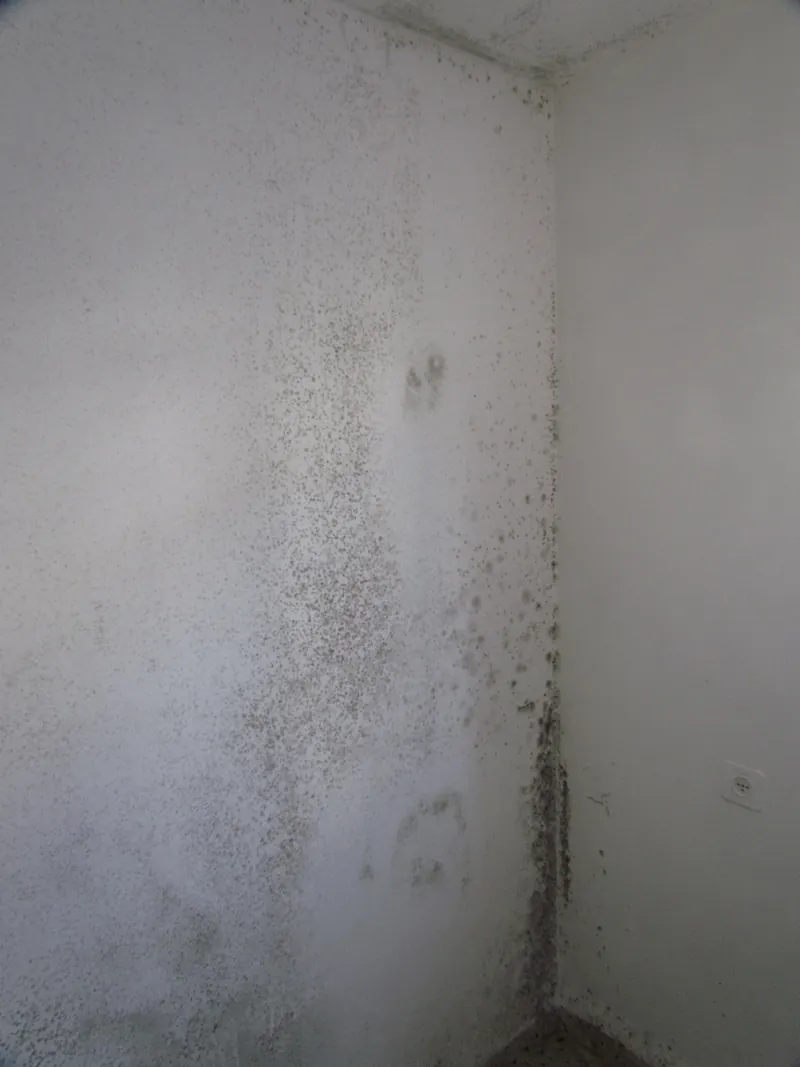

The EPA warns against painting or caulking over moldy surfaces, and it recommends a professional with contaminated-water experience when sewage or flood water caused the damage. If growth is already showing, turn to the mold after water damage guide.
When is a flooded house dry enough to rebuild?
Rebuilding should wait until moisture readings in the studs, sill plates, subfloor and concrete come back to normal levels, measured against a part of the house that stayed dry. Closing walls over wet framing traps moisture and invites mold, so ask the restoration team for readings in writing before drywall goes back up.
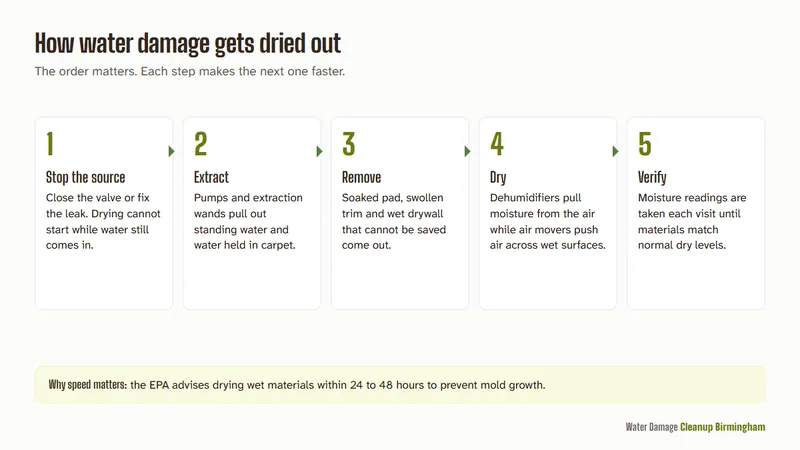
Humid weather slows that process. The Wikipedia climate summary for Birmingham calls the city humid subtropical, with hot, humid summers. For indoor air, the EPA moisture guide wants relative humidity under 60 percent and prefers 30 to 50 percent.
Dehumidifiers, air movers and sometimes heat are used to reach that range. The structural drying page and the water damage repair page explain what comes next.
Does homeowners insurance pay for flood cleanup in Alabama?
Usually not. Standard homeowners and renters policies exclude flood damage, so cleanup after creek, river or overland water normally falls to a separate flood policy from the NFIP or a private insurer. Check your declarations page and call your agent to find out which policy, if any, applies before work begins.
FEMA states that most homeowners insurance does not cover flood losses, and Triple-I says flood coverage is sold separately through the NFIP and a few private companies. On a single-family home, an NFIP policy reaches $250,000 for the structure and $100,000 for belongings at most, per FloodSmart.
Timing matters too. New NFIP policies do not take effect for 30 days, apart from a few exceptions listed in the FEMA NFIP manual, so coverage bought as the creek rises comes too late for that storm.
What if sewage backed up into the house during the flood?
Backup through the drains is its own gap: Triple-I says neither the usual homeowners form nor a flood policy picks it up, and owners buy an endorsement for it. If you have one, tell the adjuster which damage came from the drain and which came in from outside. The sewer backup cleanup page covers that work.
Under Ala. Admin. Code r. 482-1-125, insurers acknowledge a claim within 15 days unless they pay in that time, and must say whether it is accepted or denied within 30 days after proofs of loss, or the policy's period.
What questions should you ask a flood cleanup company in Birmingham?
Ask how they handle Category 3 water, what they plan to remove, how they will disinfect, and whether they record moisture readings each day. Ask for a written, itemized estimate and who sends paperwork to the insurer. Each restoration team sets its own services and prices, so confirm everything directly.
- What protective gear and containment do you use for flood water?
- How high will you cut the drywall, and why that height?
- Which disinfectant do you use, and is it safe for kids and pets after it dries?
- Will I get daily moisture readings and photos to send to my insurer?
- Do you haul away debris, or is it left at the curb?
The guide to choosing a restoration company has more vetting tips.
Sources: IICRC S500 water categories; Ready.gov flood safety; CDC on mold and flood cleanup; EPA, Mold Cleanup in Your Home; EPA moisture and humidity guidance; Wikipedia, Birmingham, Alabama (geography, climate); Wikipedia, Shades Creek; Wikipedia, Cahaba River; NWS gauges ENSA1, SCHA1, VALA1, TRSA1, CRDA1; FEMA on flood coverage; FloodSmart NFIP limits; FEMA NFIP Flood Insurance Manual; Triple-I on disasters a homeowners policy pays for; Triple-I advice on settling a claim; Ala. Admin. Code r. 482-1-125.