For Center Point, North Birmingham and Tarrant
For water damage in Center Point, AL or North Birmingham, close the valve or cover the roof opening, take photos and start drying. The EPA gives mold one to two days. Creek water needs a flood policy. ZIPs covered: 35207, 35215, 35217 Tarrant, 35234 and 35235.
Which Center Point and North Birmingham addresses do you take requests from?
Calls about water damage in Center Point, AL, North Birmingham and Tarrant come in from five ZIP codes: 35207 Birmingham, 35215 Birmingham, 35217 Tarrant, 35234 Birmingham and 35235 Birmingham. Four carry the Birmingham name and one is Tarrant. A full street address helps the restoration team check that your house is on its route.
Center Point sits in northeastern Jefferson County and became a city only in 2002, the Center Point article on Wikipedia says. It counted 16,406 residents at the 2020 census.
North Birmingham is older. It incorporated as a city in 1902 and joined Birmingham in 1910, and it now holds six neighborhoods: Acipco-Finley, Collegeville, Fairmont, Harriman Park, Hooper City and North Birmingham itself, per the North Birmingham article. Farther out, see the Trussville and Pinson page, the Gardendale and Fultondale page and the Irondale and Leeds page.
Has a tornado hit Center Point or North Birmingham before?
Several have, and the same corridor keeps coming up. Wikipedia records violent tornadoes crossing northern Birmingham and Tarrant in 1956, 1977 and 2011, and an EF3 striking Center Point in 2012. Each one left houses with open roofs and broken windows, which is how rain gets inside long after the wind has passed.
| Date | Rating | Area named by Wikipedia |
|---|---|---|
| 1956 | F4 | McDonald Chapel, Edgewater, northern Birmingham, Fultondale, Tarrant |
| April 4, 1977 | F5 | Northwest of the city through Hayes Highland and Smithfield Estates, toward Tarrant |
| April 2011 | EF2 inside the city | Pratt City and Fultondale, ending north of Tarrant |
| January 23, 2012 | EF3 | Center Point, including the elementary school |
The 1977 outbreak article notes that some houses built into hillsides near I-65 and US 31 lost their cinder-block basement walls. The 2011 Super Outbreak article traces the later storm past Fultondale before it faded north of Tarrant.
Spring is not the only risk. The Birmingham article describes November and early December as a second severe weather season. After any hard wind, check the attic with a flashlight and look for fresh ceiling stains within a day or two.
For storm-opened roofs, the storm roof leak page covers tarping and photos, and the tornado history page collects the metro record.
What leaks show up in Center Point homes built in the 1960s?
Wear-out leaks from parts that have served for decades. More than 80 percent of the homes inside Center Point's limits went up between 1960 and 1970, Wikipedia reports. A house of that age may still have original drain lines, shutoff valves and fittings, and those tend to fail quietly behind walls or under floors.
Growth came after 1947, when a dependable water supply was found and the farm community could develop, the article adds. Most houses here were built in that single rush, so many owners are dealing with the same aging parts at roughly the same time.
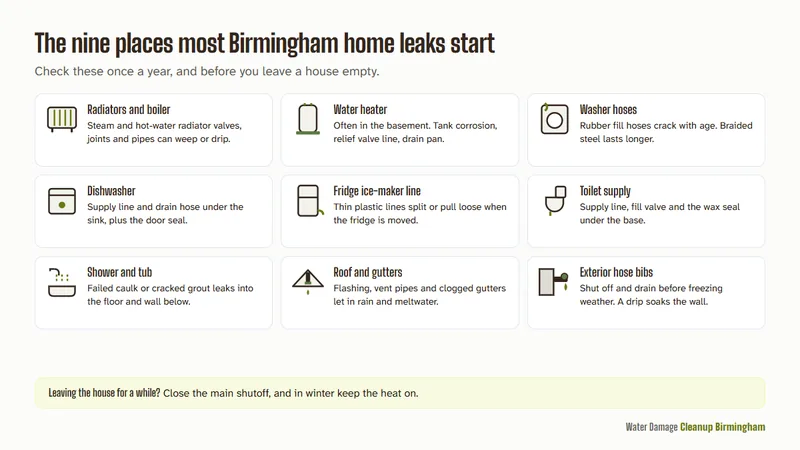
Start with the parts that hold pressure all day: the water heater, washer hoses and toilet supply lines. Then look at the shower pan and around roof vents. For a tank that drips or rusts, read our water heater leak page; for a washer, dishwasher or fridge line, the guide to appliance leaks shows the usual failure points.
Drain lines deserve a look too. A cracked waste pipe under a slab or in a crawl space rarely floods a room. More often it shows up as a sewer smell, a floor that stays damp near a bathroom, or a toilet that gurgles when the tub drains.
Does North Birmingham flood?
The low ground along Village Creek can. Wikipedia names Village Creek as the southern edge of North Birmingham. North of the city, Fivemile Creek near Republic has a National Weather Service gauge with flood stages, and its highest listed crest, 25.41 feet on May 7, 2003, went past the 25-foot major mark.
Big storms tend to hit several creeks at once. On September 5, 2011, Fivemile Creek crested at 16.23 feet and Village Creek at Avenue W reached 14.57 feet, above its 13-foot moderate stage. May 7, 2003 also matched up: on the date of the Fivemile record, the Cahaba River at Trussville crested at 19 feet.
Fivemile Creek near Republic counts as minor flooding at 18 feet, moderate at 22 and major at 25.
If outside water reaches your floor, treat it as contaminated. Never wade or drive into it: Ready.gov says moving water half a foot deep can topple an adult. Our flood cleanup page explains why, and the Birmingham flooding page lists the gauges across the metro.
Who handles water damage in a Center Point rental?
The landlord's policy usually covers the building and the tenant's renters policy covers belongings, but someone has to report the leak first. Center Point had 6,932 housing units at the 2020 census, and 13.7 percent were empty. Its rental vacancy rate was 15.4 percent against 2.6 percent for owner homes.
A unit that sits empty between tenants can leak unseen. Owners should shut the main valve or ask someone to walk through each week. Tenants should report drips in writing and photograph them as soon as they appear.
Renters also carry their own risk. A landlord's policy pays for walls, floors and fixtures, not a tenant's sofa, clothes or laptop. If a pipe bursts in the unit above yours, list what was ruined, take pictures and keep the items until an adjuster has seen them.
Slow leaks also raise coverage questions. Triple-I notes that policies leave out damage caused by poor upkeep. The renters and condos guide covers who pays for what, and the denied claim page helps if an insurer says no.
Does homeowners insurance pay for storm water after a tornado in Center Point?
For rain driven in through storm damage, usually yes. The NAIC treats a roof leak as typically covered, and Triple-I counts an accidental burst from household plumbing or an appliance as a standard covered peril. Creek water rising into the house is flood, which standard policies leave out and a separate flood policy covers.
Alabama sets the insurer's first deadline at 15 days. Under Ala. Admin. Code r. 482-1-125, the company acknowledges your claim in that time unless it pays sooner.
After it receives proofs of loss, it has 30 days, or the period your policy sets, to say whether it accepts or denies. If it needs more time, the rule requires a letter with reasons and then another every 45 days. The Alabama Department of Insurance takes complaints, and the claims guide has a document list.
Between the storm and the adjuster's visit, Triple-I recommends temporary fixes that keep more rain out, such as a tarp or boarded window, while leaving the permanent rebuild for later. Hang on to receipts for those supplies.
What should you do first after water damage in Center Point or North Birmingham?
Stop the water, keep everyone safe and document it all before cleanup starts. Then get the drying going. The EPA ties mold prevention to drying wet items inside one to two days and holding indoor humidity below 60 percent, ideally 30 to 50.
- Shut the main valve for a plumbing leak, or the fixture valve if the leak is at a sink or toilet.
- Switch off breakers for soaked rooms when the panel area is dry, and keep out from under any sagging ceiling.
- Take photos and video of each room and the source; leave ruined items for the adjuster to see.
- Report the claim and keep receipts for tarps, fans and other stopgap supplies.
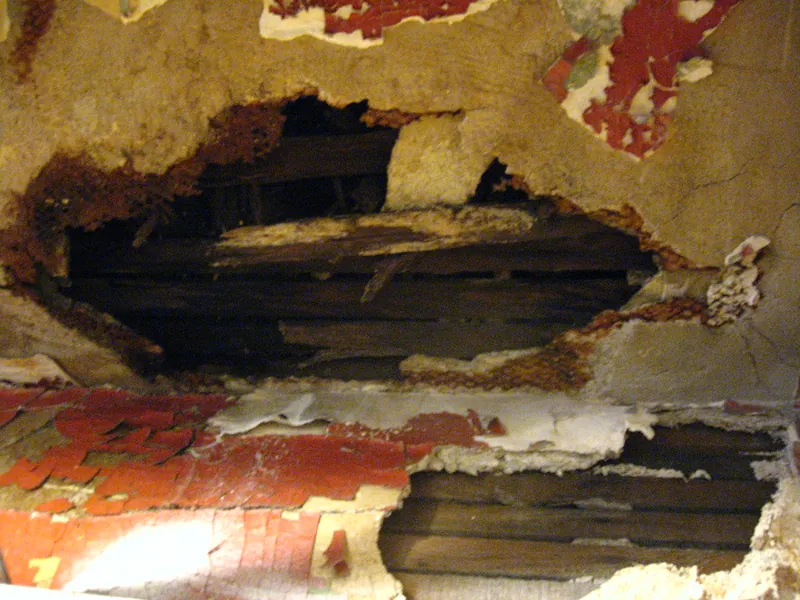
The emergency water damage page explains early extraction, and the ceiling water damage page covers a bulging, wet ceiling after a storm. Restoration teams vary in services and reach, so ask each one directly.
Sources: Wikipedia on Center Point, Alabama (incorporation, 2020 census, 1947 water supply, 1960s housing, 2012 tornado), North Birmingham (neighborhoods, boundaries, 1902 and 1910 dates), the April 1977 tornado outbreak (1956 and 1977 paths, hillside basements) and the 2011 Super Outbreak; National Weather Service gauges REPA1, ENSA1 and TRSA1 (flood stages and crests); Triple-I named perils and exclusions and claim settlement advice; Ready.gov on flood water; Insurance Information Institute claim frequency; Wikipedia, Birmingham (severe weather seasons); NAIC consumer page; Alabama Department of Insurance claim standards, Ala. Admin. Code r. 482-1-125-.06 and 482-1-125-.07; Alabama Department of Insurance; EPA mold prevention timing.