For Hoover, Bluff Park and Riverchase
For water damage restoration in Hoover, AL, close the main, stay clear of wet outlets, photograph the damage and get air moving: the EPA gives wet materials 24 to 48 hours before mold. River or creek water needs its own flood policy. Three Hoover ZIPs are listed: 35226, 35236 and 35244.
Which Hoover addresses do you take requests from?
Water damage restoration in Hoover, AL is covered through three ZIP codes: 35226 Hoover, 35236 Hoover and 35244 Hoover. The 35236 code is a PO box ZIP, so it cannot place a house on a map. Share the street address of the wet building instead, and a restoration team can confirm from it whether you fall inside its area.
Hoover is the sixth-largest city in Alabama, with 92,606 residents at the 2020 census, and it lies in two counties, Jefferson and Shelby, according to Wikipedia. Downtown Birmingham is 11 miles north by I-65 or U.S. 31.
Shades Mountain also reaches into nearby suburbs, covered on the Vestavia Hills page and the Homewood and Mountain Brook page. Downstream on the Cahaba, the Pelham and Helena page takes in the Shelby County towns past Hoover.
Does Hoover flood along the Cahaba River and its creeks?
In low spots, yes. Wikipedia lists Hoover among the cities the Cahaba passes as it runs southwest, and Shades Creek follows the north foot of Shades Mountain before joining the river. Houses up on the ridges rarely see creek water, but homes near those channels and their small side branches can take it after a heavy storm.
The National Weather Service keeps gauges on the Cahaba near Hoover, on Shades Creek near Homewood and on Cahaba Valley Creek at Indian Trail Road in Indian Springs. Only the two creek gauges publish flood stages.
| NWS gauge | Minor / moderate / major | Highest listed crests |
|---|---|---|
| Cahaba Valley Creek at Indian Springs (CISA1) | 8 / 12 / 13 feet | 12.28 feet on Oct. 6, 2021; 10.37 feet on Dec. 28, 2018 |
| Shades Creek near Homewood (SCHA1) | Minor at 14 feet | 19.88 feet on Sept. 16, 2004; 18.79 feet on May 4, 2021; 17.09 feet on Oct. 7, 2021 |
| Cahaba River near Hoover (HOVA1) | No stages published | Readings only |
October 2021 shows how one storm can hit both creeks. Cahaba Valley Creek set its highest listed crest that month, just past moderate stage, and a day later Shades Creek stood about three feet above its minor mark, per the NWS pages.
When creek or river water gets inside, the IICRC S500 standard grades it Category 3, the most contaminated class. The flood cleanup page explains what usually comes out, and the Birmingham flooding page covers the wider metro.
Why do Bluff Park homes on Shades Mountain get wet lower levels?
Because rain runs straight down the slope they are built into. Shades Mountain is a cuesta, a tilted sandstone ridge, and it summits in Hoover's Bluff Park neighborhood, says the Shades Mountain article. Water from the yards and streets above a house collects against its uphill wall during a downpour.
The mountain also holds the highest ground in Jefferson County, at 1,150 feet, according to the county article. Its Shades Sandstone shows at Moss Rock Preserve on the north side of Hurricane Creek, and at Brock Gap the ridge was blasted to let a rail line through.
Wikipedia places all of Hoover along the foothills of the Appalachian Mountains, so sloped lots are common well beyond Bluff Park. A walkout lower level, or a house set below the street, needs the same attention as one on the crest.
What to check on a sloped Hoover lot
Start with the uphill side. Run downspouts well past the foundation, keep the swale or ditch above the house free of leaves, and make sure soil slopes away from the walls rather than toward them.
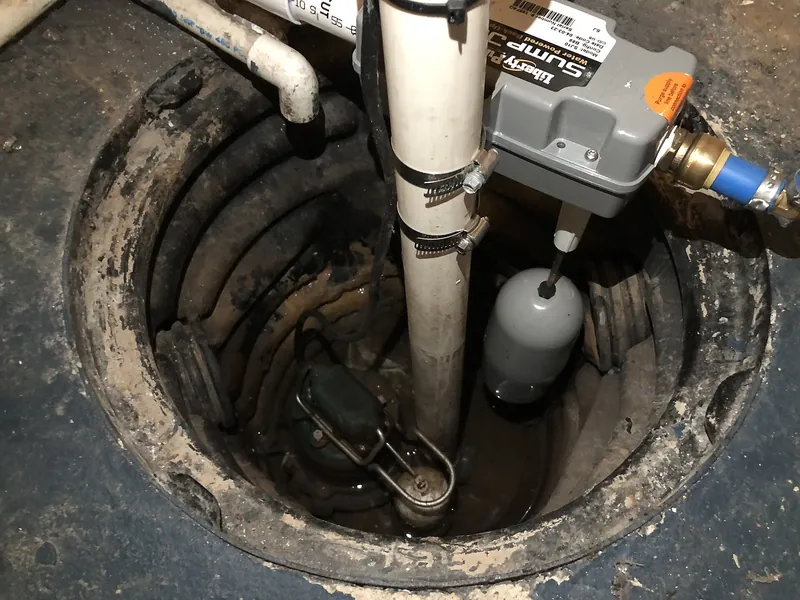
Inside, look for damp corners, chalky white lines on block walls and a dark strip where the floor meets the wall. If a sump pit sits in the lower level, fill it from a bucket ahead of storm season and watch the pump kick on and stop.
Standing water downstairs is the subject of the basement flooding page, while pits that overflow are traced to their usual causes on the sump pump failure page.
What leaks are common in Riverchase and newer Hoover subdivisions?
Mostly plumbing and appliance leaks. Hoover annexed Riverchase on September 8, 1980, the Riverchase Galleria opened in 1986, and Wikipedia says new developments have kept adding residents, with strong growth since 2008. Houses of that era hold many supply hoses, valves and drain fittings, and any one of them can let go.
Before that, the area was known as the Green Valley community from the 1930s and stayed mostly a bedroom suburb into the early 1980s. Owners of those older houses should ask a plumber what the supply pipes are made of and whether they have been replaced.
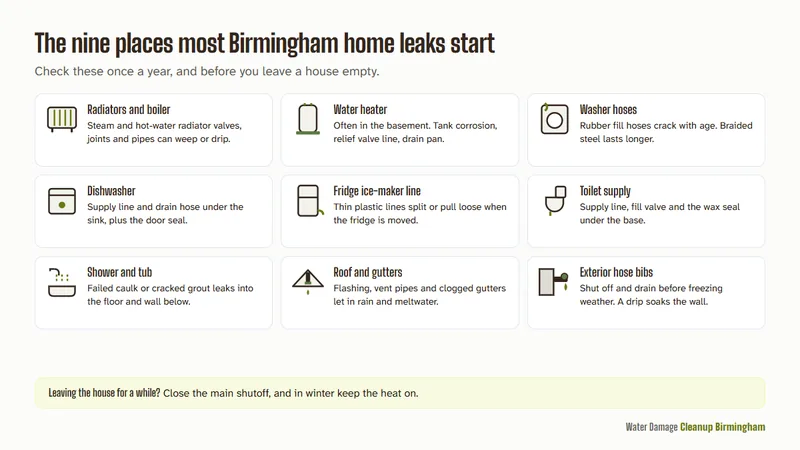
The city counted 36,799 households in 2020, and in 10.1 percent of them a person 65 or older lived alone. When only one person lives in a house, a slow drip at the laundry hookup may go unseen for a week. Battery leak alarms by the water heater, washer and toilets are worth having.
The appliance leak page walks through washer and icemaker lines, and the water heater leak page covers tanks that rust through.
Can a hard freeze burst pipes in a Hoover house?
Yes, when supply lines run through cold spaces. The American Red Cross points to cold garages and attics, crawl spaces, basements and kitchen cabinets as the places pipes most often freeze. In a hillside house, look first at lines in an unheated lower level or a garage tucked under the bedrooms.
Hold the thermostat steady around the clock, set it at 55 F or warmer before a trip, and let cold taps on exposed lines drip slightly, per the Red Cross. Its thawing list runs from hot wet towels to a hair dryer or electric heating pad, and it forbids a torch or any open flame.
If every tap goes dry on a bitter morning, close the main before the ice melts. The burst pipe page covers the cleanup, and the guide to preventing water damage lists other cold-weather steps.
Does homeowners insurance cover water damage in Hoover?
For a sudden pipe or appliance leak, usually; for creek water, only with flood insurance. The NAIC groups plumbing and roof leaks with the losses home policies usually pay and puts ground water and runoff on the other side of the line, while FEMA notes most homeowners policies exclude flooding.
Backed-up sewer lines fall through both kinds of policy. Triple-I explains that homeowners and flood coverage each exclude them, so the cover has to be added as an endorsement. Under the FEMA flood insurance manual, a new flood policy starts after a 30-day waiting period, with limited exceptions, so buy one before the creeks rise.
Once you file, the Alabama Department of Insurance claim standards in Ala. Admin. Code r. 482-1-125 set the pace. The insurer acknowledges the claim within 15 days unless it pays first, then tells you the status of acceptance or denial within 30 days after proofs of loss, or the period your policy sets.
If it needs longer, the rule requires a written reason and a fresh notice every 45 days while the file stays open. The Alabama Department of Insurance takes complaints. For help organizing photos, receipts and letters, see the insurance claims guide.
What should you do first after water damage in Hoover?
Stop the water, keep clear of wet wiring, take pictures and start drying. Give soaked materials no more than 24 to 48 hours to dry, the EPA says, or mold may follow. It also advises holding humidity below 60 percent, ideally in the 30 to 50 percent band.
- Close the main valve, wherever it sits: lower level, garage or near the street.
- Cut the breakers for soaked rooms, but only while you stand on dry ground at the panel.
- Photograph each room, the source and damaged belongings before anything is moved.
- Report the claim, keeping the claim number and the adjuster's name in one notebook.
- Ask whichever restoration team you reach which moisture readings it records and how often.
Confirm services and travel area on the first call, since restoration teams set their own. See the guide to choosing a restoration company and the water mitigation page.
Sources: Wikipedia on Hoover, Alabama (2020 census, counties, history, Riverchase, Green Valley, highways, area), Shades Mountain (cuesta, Bluff Park, Moss Rock Preserve, Brock Gap), Jefferson County, Alabama (highest point) and the Cahaba River (course, Shades Creek); National Weather Service gauges CISA1, SCHA1 and HOVA1 (flood stages and crests); IICRC S500; Red Cross frozen pipe tips; NAIC homeowners insurance; FEMA, homeowners policies and flooding; Triple-I, flood and sewer exclusions; FEMA NFIP manual; Alabama Department of Insurance claim standards, Ala. Admin. Code r. 482-1-125-.06 and 482-1-125-.07; Alabama Department of Insurance; EPA mold and moisture guide.