The short version
Water damage Birmingham AL homeowners deal with costs less when the source is closed early. Shut the valve, turn off power to wet rooms from dry ground, photograph the damage, then call your insurer and ask for a restoration team. The EPA gives wet materials 24 to 48 hours to dry, and humid Alabama summers make that window tighter.
When does water damage in a Birmingham AL home need help right away?
Treat it as urgent if the leak will not stop at the valve, if water is near wiring, the breaker box or a gas water heater, if sewage is coming up from below, or if carpet and drywall are already soaked. EPA guidance says soaked items should be dried in the first 24 to 48 hours.
Most water damage Birmingham AL homeowners face begins as something small. A drip under the kitchen sink, a fitting on the water heater, a toilet supply line. The cost grows once water slips under flooring, into the bottom of walls or down through a ceiling, where it can sit unseen.
These situations are worth a call now rather than after the weekend:
- A line in a crawl space or an outside wall that cracked during a cold snap and began leaking once it warmed up
- A spring or November thunderstorm that tore shingles loose or broke glass, so rain is reaching a bedroom or attic
- Muddy water coming in under a door or through a window well after a creek or ditch overflowed
- A water heater, washer hose or ice maker line that let go on an upper floor or in a finished basement
- A sump pump that stopped during a downpour, or sewage pushing up through the lowest drain in the house
What are the first steps to stop water damage in the house?
Close the nearest valve that controls the leak, then cut power to wet rooms from a dry spot only. Move people and pets away from dirty water. Take photos before you clean anything, let your insurance company know, and then request a restoration team whose service area includes your ZIP code.
- Stop the source. Turn the small oval handle under the sink, toilet or appliance first. If it will not turn or the leak is in a wall, close the main shutoff for the whole house.
- Make the power safe. Shut off circuits for wet rooms only while standing on a dry floor. If the panel itself is damp, leave it to the power company.
- Keep clear of dirty water. Sewage and water that came in from outdoors are the most contaminated class in the IICRC S500 standard. Wade in only with rubber boots and gloves, and keep kids out.
- Record the damage. Photograph the leak, the high-water line on walls, each wet room and the label on any appliance that failed.
- Call your insurer. Triple-I advises contacting your agent or company immediately and taking reasonable steps so the damage does not spread.
- Ask for a restoration team. Say where it came from, which rooms got wet, and when it started.
Triple-I adds: keep ruined belongings for the adjuster to see, and save big permanent repairs until after that visit. The Birmingham water damage insurance claims guide explains the paperwork that follows.
Where is the main water shutoff valve in a house?
Follow the pipe that brings water in from the street. The house main is usually on that line where it enters, in a basement, crawl space, garage or utility closet, or near the water heater on a slab. A curb box near the property line holds a second valve that the water utility normally operates.
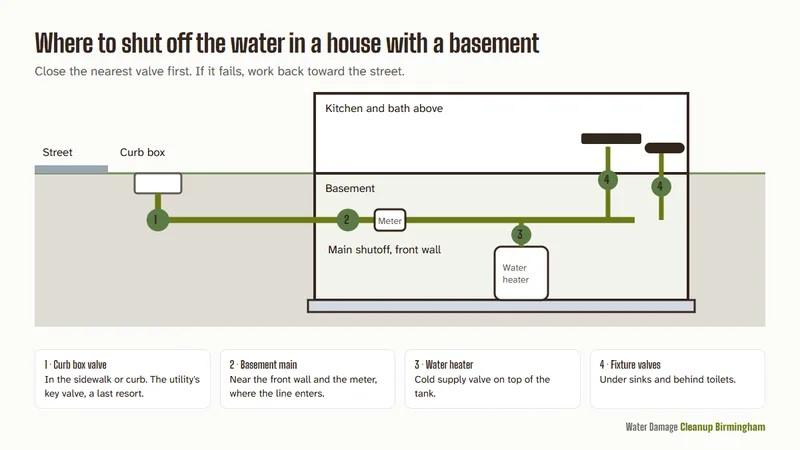
Houses built into a hillside sometimes have the main in a lower-level room on the downhill side, close to where the line comes through the foundation. On older homes the valve may be a round gate handle that has not moved in years.
Turn an old valve gently, and stop if it fights you, because a brittle stem can snap and leave you with a bigger leak than before. At that point a plumber is the right call, and the restoration team should hear that water is still flowing. The burst pipe water damage page covers what usually happens after a line splits.
Can pipes freeze and burst in Birmingham?
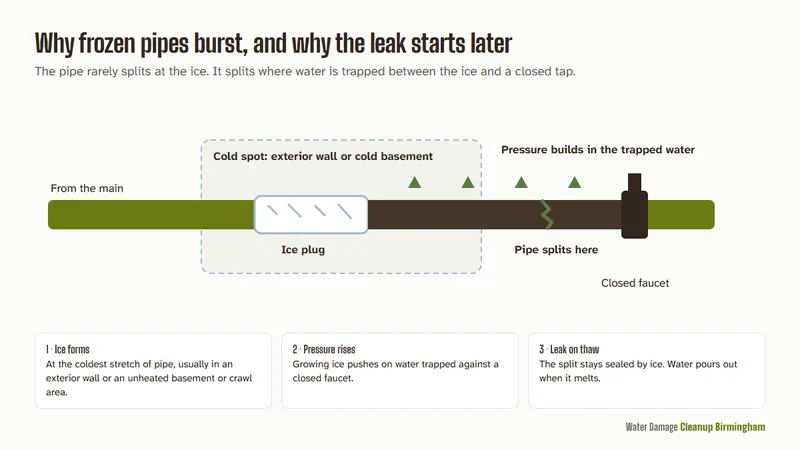
Yes, they can. Birmingham winters are mild on average, but cold nights are common enough to freeze an exposed line. When ice plugs a pipe, water trapped behind it toward a closed faucet builds pressure until the pipe cracks. Many of these leaks stay hidden until the ice melts, and then water pours out.
The Wikipedia article on Birmingham reports an average of 47 days a year with a low at or below freezing, and 1.4 days when the high stays at freezing or below. Its record low is minus 10 °F, set on February 13, 1899.
The American Red Cross points to supply pipes running through unheated parts of a house, such as basements, crawl spaces, attics, garages and the cabinet under the kitchen sink. Before a trip in cold weather, its advice is a thermostat no lower than 55 °F, the same setting at night as during the day, and a slow drip of cold water at any faucet on exposed pipe.
For a pipe that has already frozen, the Red Cross approves gentle heat: wrap it in hot, wet towels, or warm it with a hair dryer, an electric heating pad or a space heater set well back from flammable things. Blowtorches, kerosene and propane heaters, charcoal stoves and other open flames are off the table.
What should you do when a tornado or thunderstorm opens the roof?
Once the storm has passed and it is safe, cover what you can from inside or from the ground, such as a broken window or an attic opening. Set buckets under drips, move furniture and electronics out of the room, and take photos of the ceiling and walls before anything changes.
Wind damage is the usual way storm water gets in. The Birmingham article on Wikipedia places the city in Dixie Alley, notes that spring cold fronts often bring severe thunderstorms, and calls November and early December a secondary severe weather season. It lists F5 tornadoes in the northern suburbs in 1977 and the western suburbs in 1998, and an EF4 in April 2011.
According to the Wikipedia article on the 2021 Fultondale tornado, an EF3 tornado crossed Fultondale and Center Point late on January 25, 2021, partly tearing roofs from homes. When a roof is opened like that, the rain that follows soaks attic insulation and ceilings in the hours after the wind.
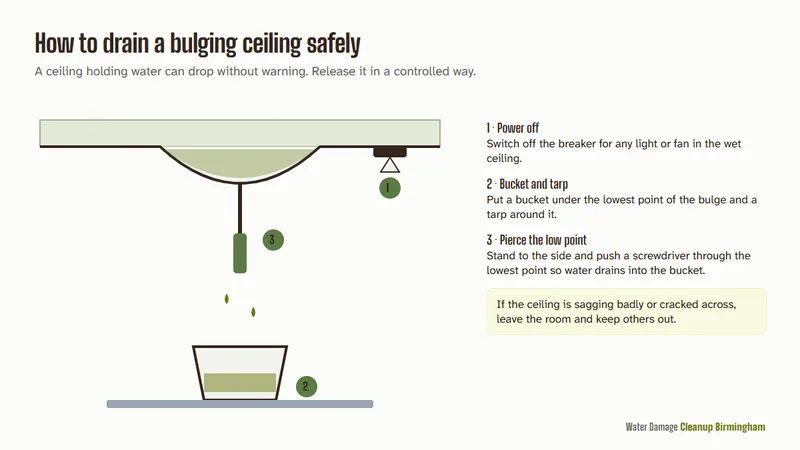
A ceiling that bulges is holding water. Switch off the breaker for any light or fan in it, and keep everyone out if the sag is wide. The storm roof leak page and the ceiling water damage page cover the next steps, and the Birmingham tornado history page looks at past storms.
Is the water in your house clean, grey or sewage?
The IICRC S500 standard ranks water by its source. Pressurized supply water starts out as Category 1, and drain water from appliances such as a washer counts as Category 2. Sewage and anything that flowed in from a creek, river or street is Category 3. That ranking decides what can stay and what goes.
| Category | Common sources in a home | What usually happens |
|---|---|---|
| 1. Clean water | A cracked supply pipe, a leaking water heater fitting, a fridge or ice maker line | Wet materials can often stay and be dried if drying starts early. |
| 2. Grey water | A washer that overflowed, a dishwasher leak, a toilet overflow with no waste in it | Carpet pad usually comes out, and surfaces are cleaned before drying. |
| 3. Grossly contaminated | A sewer backup, creek water, runoff from the yard or street | Soft, absorbent items it reached go out, and the crew suits up with gloves, boots and masks. |
Water can also change category over time. A clean leak that sits for days picks up dirt from floors and wall cavities and starts to grow bacteria. The EPA's guidance on mold cleanup at home recommends hiring someone experienced with buildings hit by contaminated water whenever sewage is involved.
What if creek water or a floor drain backup gets into the house?
Outside water and sewage are both Category 3, so keep people and pets out of them. Stop running sinks, toilets, showers and the washer if a drain is backing up, since that water heads to the same pipe. Shut off basement circuits from a dry spot, photograph everything, and ask for a restoration team that handles contaminated water.
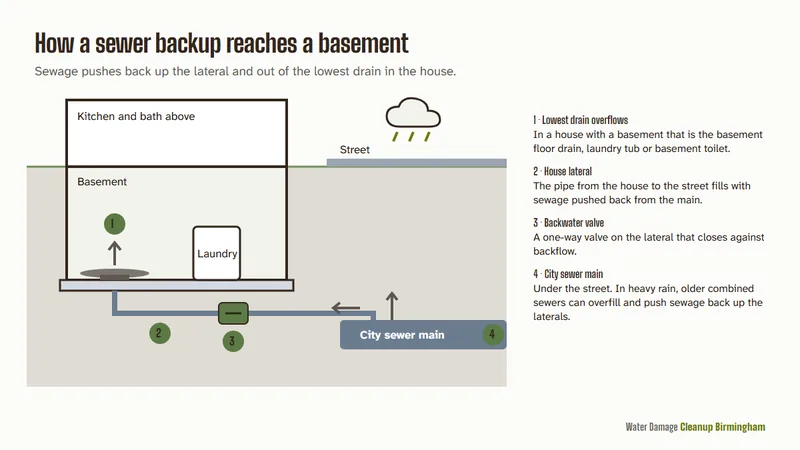
Creeks in Jones Valley can rise quickly in a heavy storm. The National Weather Service gauge on Village Creek at Avenue W in Ensley has a flood stage of 10 feet, and its highest listed crest is 14.8 feet on December 3, 1983. The Birmingham flooding page covers the other local creeks.
Sewage backup is a coverage gap many owners miss. Triple-I notes that it falls outside a typical homeowners form and outside flood insurance too, and the fix is a backup endorsement added to the policy. The flood cleanup page and the sewer backup cleanup page explain the work.
How fast does a wet house need to dry in Alabama humidity?
The EPA target is to dry wet materials and belongings in the first 24 to 48 hours. Humid air makes that harder, because damp air cannot take much more moisture from carpet pad, subfloor and wall framing. Moisture meters, not a hand on the wall, show when a room has actually dried.
The Wikipedia climate section for Birmingham calls the city humid subtropical, with hot, humid summers and highs of 90 °F or more on 65 days a year. Most summer rain arrives as afternoon and evening thunderstorms.
The EPA brief guide to mold and moisture sets the indoor humidity limit at 60 percent and names 30 to 50 percent as the range to aim for. Dehumidifiers pull water out of the air so wet materials can give up theirs, and air conditioning helps once the system is checked.
Spotting or a musty smell already? Read the mold after water damage guide for the size limit on do-it-yourself cleanup. The structural drying page covers how equipment is placed and checked.
What happens when the restoration team gets to the house?
On a careful first visit, the restoration team checks that nothing is still leaking and that electrical and gas hazards are handled. After that come moisture readings in each affected room, including rooms that look dry, removes standing water, decides which wet materials must go and sets drying equipment. Ask them to walk you through each step.
Expect a first visit to include most of these:
- Moisture readings and photos for every room the water reached, written down or logged in an app
- Standing water pumped out, or carpet and pad extracted with a wand
- Soaked pad, baseboards or the lower strip of drywall removed when the water category calls for it
- Air movers and dehumidifiers placed, with a starting reading noted for each wet area
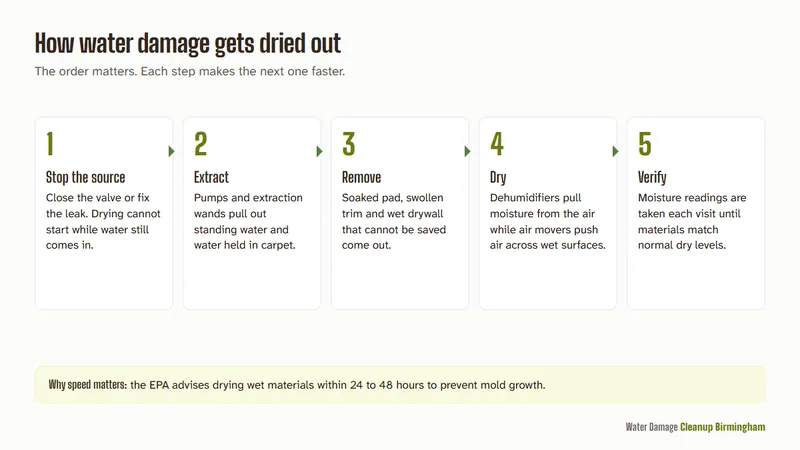
Readings should fall at every visit. If they stop falling, ask what the restoration team plans to change. The water removal page explains extraction in more detail.
The work belongs to the restoration team. Each one has its own rates, schedule and list of services, so settle those points on the phone.
Does Alabama homeowners insurance cover sudden water damage?
A standard homeowners form usually responds when a pipe or appliance suddenly lets water loose. Flooding from creeks and rivers, groundwater seeping in and sewer backup are handled differently, usually by a flood policy or a backup endorsement. Exclusions and deductibles differ, so read the water sections of your own policy before work starts.
The NAIC explains that a roof leak or a failed household pipe is the kind of water loss insurers usually pay, while water from the ground, rain runoff and melting snow typically is not. Triple-I counts sudden overflow from plumbing, heating, cooling, sprinkler systems and household appliances, along with freezing of those systems, as standard named perils.
According to the Insurance Information Institute, water damage and freezing lead to a claim at roughly one of every 60 insured homes each year. Over 2019 to 2023, the average such claim came to $15,400.
How long does an Alabama insurer have to answer a claim?
Under the Alabama Department of Insurance claim standards, Ala. Admin. Code r. 482-1-125, an insurer must acknowledge a first party claim within 15 days unless it pays in that time. Within 30 days after proofs of loss, or the period your policy sets, it must tell you whether the claim is accepted or denied.
If the insurer needs more time, rule 482-1-125-.07 requires a letter giving the reasons, then another every 45 days while the investigation stays open. A denial has to point to the policy wording it relies on. The Alabama Department of Insurance takes complaints.
Sources: Wikipedia, Birmingham, Alabama (climate, freezes, severe weather); Wikipedia, 2021 Fultondale tornado; NWS gauge ENSA1, Village Creek at Avenue W; EPA, A Brief Guide to Mold, Moisture and Your Home; EPA, Mold Cleanup in Your Home; IICRC S500 water categories; American Red Cross frozen pipe advice; NAIC homeowners insurance consumer page; Triple-I on disasters a homeowners policy pays for; Triple-I advice on settling a claim; Insurance Information Institute homeowners claim statistics; Ala. Admin. Code r. 482-1-125-.06; Ala. Admin. Code r. 482-1-125-.07.