Quick answer
For a Birmingham water leak adjustment, confirm the leak first: the EPA says a meter that moves during two hours of no water use points to a leak. Fix it, keep the dated plumber's invoice and meter photos, then ask the utility for its written leak policy and request form. Check floors and walls near the leak, since wet materials need drying in the first 24 to 48 hours.
How does a Birmingham water leak adjustment work?
A Birmingham water leak adjustment is a request to the water utility to credit part of a bill that a broken or hidden leak drove up. You usually find the leak, have it repaired, and then send proof of the repair. The utility reviews the request against its own written policy and decides what, if anything, it will credit.
The rules belong to the utility, not to this site. Birmingham Water Works serves much of the metro and sets its own terms, which can change, so this page does not quote them. Ask the utility for its current leak policy in writing before you assume what it covers.
Water Damage Cleanup Birmingham covers the floors, walls and cabinets a leak soaks. It does not handle water bills, plumbing repairs or utility disputes.
How can I tell if a high water bill is from a leak?
Check the meter while nothing in the house uses water. The EPA's WaterSense program says to read the meter, wait two hours with every tap, appliance and sprinkler off, and read it again. If the number moved at all, water is probably escaping somewhere between the meter and your fixtures.
The EPA's Fix a Leak Week page offers a second test using the colder months. A household of four that goes past 12,000 gallons in January or February, when nobody is watering the lawn, may have serious leaks, according to the agency.
Compare several bills side by side before you call anyone. A jump that appears in one cycle and stays points to a new leak, while a slow climb over months can mean a toilet or a drip that keeps getting worse. Note the meter readings and dates on paper, because the utility will want them.
The toilet dye test
Toilets are the usual suspects in a quiet house, and the EPA's check is simple: tint the tank water with food coloring and leave it alone. Tinted water in the bowl 10 minutes later means the flapper leaks. Flush right away so the dye does not stain the tank.
A flapper is a cheap part, and the EPA says to replace it at least every five years. If the tank still refills on its own after a new flapper, the fill valve may be the culprit, and a plumber can sort out which part has failed.
Where do hidden leaks usually hide in a house?
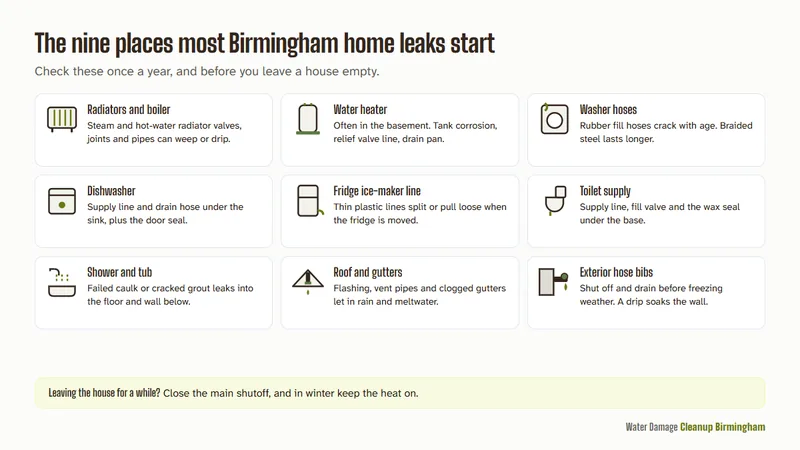
Most hidden leaks sit in places you rarely look: a toilet that runs between flushes, a faucet or shower valve that drips, a hose bib, an irrigation line, or a supply pipe under the floor. The EPA lists worn toilet flappers, dripping faucets and other leaking valves as the most common household leaks.
Small drips add up on the bill. These are the EPA's own figures from its Fix a Leak Week page.
| Leak source | How it shows up | EPA estimate of water lost |
|---|---|---|
| Worn toilet flapper | Tank refills on its own, dye reaches the bowl | Thousands of gallons a year, often silently |
| Dripping faucet | One drip per second from the spout | More than 3,000 gallons a year |
| Leaking showerhead | About 10 drips a minute after the shower is off | More than 500 gallons a year |
| Irrigation line | A hole about the thickness of a dime, soggy turf | About 6,300 gallons a month |
| All household leaks together | Average home, leaks of every kind | More than 9,300 gallons a year |
By the EPA's estimate, nine percent of homes lose 50 gallons or more a day to leaks, and repairing the simple ones can cut roughly 10 percent from the bill. Those leaks rarely damage a house, but they are the first things a utility may ask about.
Can a frozen pipe cause a big water bill in Birmingham?
Yes. A pipe that splits in a hard freeze can run for days before anyone notices, especially in a crawl space, an exterior wall or a vacant rental. Birmingham does freeze: the Wikipedia article on Birmingham counts an average of 47 days a year with a low at or below freezing.
The American Red Cross puts supply lines in unheated crawl spaces, attics, garages and kitchen cabinets at the top of its risk list. Its advice for a cold snap while you travel: a thermostat no lower than 55 F, plus a slow cold drip at any tap whose pipe runs through a cold space.
A burst line is a different case from a slow drip. It sends water into framing and insulation fast, so the utility bill is often the smaller cost. The burst pipe page covers shutting off the water and drying out the space.
What should I do first after a leak runs up the water bill?
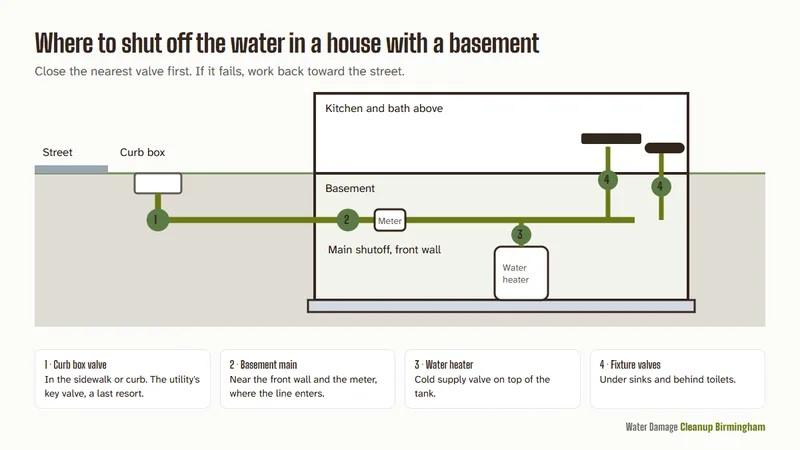
Stop the water, then build the paper trail before memories fade. Shut the main valve or the fixture stop, photograph the meter, and get the leak repaired. Every step creates a record a utility or insurer may later ask to see, so date each photo and keep each receipt in one folder.
- Shut off the water. Close the fixture stop if the leak is in one place, or the main valve if you cannot find it.
- Photograph the meter. Take a picture of the reading with the date showing, then another after the repair.
- Get the leak repaired. Hire a plumber or fix it yourself, and keep the invoice or the parts receipts.
- Look for damage. Check the floor, ceiling and walls around the leak for stains, soft spots or a musty smell.
- Call the utility. Ask for its leak adjustment policy, the request form, and the deadline for filing.
- Call your insurer if the house is wet. Report damage separately from the bill question.
Do not wait on the repair to see whether the utility will help. Water keeps flowing through the meter until the leak is fixed, and every day adds to both the bill and any damage. Sinks, tubs and dishwashers are covered on the bathroom and kitchen leak page; tanks and relief valves on the water heater leak page.
What records should I keep for a leak bill adjustment request?
Keep proof of three things: that a leak existed, that it was repaired, and when. A dated plumber's invoice naming the location of the leak does most of the work. Add meter photos, the bills before and after, and pictures of the broken part, so the utility can match the high usage to the repair date.
If you did the repair yourself, save the parts receipts and a photo of the old part next to the new one. Some utilities accept owner repairs and some want a plumber's invoice, so ask before you throw anything away.
Write a short note of your own as well. List when you noticed the bill, when you found the leak, when the water was shut off and when the repair was finished. A plain timeline answers most of the questions a billing clerk will ask.
Ask about the sewer side
On many bills, part of the charge is for sewer service figured from metered water use. If your bill shows a sewer line that rose with the water, ask whoever bills that charge whether it can be reviewed too. Water that ran out of a broken outdoor pipe never reached the sewer.
Each office may have its own form and its own deadline. Send both the same plumber's invoice and meter photos, and keep a note of who you spoke with and when.
Will homeowners insurance cover water damage from a hidden leak?
It depends on the cause and how long the leak ran. Standard policies are written around sudden events. Among the named perils on standard forms, the Insurance Information Institute includes water that escapes suddenly from plumbing or a household appliance, plus those systems freezing.
Slow leaks are harder. Upkeep is the owner's job in Triple-I's reading, so damage traced to neglect or to mold falls outside the policy, and the NAIC notes that many homeowners policies exclude mold damage. A drip that rotted a cabinet floor over months may be treated as wear rather than a sudden loss.
Report it anyway and let the adjuster decide. Triple-I's claim guide tells owners to take pictures, keep every receipt, and leave big permanent repairs for after the adjuster's visit. The insurance claims guide walks through the Alabama process, and the denied claim page covers what to do if the answer is no.
What if the leak soaked floors or walls before I found it?
Treat the wet materials as a separate problem from the bill. Mold can start once wet material stays damp past 24 to 48 hours, by the EPA's guidance, which also wants indoor humidity under 60 percent and, better, in the 30 to 50 percent band. A leak found through the bill has usually been running longer than two days.
Look where the water would collect. Check the subfloor under a toilet, the cabinet base under a sink, the drywall behind a washer and the ceiling below an upstairs bathroom. The signs of water damage guide lists the stains, soft spots and smells to look for.
Birmingham's summers make drying harder. The Wikipedia article describes a humid subtropical climate with hot, humid summers, so damp framing can stay wet for days without help. Whether a wall can dry in place or must be cut open is covered on the wet drywall page, and the Birmingham mold guide covers growth that has already started.
A restoration team can take moisture readings behind the wall and under the floor, which also documents the damage for an insurer. Restoration teams differ in what they take on, so confirm directly. Renters should read the renters and condo guide before calling anyone, because the landlord may be responsible for repairs.
How can I avoid another leak surprise on the bill?
Read the meter yourself once in a while and repeat the two-hour test a few times a year. The EPA suggests checking toilet flappers periodically and replacing them at least every five years. It also points to leak detection and flow monitoring devices that alert you to unusual water use.
Before winter, cover exposed pipes in the crawl space and disconnect garden hoses. Before a long trip, consider shutting off the main valve so a failed hose or fitting cannot run unnoticed.
The prevention guide has a fuller seasonal checklist for Birmingham homes, from gutters to water heaters.
Sources: EPA WaterSense, Fix a Leak Week (meter test, winter usage check, dye test, leak volumes, flapper replacement, flow monitors); Wikipedia, Birmingham, Alabama (freezing days, humid subtropical climate); American Red Cross, frozen pipes (pipes at risk, 55 F heat setting, dripping faucets); Triple-I, disasters covered by homeowners insurance (named perils, maintenance and mold exclusions); NAIC homeowners insurance guide (mold exclusions); Triple-I claim settling guide (photos, receipts, repair timing); EPA mold and moisture guide (24 to 48 hour drying, indoor humidity targets); Birmingham Water Works (ask for its current leak policy).