Quick answer
Home inspection water damage notes point to stains, soft wood, high meter readings or musty smells. Ask the inspector what they found, request the seller's repair and claim records, and send a roofer, plumber or restoration team to find the cause. Insurance rarely pays for damage that was there before you bought, so settle it before closing.
What does home inspection water damage mean on a Birmingham report?
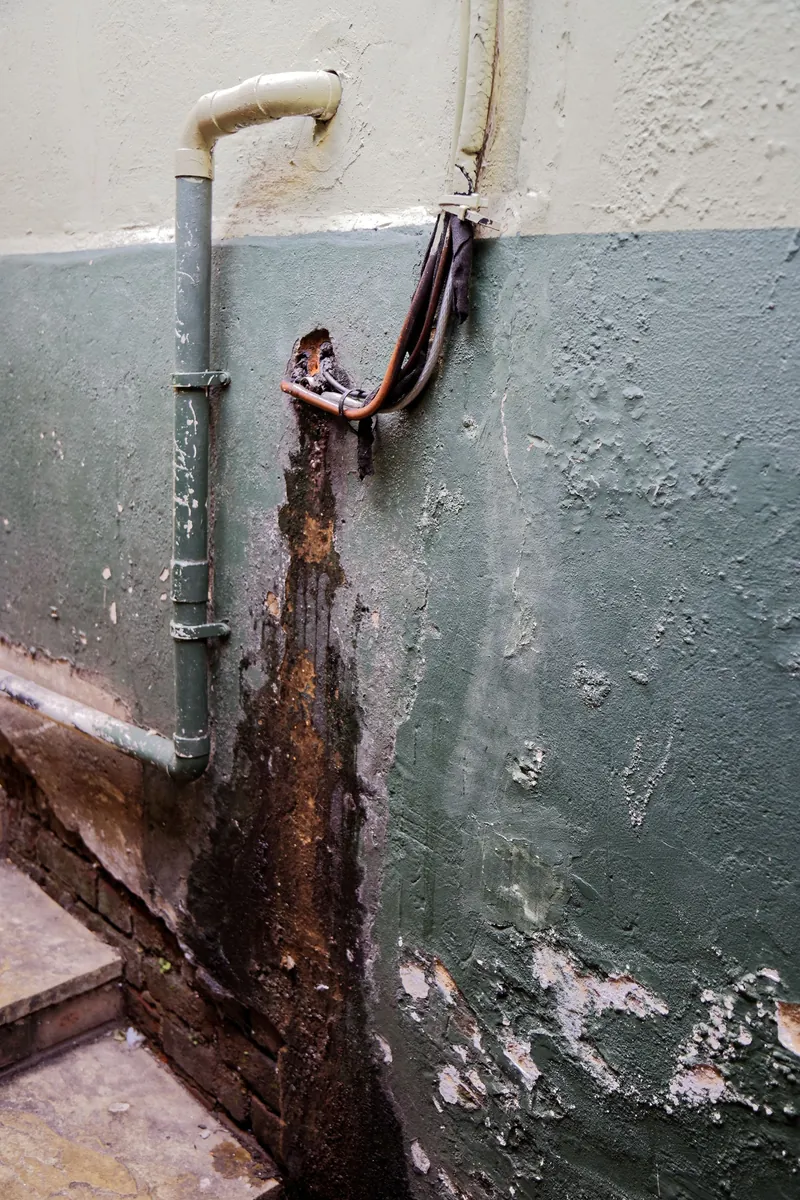
When a report lists home inspection water damage, the inspector saw signs that water reached a place it should not: a stain, soft wood, a high meter reading, rust or a musty smell. The note tells you where to look harder. It does not tell you how big the problem is or whether it is still active.
Inspectors work from what they can see and reach on one visit. A brown ring on a ceiling might be a roof leak fixed years ago, or a drip that only returns in a hard storm. Birmingham has a humid subtropical climate with abundant rain and humid summers, so old leaks often leave mold or rot behind them.
This site is the local water damage restoration line and information resource for Birmingham and nearby counties. It does not inspect homes, and nothing here replaces your inspector, your agent or a lawyer.
Where do inspectors find water problems in Birmingham houses?
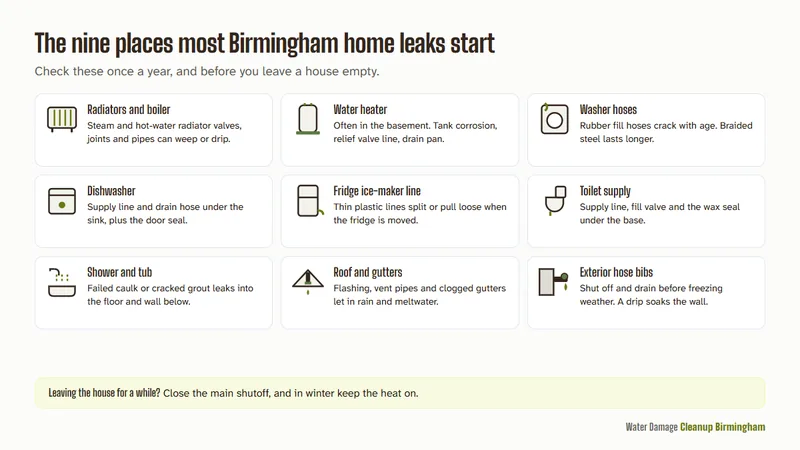
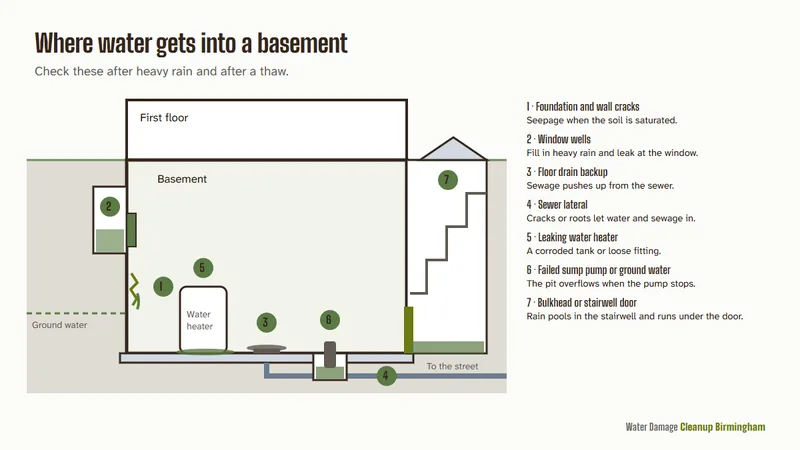
Most findings cluster in a few places: the roof and attic, bathrooms, the kitchen sink base, the water heater and the lowest level. On a sloped lot, the uphill basement wall and the crawl space get extra attention, because rain runs toward them before it reaches the street.
The Wikipedia article on Red Mountain notes that many neighborhoods sit along its 33 miles, and Shades Mountain takes in parts of Homewood, Vestavia Hills, Mountain Brook and Hoover. On a hillside lot, ask how water drains around the high side of the foundation.
| Part of the house | What the report may say | What to ask next |
|---|---|---|
| Attic and roof deck | Darkened sheathing, stained rafters, daylight at vents | Is the wood dry now, and when was the roof replaced? |
| Basement or lower level | Efflorescence, peeling paint, a damp floor-wall joint | Is there a sump pit, and does the pump run? |
| Crawl space | Standing water, wet insulation, white crust on soil | How high was the moisture reading on the joists? |
| Bathrooms and kitchen | Soft subfloor, swollen cabinet base, loose tile | Is the leak active or old and repaired? |
| Exterior walls | Stains under windows, gaps at trim, gutters spilling | Does water run toward the house anywhere? |
The EPA mold course says a white, fibrous material on crawl space soil may be alkaline salts rather than mold, a sign of past moisture. For basement clues, see our basement flooding page.
Can a home inspection miss hidden water damage?
Yes. A standard inspection is visual and non-invasive, so the inspector will not usually cut drywall or pull carpet, and water behind finished walls, under flooring or above a ceiling can go unseen. A dry week before the visit can also hide a leak that only shows after heavy rain.
The EPA's course on finding mold names where growth hides: behind wallboard, paneling or wallpaper, on the upper face of ceiling tiles, beneath carpet padding, inside damp wall cavities and in crawl spaces. Fresh paint over a ceiling stain is another reason to ask questions, since it can cover a past leak.
Moisture meters help. The same EPA chapter explains that investigators press or insert a meter into drywall, wood, brick or concrete to find wet areas, and some use a borescope through a small hole to look inside a wall. Our signs of water damage guide lists what you can check on a second walk-through.
Should buyers pay for mold testing after a home inspection?
Usually not if the mold is already visible. The EPA says that when mold can be seen, sampling is generally unnecessary, and the job is to fix the water problem and clean up the growth. Testing makes more sense when the source is unclear, a legal dispute is likely, or someone in the house has health concerns.
The EPA also points out that there are no federal standards for airborne mold, so a test cannot prove a house passes or fails. Air samples only describe the moment they were taken, and the results need someone experienced to read them. Not everything dark is mold, either: the agency notes that paint on the back of drywall can look like growth.
Health still matters. According to the CDC, mold exposure may bring on coughing, wheezing, burning eyes or a blocked nose, and people with asthma or a mold allergy can react more strongly. For cleanup choices and when a specialist fits, read our mold after water damage guide.
What should you ask the seller about past water leaks?
Ask what happened, when, how it was fixed and who did the work. A seller who can show a plumber's invoice, a roof replacement date or a closed insurance claim gives you far more to go on than a stain and a shrug. Get the answers in writing through your agent.
Good questions are specific: has water ever reached the basement or crawl space, and after what kind of rain, and has a pipe, water heater, washer hose or sewer line ever failed? Then ask whether any drywall, flooring or insulation was replaced, and whether the area was dried before it was closed up.
Each answer points to a different follow-up. A past backup is covered on our sewer backup cleanup page, and an old tank failure on the water heater leak page. If the seller says a room was simply painted after a leak, ask the inspector to take readings there and check the framing above or below it.
What should you do when the inspection report flags water damage?
Treat the note as the start of a short investigation. Get the inspector to explain it, ask the seller what happened, bring in the right specialist, and get written estimates before your option or contingency period ends. Each step gives you facts to negotiate with instead of guesses.
- Call the inspector and ask what they saw, where they took readings and whether the area felt damp.
- Ask your agent to request repair records, insurance claim history and any roof or plumbing invoices from the seller.
- Send the right person for the problem: a roofer for an attic stain, a plumber for a sink base, a foundation or drainage contractor for a wet basement wall.
- If wood or drywall is still wet, ask a restoration team to map moisture and say what would have to come out.
- Get written estimates with line items so you can compare them and use them in your repair request.
- Keep every report and photo with your closing papers, since they show what was known when you bought the house.
National averages give a sense of scale. Fixr puts typical water damage restoration between $1,200 and $5,000, but the real figure depends on the house. Our restoration cost guide explains what drives the price, and the guide to buying a water damaged house covers the negotiation side.
Does a nearby creek or flood zone change what to check?
It should. A house near Village Creek, Valley Creek, Shades Creek or the Cahaba deserves a look at the flood map and at the lowest floor, even if the inspector found nothing. Creek water that came inside once can return, and a dry visit says little about the next heavy storm.
FEMA's glossary ties its Special Flood Hazard Area to a flood with a 1-percent chance in any year, drawn on the maps as A or AE zones. Land outside those lines can still flood, so ask the seller directly about past high water.
NWS records show Shades Creek near Homewood cresting at 19.88 feet on Sept 16, 2004, against a minor flood stage of 14 feet. Village Creek at Avenue W in Ensley reached 14.8 feet on Dec 3, 1983, its highest listed crest. Our Birmingham flooding page covers each creek.
Will homeowners insurance cover old water damage found at inspection?
Rarely. Insurers look for sudden, accidental damage, and a stain that was in the report before you bought the house is hard to present that way. Triple-I adds that standard policies exclude damage from lack of maintenance, mold and flood, so long-running seepage and creek water usually fall outside coverage either way.
The NAIC draws the line this way: a plumbing failure or roof leak is typically covered, but rain runoff and ground water seeping in are not. Sewer backup, Triple-I adds, is bought as a separate endorsement. Ask your agent about both before closing, especially for a house with a basement floor drain.
Water losses are common enough to plan for. By Triple-I's count, a water or freezing claim hits about one insured home out of every 60 each year, and the 2019 to 2023 average for such a claim was $15,400. Our insurance claims guide explains how Alabama claims are handled once you own the home.
When is it worth calling a restoration team before closing?
Call one when moisture is still present, when the inspector notes soft or stained framing, or when a musty smell has no clear cause. A restoration team can read moisture across a wider area, estimate what would be removed, and tell you whether drying alone could work. The seller has to agree to any testing that damages finishes.
EPA guidance gives soaked materials a window of 24 to 48 hours to dry before mold starts, and it wants indoor air kept under 60 percent relative humidity. A space that has stayed damp longer than that is likely to need more than fans. The EPA's chapter on why mold grows warns that a leak left long enough can let mold weaken floors and walls by feeding on wet wood.
Restoration teams differ in what they assess and how they write it up, so ask what a pre-purchase visit includes before booking. For a crawl space or a joist problem, our structural drying page explains how framing is dried and checked.
Sources: EPA Mold Course, Chapter 3 (hidden mold locations, moisture meters and borescopes, alkaline salts on crawl space soil, sampling usually unnecessary when mold is visible, no federal airborne mold standards, paint that looks like mold, choosing an experienced inspector); EPA Mold Course, Chapter 2 (long leaks weaken floors and walls); EPA home moisture guide (the 24 to 48 hour window, 60 percent ceiling); CDC, About Mold and Your Health; Triple-I, covered disasters (maintenance, mold and flood exclusions, sewer backup endorsement); Triple-I homeowners facts (one in 60, $15,400 average for 2019 to 2023); NAIC homeowners insurance; FEMA flood zone glossary; NWS gauge SCHA1 and NWS gauge ENSA1 (crests and flood stage); Fixr restoration cost, 2025 ($1,200 to $5,000); Wikipedia, Birmingham, Alabama (climate); Wikipedia, Red Mountain (33 miles, neighborhoods); Wikipedia, Shades Mountain (Bluff Park, Homewood, Vestavia Hills, Mountain Brook).