Quick answer
For a new construction leak warranty claim, shut off the water, photograph everything and notify the builder in writing the way the warranty requires. Begin drying right away, because EPA guidance allows wet materials only a day or two before mold appears. Call your insurer too. Warranty terms vary, so read yours and get legal advice for disputes.
What should you do first when a new home leaks?
Stop the water, protect the house, and put the builder on notice in writing. A new construction leak warranty usually asks for prompt notice, but no builder expects you to watch water spread while you wait for a reply. Shut off the supply, start drying, and document every step so the warranty claim and any insurance claim both hold up.
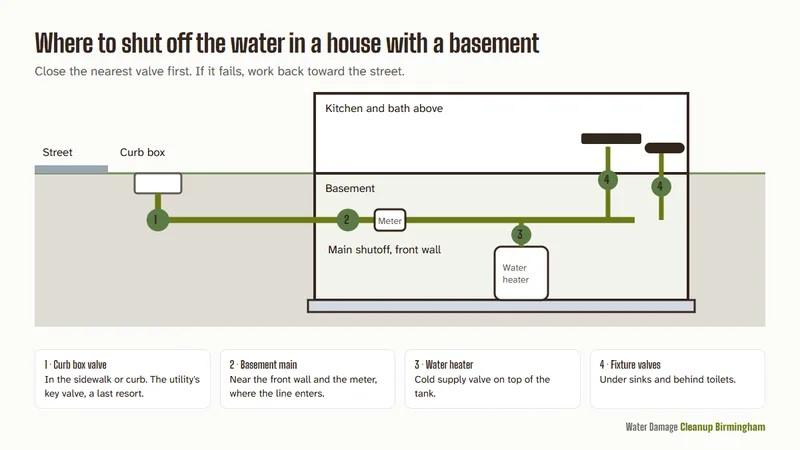
- Close the fixture stop or the main water valve. In many new homes the main sits in the garage, a utility closet or near the water heater.
- Turn off power at the breaker to any room where water reaches outlets, cords or appliances, if you can reach the panel from a dry floor.
- Take wide photos and video of every wet room, then close-ups of the source, before anything is moved or cut.
- Email or mail the builder's warranty contact with the date, address, what happened and photos. Keep a copy.
- Call your insurance agent and say a restoration team may need to start drying.
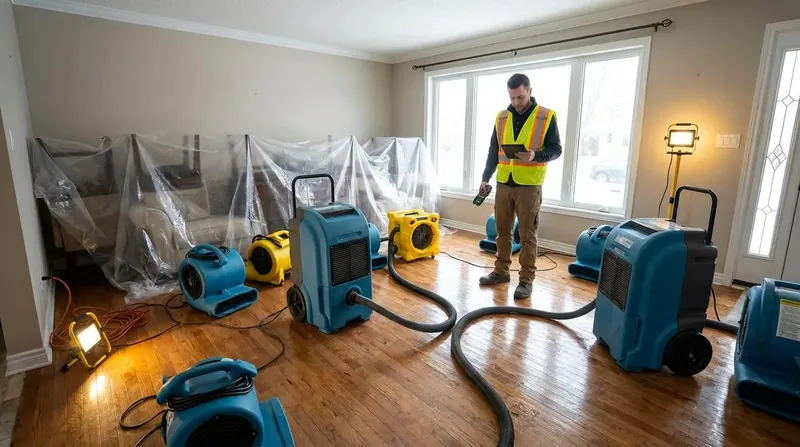
- Move furniture and rugs off wet floors, and start fans and a dehumidifier if the water is clean.
Mold can start on soaked drywall and lumber in 24 to 48 hours, per the EPA, and a builder's warranty visit may take longer than that to schedule. This site is the local water damage restoration line and information resource for Birmingham area homeowners. It does not give legal advice, and warranty terms vary from builder to builder.
Where do leaks in a brand new house usually start?
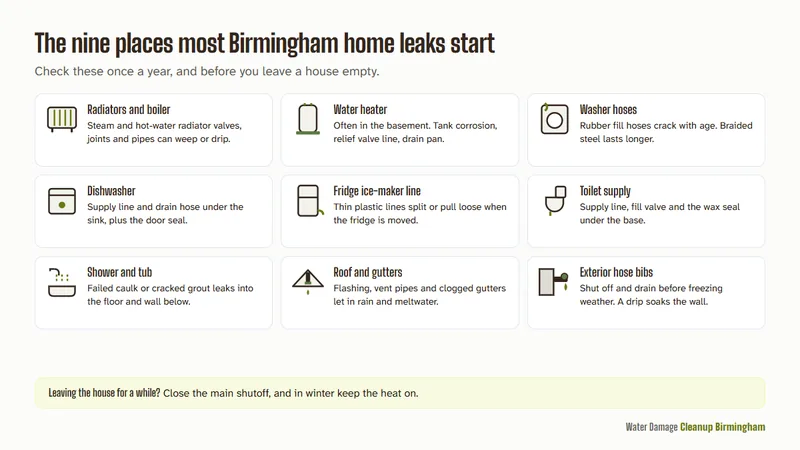
Most new-home leaks start at a connection someone made on site: a supply line under a sink, a drain joint, a shower pan, a window flashing lap or the roof where it meets a wall. Air conditioning condensate lines and yard grading that tips toward the house are close behind.
The EPA's mold course makes the general point plainly: a building has to be designed for its climate, site and use, and that design has to be followed during construction, or moisture problems can follow. Its list of common causes includes leaking roofs, pipes inside wall cavities, and gutters and landscaping that send water toward the building.
| Leak point | How it usually shows | Trade to ask about it |
|---|---|---|
| Sink and toilet supply lines | Wet cabinet floor, stain on the ceiling below | Plumber |
| Shower pan or tub drain | Loose tile, damp baseboard outside the bathroom | Plumber or tile installer |
| Window and door flashing | Stain under a window corner after wind-driven rain | Framer, window or siding installer |
| AC condensate line or pan | Ceiling stain under the attic unit in summer | HVAC contractor |
| Grading and gutters | Water at the slab edge or in the garage after storms | Builder's site or drainage crew |
Water that runs down inside an exterior wall is covered on our water behind siding page, and supply line failures on the bathroom and kitchen leak page.
Does a builder warranty cover water damage from a leak?
Sometimes, but read the document before you assume. Many builder warranties separate the defect itself, such as a bad fitting or missing flashing, from the damage it caused to drywall, floors and belongings. Some cover both, some cover only the defect, and many set notice rules and deadlines that decide whether a claim is accepted.
Look for a few things in the warranty booklet or closing packet. Find out how long each part of the house is covered, what counts as a defect, whether resulting water damage is included, how notice must be given, and what the homeowner has to maintain. Caulk joints, gutters and grading are often listed as owner upkeep after move-in.
A third-party warranty company may administer the warranty instead of the builder, with its own forms. If the language is unclear, ask the builder to explain it in writing, and talk with a lawyer before you sign any release or settlement. This page cannot tell you what your warranty means.
Keep the walkthrough or punch list from closing with the warranty papers. If a damp spot, a loose fitting or a ceiling mark was noted before you moved in, that list shows the builder already knew about it, which helps when the same area leaks later.
Who pays to dry a new house while the builder decides?
Usually you start, then sort out who pays. Drying cannot wait for a warranty review, so most owners call their insurer and a restoration team as soon as the water is off. Keep every receipt and the restoration team's moisture logs, because the builder, a warranty company or the insurer may each ask for them later.
A burst fitting inside the house is the kind of loss homeowners policies are built for: the NAIC calls plumbing water damage typically covered, with runoff and seeping ground water left out. Triple-I describes the matching peril as an accidental overflow or discharge from a plumbing, HVAC or appliance system, and flood as something only a separate policy covers.
Triple-I's claims guidance asks owners to take reasonable steps against further damage while waiting on permanent repairs until the adjuster has looked. That fits a new home well: dry it now, and leave rebuilding until the builder and insurer have both seen it. Our water mitigation page explains what the drying stage covers.
Clean supply water is the easiest case. The IICRC's water categories treat a burst supply line as clean water, while a drain or sewer leak is contaminated and needs more removal. Tell the restoration team which kind it is when you call.
How do you put a warranty claim in writing?
Use the method the warranty names, whether that is a portal, email or a tracked letter, and send it the day you find the leak. Describe what you saw, where and when, attach photos, list the steps you took to stop damage, and ask when someone will inspect. Keep proof that it was sent.
- Lead with the address, lot number if you have it, closing date and your contact details.
- Describe the leak in plain words: where water appeared, how much, and what you shut off.
- Attach dated photos of the source and each wet room.
- Say that drying has started to limit damage, and name the restoration team if one is on site.
- Ask for an inspection date and a written answer on whether the defect and the resulting damage are covered.
- Save the sent message, any tracking number and every reply in one folder.
If the builder sends its own trades, ask them to note what they found in writing before they cover anything up. A photo of the failed fitting or flashing is the most useful single piece of evidence you can keep.
Why do Shelby County and Trussville owners run into this?
Because so many homes there are new. Shelby County and the growing edges of Jefferson County have seen steady suburban building, and every new house goes through the same first year of settling, first storms and first summer of air conditioning. That is when installation mistakes tend to show up.
The Shelby County article credits US 31 and other road links to Jefferson County with suburban growth in towns such as Pelham, Helena, Alabaster and Chelsea, and gives the county 223,024 people at the 2020 census. Trussville grew from 19,993 people in 2010 to 26,123 in 2020, and Hoover, at 92,606 in 2020, has grown fast through annexation and new developments.
The NWS gauge for the Cahaba River at Trussville recorded a crest of 19 feet on May 7, 2003. Outside flood water is a separate question from a building defect, and Triple-I notes that standard homeowners policies leave flood to its own policy, so check the flood map for any lot near a creek. Local pages: Trussville and Pinson, Pelham and Helena, Alabaster and Calera, Chelsea and Columbiana and Hoover.
What if the builder and the insurer both say no?
Ask each one for the reason in writing, with the exact clause they rely on. A denial that points to the other party is common, and it usually means the cause of the leak needs a clearer answer. An independent report from a plumber, roofer or engineer can settle which part failed.
On the insurance side, Alabama's claim standards set the pace. Under Ala. Admin. Code r. 482-1-125-.06, the insurer acknowledges a claim within fifteen days unless it pays in that time. Rule 482-1-125-.07 says you should learn whether it is accepted or denied 30 days after proofs of loss, or in the policy's period, and a denial must cite the policy provision it relies on.
Triple-I notes that many policies allow an appraisal when you disagree on the amount, and the Alabama Department of Insurance takes complaints about insurers. Builder disputes are a contract matter, so talk with a lawyer, and keep paying attention to drying and mold while the argument runs, since a wet wall does not wait for a decision. Our claim denied page covers the insurance side step by step.
How do you check a new house for leaks in its first year?
Make a short monthly walk part of the first year. Look under every sink, around tubs and showers, at the water heater pan, in the attic after the first hard rain, and around the AC unit once summer starts. Note anything odd and report it before the warranty period on that item ends.
Keep indoor humidity below 60 percent, ideally in the 30 to 50 percent range the EPA suggests, since new drywall, lumber and concrete give off moisture as they settle in. A cheap humidity gauge in the basement or a closet tells you whether the air conditioning is keeping up.
Watch the yard after storms, too. Water that pools against the foundation or runs into the garage points to grading or downspouts that need attention while the builder is still responsible. Our prevention guide and signs of water damage guide give a longer checklist.
Sources: EPA home moisture guide (24 to 48 hour drying window, humidity under 60 percent, ideally 30 to 50); EPA Mold Course, Chapter 2 (design followed during construction, common moisture problems); NAIC homeowners insurance (plumbing leaks versus ground water and runoff); Triple-I, covered disasters (accidental discharge peril, flood excluded); Triple-I, settling claims (protect property, hold permanent repairs, appraisal); IICRC S500 water categories; Ala. Admin. Code r. 482-1-125-.06 (fifteen days) and 482-1-125-.07 (30 days or the policy's period, denial must cite the provision); Wikipedia, Shelby County (223,024 in 2020, US 31 suburban growth); Wikipedia, Trussville (19,993 in 2010, 26,123 in 2020); Wikipedia, Hoover (92,606 in 2020, new developments); NWS gauge TRSA1 (19 ft crest, May 7, 2003).