Quick answer
Basement apartment flooding usually comes from a sewer backup, a failed sump pump, storm runoff or a leak upstairs. Get out of the water safely, tell the landlord in writing, photograph everything and call your renters insurer. Landlords usually handle the building and tenants their belongings; renters policies leave out flood, and sewer backup often needs an add-on.
What causes basement apartment flooding?
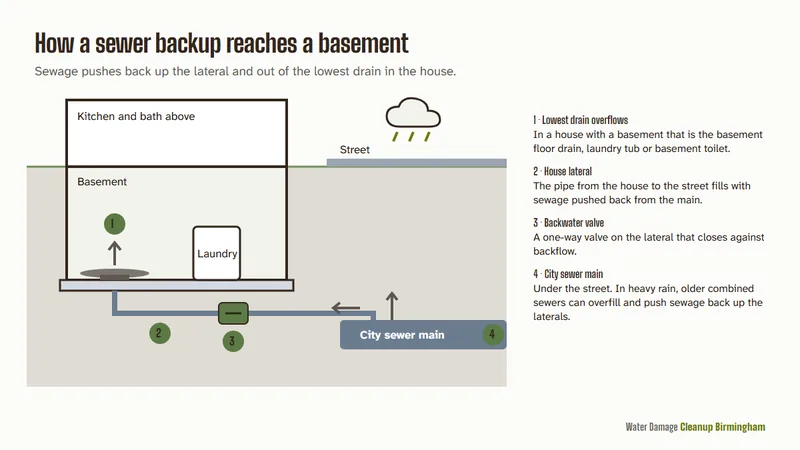
Most basement apartment flooding starts in one of four places: a sewer line that backs up through the floor drain, a sump pump that stops, storm runoff pushing through walls, or a leak from the plumbing and appliances in the unit or the house above. In a few low spots near creeks, outside flood water reaches the unit too.
The source matters because it decides how dirty the water is, who pays and how much has to be torn out. The water categories below follow the IICRC S500 standard.
| Source | What tenants usually notice | Water type (IICRC) | Who to tell first |
|---|---|---|---|
| Sewer backup | Dark water and a foul smell at the floor drain, shower or toilet | Category 3, contaminated | Landlord, then a plumber |
| Failed sump pump | Water spreading from the pump closet or a corner, often during heavy rain | Category 3 if it is outside water | Landlord |
| Storm runoff through walls | Wet carpet along an outside wall, damp block, water at the floor edge | Category 3, surface water | Landlord |
| Pipe, water heater or washer leak | Clean water from a ceiling, closet or utility room | Category 1 or 2 | Landlord and a plumber |
Leaks from upstairs often show first as a stain or drip in the basement ceiling, which the ceiling water damage page covers. Water heaters often sit in or beside a basement unit, so the water heater leak page is worth a look too.
What should you do first when your basement apartment floods?
Get yourself and your belongings out of the water safely, then tell the person who controls the building. A tenant usually cannot reach the main valve, the sewer cleanout or the sump circuit, so the landlord needs to know quickly. Record everything before you start moving soaked items around.
- Stay out of water near outlets, cords or a power strip. If the unit has its own breaker panel and you can reach it from a dry floor, switch off the circuits for the wet rooms.
- Stop using sinks, toilets and the washer if dirty water is rising from a drain, because every flush upstairs or in your unit adds to it.
- Text or email the landlord with the time, what you see and a few photos, so the notice is in writing.
- Take photos and short videos of each room, how high the water climbed on the walls, and anything it ruined. Triple-I advises keeping damaged things until the adjuster has seen them.
- Lift what you can onto beds, tables or shelves, and move papers, medicine and electronics upstairs or to a car.
- Call your renters insurer to open a claim for your belongings, even if the landlord is handling the building.
If the water came up through a drain, the sewer backup cleanup page explains why that water needs more care. The emergency water damage page covers what happens in the first visit from a restoration team.
Who is responsible for water damage in a basement apartment, the landlord or the tenant?
In most rentals the owner looks after the building and the tenant looks after their own things: walls, floors, built-in cabinets, the water heater and structural drying usually fall to the landlord. Your furniture, clothes and electronics usually fall to you or your renters insurance. Your lease may set out more.
Triple-I's renters insurance guide is blunt about the gap: a landlord may insure the building, but that policy will not replace a tenant's possessions or pay the tenant's living costs while repairs go on. A renters policy, in turn, does not cover the building, because the landlord owns it.
Fault can shift the bill. If a tenant left a tub running, the tenant's liability coverage may come into it; if a known drain problem was ignored, the owner's side may. Those are questions for the lease, the two insurers and, if needed, a lawyer.
If you own the house and rent out the basement
Tell your insurance agent the lower level is rented if you have not already. A policy written for a single household may treat a rented unit differently, and you want that settled before a claim, not during one. Ask in writing whether the policy covers the rented space and the tenant's use of it.
Keep the tenant informed while drying runs. Equipment noise, removed carpet and opened walls make the unit hard to live in, and a clear schedule from the restoration team you reach helps both of you plan.
Does renters insurance cover a flooded basement apartment?
The answer turns on the water's source. Per Triple-I, a standard renters policy protects belongings against fire, theft, windstorm, water and the other disasters it lists, but floods are not covered. A burst pipe in the house above is usually a listed peril; creek water or storm runoff pouring in usually is not.
The same Triple-I renters guide says flood cover is sold separately, through the National Flood Insurance Program and a few private insurers, often by the same agent who sold the renters policy. Triple-I also notes that sewer backup is left out of a typical homeowners policy and is added by endorsement, so ask your agent whether your renters policy carries a similar add-on.
Read the policy's list of covered perils and its water exclusions before you call. Then describe the loss in plain terms: where the water came in, when you first saw it and what it reached. A claim for belongings soaked by a burst supply line reads very differently from one for things ruined by runoff through a wall, and the adjuster will ask.
What about a hotel while the unit dries?
Renters policies include additional living expenses, Triple-I says, which pay the extra cost of living elsewhere when a covered disaster makes the home unlivable. If the loss is a covered one, keep hotel, meal and laundry receipts. If the water was flood water and you have no flood policy, that coverage usually does not apply.
Ask the adjuster early whether the unit counts as unlivable under your policy, and get the answer in writing. A unit with working power but no floor covering and loud drying equipment can fall in a gray area, so the adjuster's word matters before you book a room.
The renters and condo owners guide goes deeper on these policies, and the insurance claims guide covers Alabama claim timing.
Is it safe to stay in a flooded basement apartment?
Not until the water is gone, the power has been checked and anything touched by sewage or outside water has been cleaned or removed. A small clean-water leak caught early may let you stay with fans running. A sewer backup or a flooded floor usually means sleeping somewhere else for a while.
The EPA advises calling in professionals who have experience with buildings damaged by contaminated water when sewage or other dirty water is involved. Soaked carpet, pad and the bottom of the drywall in a sewage-flooded unit usually come out.
Mold is the slower risk. The CDC links mold to coughing, wheezing, burning eyes, a sore throat, skin rash and a stuffy nose, and warns that asthma sufferers and people allergic to mold may have severe reactions. A basement bedroom with damp carpet is a poor place for them.
Which Birmingham basements are most likely to flood?
Units on low ground near the creeks that drain Jones Valley and Shades Valley carry the most risk from outside water. Any basement can take a sewer backup or a pump failure, though, and a house built into a slope can push runoff against the uphill wall during a long, heavy rain.
The Wikipedia article on Birmingham says Jones Valley is drained by Village Creek and Valley Creek, which flow to the Black Warrior River. The NWS gauge for Village Creek in Ensley lists a record crest of 14.8 feet on December 3, 1983, against a minor flood stage of 10 feet.
Red Mountain divides Jones Valley from Shades Valley, and Shades Creek rises on it and runs through Homewood and Mountain Brook. The Shades Creek gauge near Homewood lists 19.88 feet on September 16, 2004, and 18.79 feet on May 4, 2021, with minor flooding starting at 14 feet. The Birmingham flooding page lists more crests, and the West End and Ensley page and the Homewood and Mountain Brook page cover those creeks.
How is a flooded basement apartment dried out?
Water is pumped and extracted first, then wet carpet, pad and soaked drywall come out, then air movers and dehumidifiers run until moisture readings in the walls and floor reach dry levels. The EPA says drying wet areas in the first 24 to 48 hours greatly lowers the odds of mold.
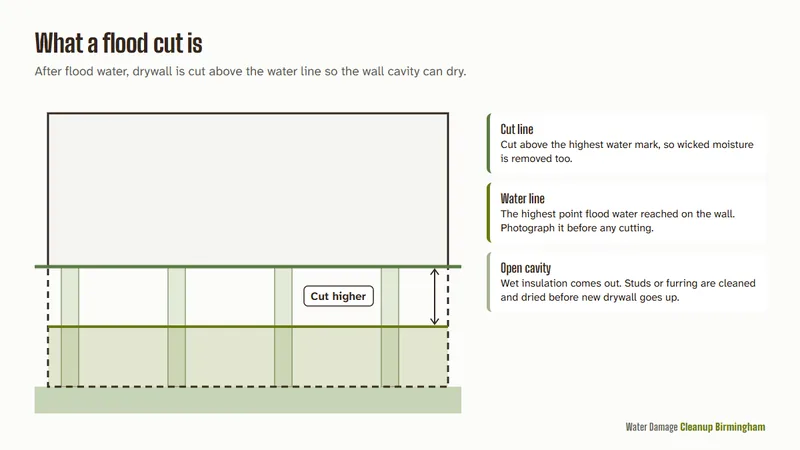
Basements dry slowly because the concrete floor and block walls hold water and the space gets little fresh air. Birmingham summers are hot and humid, the city's Wikipedia article notes, so dehumidifiers do most of the work. The EPA sets the indoor humidity goal below 60 percent, ideally 30 to 50 percent.
Ask for the moisture readings in writing before carpet or new drywall goes back in. A finished basement that is closed up wet can grow mold behind the new walls. The structural drying page describes the process, and the wet carpet page covers when carpet can be saved.
How can a basement apartment be kept from flooding again?
Most fixes belong to the owner, since they involve the plumbing, the grading and the sump system. A backwater valve on the sewer line, a battery backup for the sump pump, clean gutters with long downspout extensions, and soil sloped away from the walls all cut down the number of floods a lower unit sees.
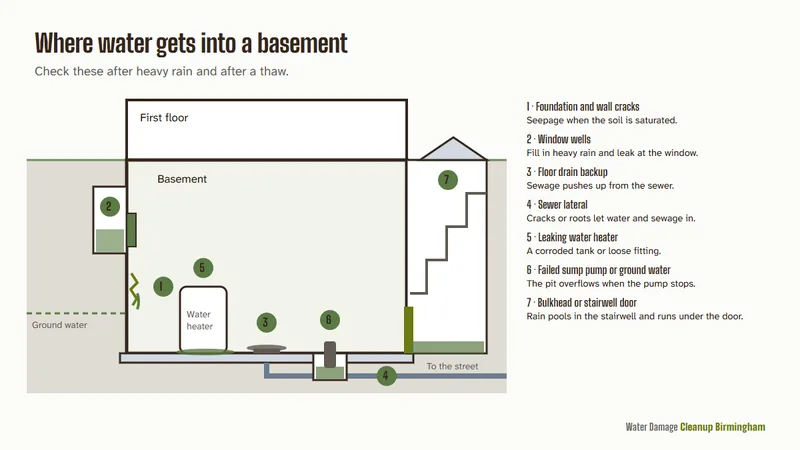
Tenants can help too. Keep belongings off the floor on shelves or plastic bins, report a slow floor drain or a sump pump that cycles constantly, and run a dehumidifier in summer. A cheap hygrometer shows whether the room stays near the EPA's range.
Before the spring storm season, an owner can fill the sump pit with a bucket of water to make sure the float trips and the pump empties it. The page on failed sump pumps and the water damage prevention guide have more checks. Restoration teams differ in the work they take on; confirm the scope directly with the one you reach.
Sources: Triple-I, Renters Insurance (landlord policy does not cover tenant belongings or living costs, perils listed, floods not covered, NFIP and private flood cover, additional living expenses, no building coverage); Triple-I, which disasters are covered (flood excluded, sewer backup endorsement); Triple-I, settling claims (photos, keep damaged items for the adjuster); the S500 standard from the IICRC (Category 1 to 3 water); the EPA brief guide on household mold and moisture (drying window, indoor humidity goal); EPA, mold cleanup in your home (contaminated water and professionals); CDC, mold and your health (symptoms, asthma, soaked carpet); NWS gauge ENSA1, Village Creek at Avenue W, Ensley; NWS gauge SCHA1, Shades Creek near Homewood; Wikipedia, Birmingham, Alabama (Jones Valley creeks, humid summers); Wikipedia, Red Mountain (Jones Valley and Shades Valley); Wikipedia, Shades Creek (source on Red Mountain, cities it crosses).